24/7 Space News
TIME AND SPACE
Australian team maps quantum error memory over time
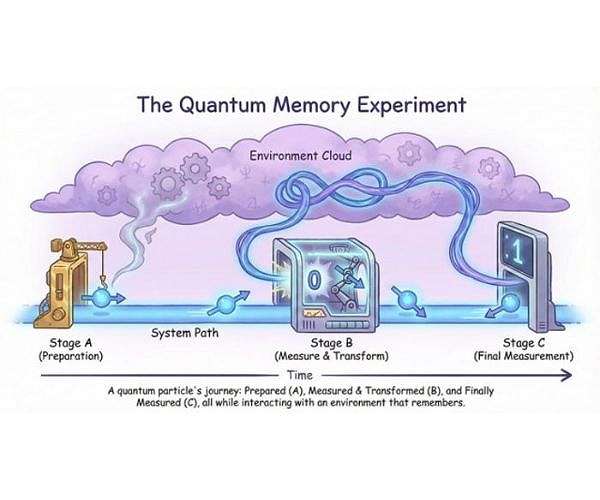
illustration only

Australian team maps quantum error memory over time

by Simon Mansfield
Sydney, Australia (SPX) Jan 01, 2026

A collaboration led by Macquarie University has reconstructed how errors develop and spread inside working quantum computers, revealing that noise can link events across time rather than appearing as isolated random faults.

The researchers show that small inaccuracies in quantum processors can linger, evolve and correlate across different computational steps, creating a form of temporal memory that standard error models do not capture.

Lead author Dr Christina Giarmatzi explains that these machines can retain a memory of their own errors, which may be classical or quantum in nature depending on how the faults connect through time.

Many quantum algorithms and protocols assume that hardware noise is Markovian, meaning that each error is independent and does not depend on earlier events, but the study demonstrates that this assumption often fails in practice.

This time-linked behavior is now identified as a central obstacle to building practical, large-scale quantum computers, because conventional error-correction schemes are typically designed for uncorrelated, memoryless noise.

To probe these effects, the team carried out experiments on superconducting quantum processors, using devices operated in the University of Queensland laboratory as well as chips accessed through IBM's cloud-based quantum computing services.

By analyzing how quantum processes evolve at multiple points in time, the researchers were able to reconstruct the full temporal dynamics of the noise, tracking when disturbances arise and how they propagate through successive operations.

According to Dr Giarmatzi, this reconstruction offers a new way to see how quantum systems behave when their errors are correlated across time, providing information that is essential for developing more reliable, error-controlled machines.

The work indicates that even state-of-the-art quantum processors display subtle but important patterns of time-correlated noise, including effects that originate from neighboring qubits interacting on the same chip.[2]

These insights are expected to guide the design of improved characterization tools and error-correction strategies that explicitly account for temporal correlations, an important step on the path to dependable, fault-tolerant quantum computers.

Team member Tyler Jones notes that the project demonstrates how theoretical models of time-correlated errors can be implemented and tested on real hardware, helping to refine both the devices and the methods used to benchmark them, and emphasizes that robust characterization of time correlations is needed to build powerful quantum machines.

The researchers have released their experimental data and code for public use, and the full study appears in the journal Quantum.

Research Report:Multi-time quantum process tomography on a superconducting qubit

Related Links
Macquarie University
Understanding Time and Space

Subscribe Free To Our Daily Newsletters
Tweet

RELATED CONTENT
The following news reports may link to other Space Media Network websites.
TIME AND SPACE
Conventional photon entanglement reveals thousands of hidden topologies in high dimensions
London, UK (SPX) Dec 18, 2025
Researchers at the University of the Witwatersrand in South Africa, working with Huzhou University in China, have shown that a standard source of entangled photons used in quantum optics carries a rich set of hidden topological structures in high dimensions. They report entanglement across 48 dimensions with more than 17 000 distinct topological signatures, providing a large alphabet for encoding quantum information in a way that can be robust against noise. Many quantum optics laboratories genera ... read more

TIME AND SPACE
ESA reaches new benchmark in autonomous formation flying

Hydrogen peroxide thruster qualifies for ESA launcher attitude control

China launches twin Shijian-29 satellites to test space-target detection tech

Billionaire Trump nominee confirmed to lead NASA amid Moon race

TIME AND SPACE
AI systems proposed to boost launch cadence reliability and traffic management

China debuts Long March 12A reusable rocket in Jiuquan test flight

Japan's flagship H3 rocket fails to launch satellite

North Korea tests hypersonic missiles, says nuclear forces ready for war

TIME AND SPACE
Curiosity Blog, Sols 4750-4762: See You on the Other Side of the Sun

Wind-Sculpted Landscapes: Investigating the Martian Megaripple 'Hazyview'

NASA team presses MAVEN recovery before Mars solar conjunction

Perseverance rover cleared for long distance Mars exploration

TIME AND SPACE
China harnesses nationwide system to drive spaceflight and satellite navigation advances

Shenzhou 21 crew complete eight hour spacewalk outside Tiangong station

Foreign satellites ride Kinetica 1 on new CAS Space mission

Experts at Hainan symposium call for stronger global space partnership

TIME AND SPACE
Southern Launch to Host Lux Aeterna Re-Entries South Australia

Smart modeling framework targets 6G spectrum chaos in space air and ground networks

Time-expanded network model cuts complexity in mega constellation launch planning

K2 Space raises 250m to scale Mega class high power satellites

TIME AND SPACE
India space agency launches its heaviest satellite

Space ground fluid AI framework targets satellite powered 6G edge intelligence

Engineered interlayers boost satellite insulation and flexible electronics

Planet delivers first light image from Pelican 6 satellite capturing Lhasa Gonggar Airport

TIME AND SPACE
Deep Arctic gas hydrate mounds host ultra deep cold seep ecosystem

Joint ground- and space-based observations reveal Saturn-mass rogue planet

Hubble pinpoints asteroid smash ups in nearby Fomalhaut system

Evolution study finds history and environment shifts can steer species in very different directions

TIME AND SPACE
Uranus and Neptune may be rock rich worlds

SwRI links Uranus radiation belt mystery to solar storm driven waves

Looking inside icy moons

Saturn moon mission planning shifts to flower constellation theory

Subscribe Free To Our Daily Newsletters


The content herein, unless otherwise known to be public domain, are Copyright 1995-2024 - Space Media Network. All websites are published in Australia and are solely subject to Australian law and governed by Fair Use principals for news reporting and research purposes. AFP, UPI and IANS news wire stories are copyright Agence France-Presse, United Press International and Indo-Asia News Service. ESA news reports are copyright European Space Agency. All NASA sourced material is public domain. Additional copyrights may apply in whole or part to other bona fide parties. All articles labeled "by Staff Writers" include reports supplied to Space Media Network by industry news wires, PR agencies, corporate press officers and the like. Such articles are individually curated and edited by Space Media Network staff on the basis of the report's information value to our industry and professional readership. Advertising does not imply endorsement, agreement or approval of any opinions, statements or information provided by Space Media Network on any Web page published or hosted by Space Media Network. General Data Protection Regulation (GDPR) Statement Our advertisers use various cookies and the like to deliver the best ad banner available at one time. All network advertising suppliers have GDPR policies (Legitimate Interest) that conform with EU regulations for data collection. By using our websites you consent to cookie based advertising. If you do not agree with this then you must stop using the websites from May 25, 2018. Privacy Statement. Additional information can be found here at About Us.