





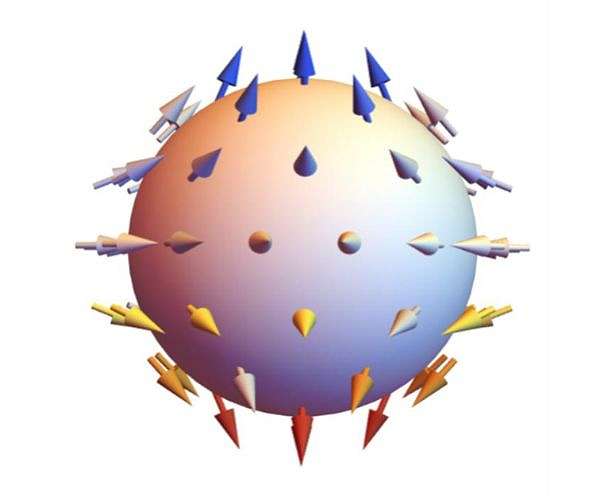
Many quantum optics laboratories generate entangled photons through spontaneous parametric downconversion, which naturally entangles the spatial degrees of freedom of light. The team has now demonstrated that this spatial entanglement hides a spectrum of high-dimensional topologies that can be used to encode information and protect it from environmental disturbances.
The researchers used the orbital angular momentum (OAM) of light to reveal these topologies, moving from two-dimensional to very high-dimensional structures. Because OAM can, in principle, take on an unlimited set of values, the corresponding topological structure can also span an unbounded range, enabling a broad set of topological signatures within a single entangled-photon source.
Reporting their findings in Nature Communications, the team showed that measuring the OAM of both photons in an entangled pair exposes a topological character intrinsic to the entanglement. Professor Andrew Forbes of the Wits School of Physics stated that they achieved this using only one property of light, OAM, whereas previous approaches assumed that at least two properties, such as OAM and polarization, were required: "We report a major advance in this work: we only need one property of light (OAM) to make a topology, whereas previously it was assumed that at least two properties would be needed - usually OAM and polarisation. The consequence is that since OAM is high-dimensional, so too is the topology, and this let us report the highest topologies ever observed." The team further found that when the topology extends beyond two dimensions, it must be described by a spectrum of topological numbers rather than a single value, in contrast to conventional optical topologies.
A key aspect of the result is that it relies on SPDC sources that are already standard in quantum optics laboratories, rather than requiring specialized hardware. Pedro Ornelas noted that "You get the topology for free, from the entanglement in space. It was always there, it just had to be found."
Lead author Prof. Robert de Mello Koch of Huzhou University explained that locating the relevant topological structure in this high-dimensional setting was not straightforward. He said that the team used abstract tools from quantum field theory to predict where the topology would appear and what signatures to look for, and then confirmed those predictions experimentally.
OAM entanglement has been used in many quantum systems but has often been regarded as fragile under realistic conditions. The researchers argue that treating OAM entanglement through the lens of its underlying topology could provide new ways to stabilize and deploy it in practical quantum technologies.
Research Report:Revealing the topological nature of entangled orbital angular momentum states of light
Related Links
University of the Witwatersrand
Understanding Time and Space
| Subscribe Free To Our Daily Newsletters |
| Subscribe Free To Our Daily Newsletters |








