





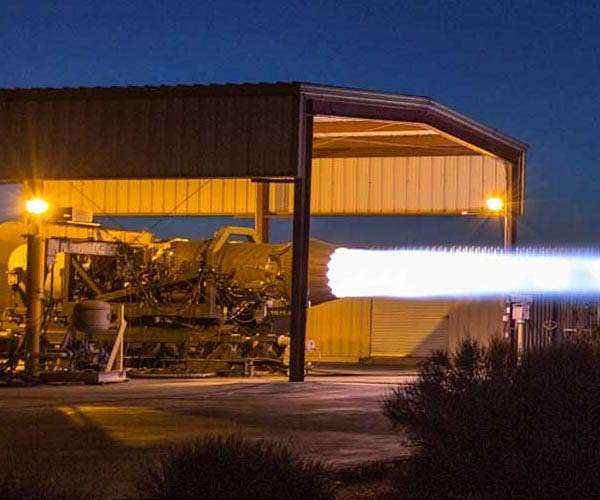
HySIITE, short for Hydrogen Steam Injected, Inter Cooled Turbine Engine, emerged from a project that treated hydrogen not just as a drop in replacement for jet fuel, but as a fundamentally different working fluid. The team wanted to reimagine the engine from the ground up around hydrogen's properties, including its high flame speed and temperature. Supported by the U.S. Department of Energy's ARPA E program, they tested the concept on rigs at the RTX Technology Research Center in East Hartford, Connecticut, demonstrating an architecture that could improve performance by about 35 percent while nearly eliminating nitrogen oxide emissions.
The key enabler was the way the engine handles water. When hydrogen burns, it produces water vapor as a natural by product. In the HySIITE concept, the engine captures roughly a gallon of this water every three seconds from the exhaust stream. That recovered water is then used as steam inside the engine to control how the liquid hydrogen burns, helping to manage flame speed and temperature, while also recapturing waste heat and improving overall cycle efficiency.
The project team explored a recuperated engine cycle, an idea studied for decades but rarely practical for large commercial aircraft. Traditionally, recuperation relies on bulky heat exchangers to transfer energy from hot exhaust to the core flow, adding weight and complexity. In this case, engineers instead considered steam injection as a way to recover heat. That shift opened the door to a different architecture, and it was here that DISCOVER proved critical in identifying how to make the cycle viable for commercial scale propulsion.
DISCOVER is an AI powered design space exploration program developed at the RTX Technology Research Center in partnership with Collins Aerospace. Its role is to take lists of components, rules about how they can connect, and performance models, then generate and evaluate vast numbers of system architectures. For the hydrogen engine, Steve Taylor and Joe Turney of the DISCOVER team calculated that the roughly 70 engine components could be arranged in about a quattuorvigintillion different ways, a one followed by 75 zeros. That figure far exceeds the number of atoms in the universe, making any manual or conventional parametric search impossible.
To make the problem tractable, the team encoded engineering rules and constraints into DISCOVER and let the software sift through the design space. From the ocean of possibilities, DISCOVER identified 4,202 architectures that met the feasibility criteria and could plausibly deliver the performance the engineers wanted. Those candidate designs were plotted as a cloud of points, each representing a different engine configuration, and the team could see at a glance which arrangements delivered the best combinations of efficiency, emissions and practicality.
Before DISCOVER, engineers might have been able to study only a handful of architectures in the same amount of time. With the tool, they were able to validate thousands, and just as important, understand why some designs worked better than others. As Larry Zeidner, a technical fellow and leader of the DISCOVER development team, explained, the challenge is not recognising a good design once you see it, but finding it in a vast sea of options. DISCOVER became the mechanism for separating the metaphorical pearls from the surrounding water.
One of the most important insights from this process was the value of shrinking the engine core. DISCOVER's analysis highlighted that a smaller core made it easier to capture and circulate water, and that water, once injected as steam, made it feasible to maintain a compact core while still realizing high efficiency. This created what engineers described as a virtuous cycle: a smaller core simplifies water capture and convection, and that water, in turn, supports the steam injection strategy that enables the smaller core to work so effectively.
The HySIITE team also had to overcome two intertwined challenges inherent in hydrogen combustion. Hydrogen burns extremely hot and very fast, which makes its flame difficult to control and raises the risk of high nitrogen oxide formation. At the same time, the engine needed steam in the combustor to increase efficiency, but too much steam can quench the flame and destabilize combustion. As project lead Neil Terwilliger put it, it can feel like trying to light and sustain a fire while simultaneously spraying it with a hose.
Through testing and analysis, the group discovered that hydrogen's high flame temperature and speed could be turned into an advantage. By carefully tuning the mixture, they were able to inject substantial amounts of steam into the combustor, using it to moderate flame temperature and control flame speed without losing stability. Terwilliger reported that the team observed near elimination of nitrogen oxide production, with no issues of the flame flashing back onto hardware or causing thermal damage. In this case, two apparent problems cancelled one another, creating a narrow but workable operating window.
While commercial hydrogen powered aircraft remain decades away, the HySIITE concept suggests that hydrogen engines could deliver roughly three times the net energy savings compared with synthetic aviation fuels when evaluated on a system basis. The work feeds into ongoing industry wide discussions about future aviation fuels and propulsion architectures, offering a concrete data point on how much better engines can be when designed specifically around hydrogen. For advanced concepts teams at Pratt and Whitney, this helps answer a central question: if hydrogen is available, what is the best use of it in an engine?
Under the hood, DISCOVER operates by combining rule based architecture generation with numerical models that simulate thermodynamics, aerodynamics, cost and reliability. Once the program identifies feasible architectures, it evaluates them against performance and risk metrics, allowing engineers to see not only which design scores highest, but also how sensitive different configurations are to assumptions and uncertainties. The dense cloud of data points reveals which features contribute most to performance and which design choices tend to hold concepts back.
This deeper understanding lets engineering teams prioritize where to invest technology development resources. If certain features consistently appear in the highest performing architectures, they become candidates for additional research and maturation. Conversely, if an otherwise promising architecture underperforms for a clear reason, engineers can search for workarounds or new technologies to remove that limitation. DISCOVER thus becomes part decision support tool, part technology roadmap generator.
RTX is now working on a successor program that will use artificial intelligence and machine learning to explore even larger design spaces and streamline the way teams visualize and interpret the data. The aim is to make it easier for subject matter experts, who may not be specialists in AI, to interact with and benefit from advanced design tools. Better visualizations can help them understand tradeoffs more intuitively and spot non obvious trends in the cloud of candidate solutions.
Beyond hydrogen engines, teams across RTX are already applying DISCOVER to a variety of aerospace and defense challenges. Collins Aerospace has used the tool to create new layouts for aircraft galleys and to design a power and thermal management system for the U.S. Air Force. Raytheon is employing it to explore novel microelectronics architectures in partnership with the Defense Advanced Research Projects Agency, combining unconventional device concepts with new packaging and integration strategies.
Pratt and Whitney and the RTX Technology Research Center have also used DISCOVER in collaborations with universities to examine hybrid electric propulsion concepts. In these studies, the tool helps partition power flows between electrical and mechanical paths and explores where generators, motors, batteries and turbines should be placed to best balance efficiency, weight and reliability. As more teams inside RTX learn to use the software, its impact is expected to grow beyond pure performance optimization.
One emerging focus is manufacturability and life cycle cost. Engineers such as Mike Ikeda in the RTX Chief Technology Office are asking whether design space exploration can be expanded to include metrics such as ease of production, cost, and durability in service. The goal is to give designers earlier access to information about how their choices affect production complexity and long term maintenance, so they can choose architectures that are not only efficient, but also practical to build and sustain.
Ultimately, Zeidner and his colleagues argue that DISCOVER's value lies in helping experts do what they already do, but faster, with more confidence and less risk. By automating the search through billions or trillions of possible architectures and presenting distilled, interpretable results, the software allows human engineers to spend more time on high level judgment and creative problem solving. The HySIITE hydrogen engine concept stands as an example of how combining advanced computational tools with domain expertise can unlock architectures that might otherwise remain hidden in an overwhelming design space.
Related Links
RTX
Aerospace News at SpaceMart.com
| Subscribe Free To Our Daily Newsletters |

| Subscribe Free To Our Daily Newsletters |








