





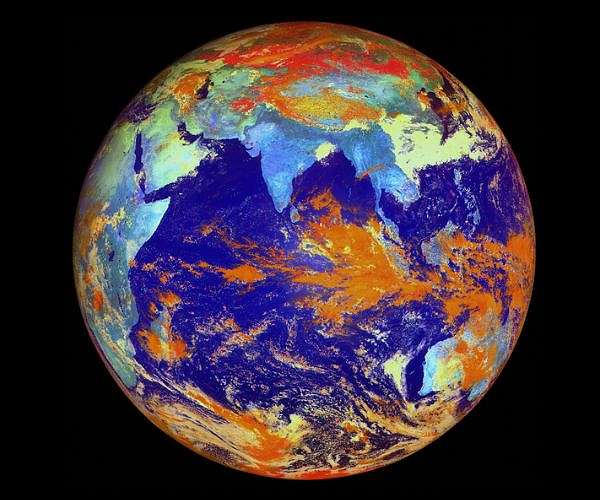
The study, published February 3 in the journal Nature Climate Change, examined six decades of observational records to trace how warming has altered large scale circulation across the Indian and tropical Pacific Oceans. The team found that changes in surface winds are redirecting currents so that an expanding pool of tropical freshwater now feeds into one of the historically saltiest areas of the Southern Hemisphere.
On average, seawater has a salinity of about 3.5 percent, roughly the same as dissolving one and a half teaspoons of table salt in a cup of water. In contrast, surface waters across an extensive swath from the eastern Indian Ocean into the western Pacific tropics are naturally fresher because frequent rainfall adds large volumes of freshwater while evaporation remains relatively low.
This sprawling Indo Pacific freshwater pool is tightly linked to the global thermohaline circulation, a planetary scale system that moves heat, salt and freshwater around the oceans. Warm, relatively fresh surface waters flow from the Indo Pacific toward the Atlantic Ocean, helping sustain the mild climate of western Europe before cooling, becoming saltier and denser in the North Atlantic, and eventually sinking to form a deep return flow back toward the Indian and Pacific basins.
Historically, the Southern Indian Ocean off southwest Australia has stood out as a dry zone where evaporation far exceeds precipitation, leaving surface waters notably salty. Drawing on long term measurements, lead researcher Weiqing Han and colleagues calculated that the area covered by high salinity surface water there has shrunk by about 30 percent over the past 60 years, representing the fastest freshening signal detected anywhere in the Southern Hemisphere.
First author Gengxin Chen estimated that the additional freshwater entering this ocean region each year is equivalent to about 60 percent of the volume of Lake Tahoe. By another measure, the influx would be sufficient to meet the drinking water needs of the entire United States population for more than 380 years, underscoring the scale of the change.
The researchers concluded that this freshening does not stem from local shifts in rainfall. Instead, a combination of observational data and climate model simulations shows that anthropogenic warming is altering surface winds over the Indian and tropical Pacific Oceans, which in turn is steering more water from the Indo Pacific freshwater pool into the Southern Indian Ocean.
As the surface ocean becomes fresher, its density decreases, which enhances the layering between lighter water above and saltier, denser water below. Stronger vertical salinity gradients suppress the mixing processes that normally allow surface waters to sink and deeper waters to rise, limiting the exchange of heat and nutrients between the upper ocean and the depths.
Previous work has suggested that continued climate change and freshwater input from melting Greenland ice and Arctic sea ice could slow portions of the North Atlantic branch of the thermohaline circulation by disrupting the salinity balance needed for surface waters to sink. The newly documented expansion of the Indo Pacific freshwater pool and its export toward the Southern Indian and Atlantic Oceans adds another potential influence on this global conveyor belt.
Weaker vertical mixing also has implications for marine ecosystems. When fewer nutrients are transported upward from deeper waters, phytoplankton and seagrass communities in the sunlit surface layers may face reduced food supplies, with cascading effects throughout the marine food web. At the same time, reduced mixing allows excess heat to remain trapped near the surface, intensifying thermal stress on organisms already challenged by rising ocean temperatures.
Chen noted that changes in salinity can directly affect plankton and seagrass, which form the base of many coastal and open ocean ecosystems. Shifts in these foundational communities could ripple through higher trophic levels, altering biodiversity and potentially reshaping fisheries and other ocean resources that depend on a stable physical and chemical environment.
Research Report: The expanding Indo-Pacific freshwater pool and changing freshwater pathway in the South Indian Ocean
Related Links
University of Colorado at Boulder
Water News - Science, Technology and Politics
| Subscribe Free To Our Daily Newsletters |
| Subscribe Free To Our Daily Newsletters |








