





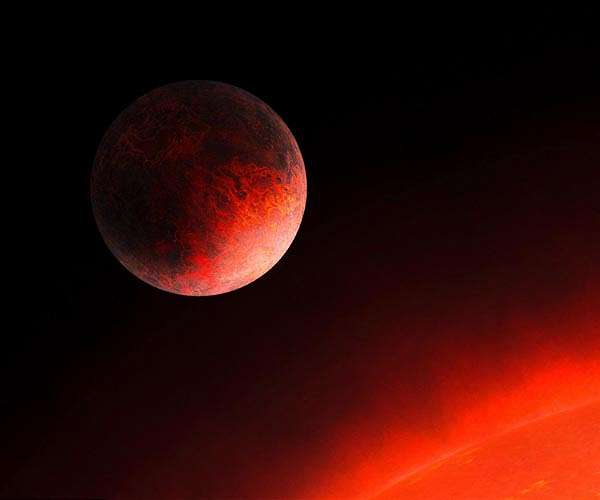
TOI-561 b has about twice Earths mass but orbits its star at roughly one fortieth of Mercurys distance from the Sun, completing a year in just 10.56 hours with one hemisphere locked in permanent daylight. Although its host star is slightly less massive and cooler than the Sun, the planets extreme proximity produces intense irradiation.
Carnegie Science Postdoctoral Fellow Nicole Wallack noted that theory predicts a planet this small and hot should lose its atmosphere shortly after formation, yet the data indicate a relatively thick blanket of gas remains. In contrast to the inner planets of our Solar System, which shed their primordial gas envelopes, TOI-561 bs atmosphere has persisted around a star that is much older than the Sun.
The atmosphere appears to help explain the planets unusually low bulk density. Carnegie astronomer Johanna Teske pointed out that TOI-561 b is less dense than an Earth-like mixture of rock and metal would suggest, although it does not fall into the class of so-called super-puff planets.
Initially, the team considered whether a small iron core and a mantle built from lower-density rock could account for the measurements. Teske emphasized that TOI-561 b stands out among ultra-short-period planets because it orbits an iron-poor star about twice as old as the Sun in the Milky Ways thick disk, implying formation in a different chemical environment from that of the Solar System.
This context suggests TOI-561 b may exemplify rocky planets that formed when the universe was younger and heavy elements were less abundant. However, composition alone could not reconcile all of the observational constraints, prompting the team to examine atmospheric scenarios.
The researchers proposed that a substantial atmosphere could make the planet appear larger and therefore less dense, consistent with the inferred radius and mass. They designed their observing program to test whether such an atmosphere exists, using thermal measurements to probe the dayside temperature.
To do this, the team used JWSTs Near-Infrared Spectrograph to monitor the brightness of the star-planet system as TOI-561 b moved behind its star, a technique similar to methods applied to the TRAPPIST-1 system and other rocky exoplanets. By comparing the total flux before and during secondary eclipse, they inferred the temperature of the dayside hemisphere.
If TOI-561 b were a bare rocky surface without an atmosphere to redistribute heat, its dayside temperature would approach about 4,900 degrees Fahrenheit, or 2,700 degrees Celsius. Instead, the data show a dayside temperature closer to 3,200 degrees Fahrenheit, or about 1,800 degrees Celsius, which is still extremely hot but substantially cooler than the bare-rock prediction.
The team evaluated whether internal processes alone could produce this cooler dayside. A magma ocean could move some heat toward the nightside, but without an atmosphere the dark hemisphere would likely solidify, limiting the efficiency of this mechanism. A thin layer of rock vapor over the molten surface might also form, but by itself would not reduce the dayside temperature enough to match the observations.
Co-author Anjali Piette of the University of Birmingham argued that only a thick, volatile-rich atmosphere can account for the full set of measurements. She explained that strong winds would transport heat to the nightside, while molecules such as water vapor could absorb some of the outgoing near-infrared radiation before it escapes, making the planet appear cooler to the telescope; bright silicate clouds could further lower the temperature by reflecting starlight.
Although JWST provides evidence for this atmosphere, the team still must explain how a small planet under such intense irradiation can retain so much gas. Some atmospheric material likely escapes to space, but not at the rates predicted by standard models for ultra-short-period rocky planets.
Co-author Tim Lichtenberg of the University of Groningen, who is also part of the Carnegie-led Atmospheric Empirical Theoretical and Experimental Research project, proposed that the magma ocean and atmosphere are in dynamic equilibrium. He suggested that gases continually outgas from the molten interior to replenish the atmosphere while, at the same time, the magma absorbs volatiles back into the planet, and that the planet must be significantly richer in volatile elements than Earth, describing it as really like a wet lava ball.
Teske remarked that the current dataset raises new questions about TOI-561 b and similar worlds. The observations hint that atmospheric retention and magma-atmosphere exchange on highly irradiated rocky planets may be more complex than existing theories predict.
These results are the first from JWST General Observers Program 3860, which monitored the TOI-561 system continuously for more than 37 hours, covering nearly four full orbits of TOI-561 b. The team is now analyzing the complete dataset to construct a temperature map around the planet and to better constrain the atmospheric composition.
Research Report:A Thick Volatile Atmosphere on the Ultrahot Super-Earth TOI-561 b
Related Links
Carnegie Institution for Science
Lands Beyond Beyond - extra solar planets - news and science
Life Beyond Earth
| Subscribe Free To Our Daily Newsletters |
| Subscribe Free To Our Daily Newsletters |







