24/7 Space News
OUTER PLANETS
Computer models let scientists peer into the mystery beneath Jupiter's clouds
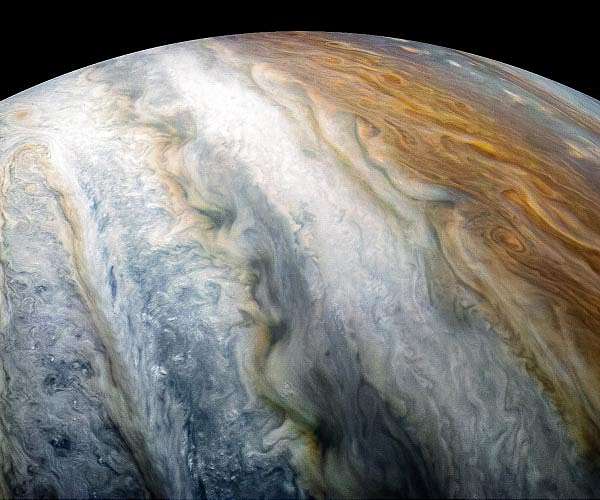
illustration only

Computer models let scientists peer into the mystery beneath Jupiter's clouds

by Louise Lerner for UC News
Chicago IL (SPX) Jan 19, 2026

Spectacular clouds swirl across the surface of Jupiter. These clouds contain water, just like Earth's, but are much denser on the gas giant--so thick that no spacecraft has been able to measure exactly what lies beneath.

But a new study led by University of Chicago and Jet Propulsion Lab scientists has given us a deeper look at the planet by creating the most complete model to date of Jupiter's atmosphere.

Among other things, the analysis addresses a longstanding question about how much oxygen the gas giant contains: It estimates that Jupiter has about one and a half times more oxygen than the sun. This helps scientists narrow down the picture of how all the planets in the solar system formed.

"This is a long-standing debate in planetary studies," said Jeehyun Yang, a postdoctoral researcher at UChicago and first author on the paper. "It's a testament to how the latest generation of computational models can transform our understanding of other planets."

The study was published Jan. 8 in The Planetary Science Journal.

We've known about Jupiter's stormy skies for at least 360 years--that's when astronomers using early telescopes documented a curious, large permanent blotch on Jupiter's surface.

The Great Red Spot is a gigantic storm, twice the size of Earth, that has swirled for centuries. It's just one of many on the planet, as fierce winds and deep clouds mean the entirety of Jupiter's surface is covered in a kaleidoscope of storms.

What we don't know is precisely what lies beneath those storms. The clouds are so thick that NASA's Galileo spacecraft lost contact with Earth as it plunged into the deeper atmosphere in 2003. The next mission to visit Jupiter, Juno, is currently cataloguing the planet from a safe distance in orbit.

These measurements from orbit can tell us the components in the upper atmosphere: ammonia, methane, ammonium hydrosulfide, water and carbon monoxide, among others. Scientists have combined this with knowledge about chemical reactions to build models of Jupiter's deep atmosphere.

But studies have disagreed about certain points, such as how much water--and thus oxygen--the planet contains. Yang saw an opportunity to apply a new generation of chemical modeling to the knotty question.

The chemistry of Jupiter's atmosphere is incredibly complex. Molecules travel between the extremely hot conditions deep in the atmosphere and the cooler upper regions, changing phases and rearranging into different molecules, via thousands of different types of reactions. But the behavior of clouds and droplets has to be accounted for, too.

To better capture all these phenomena, Yang worked with a team of scientists to incorporate both chemistry and hydrodynamics into one model--a first.

"You need both," Yang said. "Chemistry is important but doesn't include water droplets or cloud behavior. Hydrodynamics alone simplifies the chemistry too much. So, it's important to bring them together."

Among the findings is a new calculation for how much oxygen Jupiter has. According to their analysis, Jupiter likely has about one and a half times more than the sun.

For decades, scientists have been arguing about this number. A major recent study had put it much lower, at only a third of the sun's.

But knowing this statistic is particularly relevant for understanding how our solar system formed.

All of the elements that make up planets--and us--are the same stuff that makes up the sun. But there can be differences in the amounts of these materials, and we can use those clues to piece together how the planets must have formed.

For example, did Jupiter form in the same place where it is now, or did it form closer or further away and drift over time? Clues can come from the fact that much of the oxygen in the planet is bound up in water, which will freeze--and behave differently--if it's too far away from the warmth of the sun. Ice is easier for planets to accumulate than water vapor.

In turn, knowing more about which conditions create which kinds of planets can help us as we search for habitable planets beyond our own solar system.

The model also suggested that Jupiter's atmosphere likely circulates up and down much more slowly than long believed.

"Our model suggests the diffusion would have to be 35 to 40 times slower compared to what the standard assumption has been," said Yang. For example, it would take a single molecule several weeks to move through one layer of the atmosphere, rather than hours.

"It really shows how much we still have to learn about planets, even in our own solar system," Yang said.

Related Links
University of Chicago
The million outer planets of a star called Sol

Subscribe Free To Our Daily Newsletters
Tweet

RELATED CONTENT
The following news reports may link to other Space Media Network websites.
OUTER PLANETS
Jupiter's moon Europa has a seafloor that may be quiet and lifeless
St. Louis MO (SPX) Jan 06, 2026
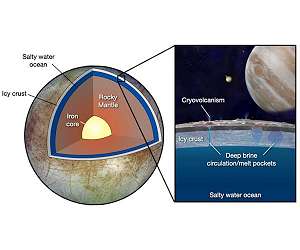
The giant planet Jupiter has nearly 100 known moons, yet none have captured the interest and imagination of astronomers and space scientists quite like Europa, an ice-shrouded world that is thought to possess a vast ocean of liquid salt water. For decades, scientists have wondered whether that ocean could harbor the right conditions for life, placing Europa near the top of the list of solar system bodies to explore. A new study led by Paul Byrne, an associate professor of Earth, environmental, and ... read more

OUTER PLANETS
Explore the World with These Travel Tips

The Quiet Transformation of GPS - What's Coming by 2026

NASA Back for Seconds with New Food System Design Challenge

New orbital mapping system targets Earth Moon libration traffic

OUTER PLANETS
NASA moves moon rocket to launch pad ahead of Artemis 2 mission

PH-1 test flight advances Chinese reusable suborbital spacecraft plans

GE and Lockheed validate compact rotating detonation ramjet for hypersonic missiles

Firefly prepares Alpha Block II upgrade for Flight 8

OUTER PLANETS
Ancient deltas reveal vast Martian ocean across northern hemisphere

Tiny Mars' big impact on Earth's climate

The electrifying science behind Martian dust

Sandblasting winds sculpt Mars landscape

OUTER PLANETS
Tiangong science program delivers data surge

China tallies record launch year as lunar and asteroid plans advance

China harnesses nationwide system to drive spaceflight and satellite navigation advances

Shenzhou 21 crew complete eight hour spacewalk outside Tiangong station

OUTER PLANETS
China outlines mega constellations in ITU satellite filings

ThinkOrbital raises seed funding to advance orbital defense and construction systems

Aerospacelab expands Pulsar navigation constellation work with new Xona satellite order

Multiple satellite filings demonstrate transparency, responsibility and ambition: China Daily editorial

OUTER PLANETS
The decentralized future of space transactions

How IVRT Testing Ensures Consistent Product Quality

The Silent Partner - How Machine Learning Quietly Powers Modern Space Operations

Why Space Theme Slots Are Popular with Canadian Casino Players

OUTER PLANETS
Frozen hydrogen cyanide crystals may have helped spark early chemistry for life

Pandora exoplanet mission checks in after launch

Mixed crystal phase of superionic water mapped inside giant planets

Berkeley Scientists set to home in on 100 signals from Seti at Home

OUTER PLANETS
Jupiter's moon Europa has a seafloor that may be quiet and lifeless

Uranus and Neptune may be rock rich worlds

SwRI links Uranus radiation belt mystery to solar storm driven waves

Looking inside icy moons

Subscribe Free To Our Daily Newsletters


The content herein, unless otherwise known to be public domain, are Copyright 1995-2024 - Space Media Network. All websites are published in Australia and are solely subject to Australian law and governed by Fair Use principals for news reporting and research purposes. AFP, UPI and IANS news wire stories are copyright Agence France-Presse, United Press International and Indo-Asia News Service. ESA news reports are copyright European Space Agency. All NASA sourced material is public domain. Additional copyrights may apply in whole or part to other bona fide parties. All articles labeled "by Staff Writers" include reports supplied to Space Media Network by industry news wires, PR agencies, corporate press officers and the like. Such articles are individually curated and edited by Space Media Network staff on the basis of the report's information value to our industry and professional readership. Advertising does not imply endorsement, agreement or approval of any opinions, statements or information provided by Space Media Network on any Web page published or hosted by Space Media Network. General Data Protection Regulation (GDPR) Statement Our advertisers use various cookies and the like to deliver the best ad banner available at one time. All network advertising suppliers have GDPR policies (Legitimate Interest) that conform with EU regulations for data collection. By using our websites you consent to cookie based advertising. If you do not agree with this then you must stop using the websites from May 25, 2018. Privacy Statement. Additional information can be found here at About Us.