





The authors report that terrestrial networks from 1G through 4G and now 5G have steadily increased data rates and service quality, but they still struggle to cover remote and sparsely populated regions because of geography, deployment costs, and limited spectrum. Satellite communication systems are presented as a way to close these gaps by adding wide-area coverage, reducing service disparities, and supporting high-throughput links when integrated with ground networks.
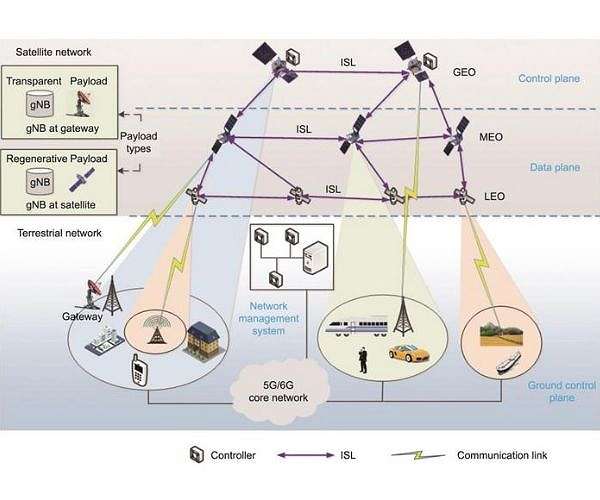
In the envisioned architecture, satellite networks become a component of future 5G/6G systems and operate together with terrestrial networks as a unified platform. Satellites in geostationary Earth orbit, medium Earth orbit, and low Earth orbit take on different roles including access, forwarding, and relay, depending on altitude and mission profile. Geostationary satellites remain suited for fixed services where longer latency is acceptable, while low Earth orbit constellations can provide lower latency links and help deliver global broadband and Internet of Things connectivity.
Advances in satellite technology have narrowed performance differences between satellite and terrestrial links. High-throughput satellites, large low Earth orbit constellations, and more capable payloads that support beamforming and onboard processing have increased capacity and helped reduce latency for users.
The development of inter-satellite links, especially optical inter-satellite links, is described as a major step because these links can raise data rates and improve immunity to interference. At the same time, dense constellations with many interconnected spacecraft still face high deployment and operational costs and require accurate beam pointing and network coordination.
International standardization organizations have started to formalize how satellite and terrestrial systems work together. The article discusses how the 3rd Generation Partnership Project and the International Telecommunication Union are developing technical reports and specifications that incorporate non-terrestrial networks into 5G and future standards.
According to the authors, 3rd Generation Partnership Project Release 17 is the first to recognize non-terrestrial networks as a core element of the 5G system architecture, supporting features such as direct satellite-to-device connectivity and satellite-enabled Internet of Things services.
The study identifies multiple technical challenges that must be resolved for full integration of satellite communication with 5G/6G terrestrial networks. These include coping with long propagation delays over space links, managing high Doppler shifts caused by rapid satellite motion, and designing resource management schemes that allocate spectrum and power efficiently across both satellite and ground segments.
Additional issues involve dynamic adaptation of beam coverage, robust mobility and handover procedures for users moving across beams and orbits, and routing strategies that select effective paths through multi-orbit networks.
Looking forward, the authors outline research directions that could support large, hybrid satellite-terrestrial systems. They point to AI-driven network management as a tool to handle complex topologies and traffic patterns, and they highlight direct smartphone access to satellites as a potential capability for areas with no terrestrial coverage.
Other focus areas include mega-constellations in low Earth orbit, methods for spectrum sharing between space and ground systems, optical wireless communication technologies, and reconfigurable intelligent surfaces that can shape radio environments to improve link quality.
The article concludes that combining satellite and terrestrial systems is a major trend in the transition from 5G to 6G communications. As technical and standardization challenges are addressed, integrated multi-orbit satellite layers working alongside terrestrial infrastructure are expected to support more continuous global connectivity and enable a wider range of future communication services.
Research Report:Evolution of Satellite Communication Systems Toward 5G/6G for 2030 and Beyond
Related Links
Harbin Institute of Technology
Satellite-based Internet technologies
| Subscribe Free To Our Daily Newsletters |

| Subscribe Free To Our Daily Newsletters |








