





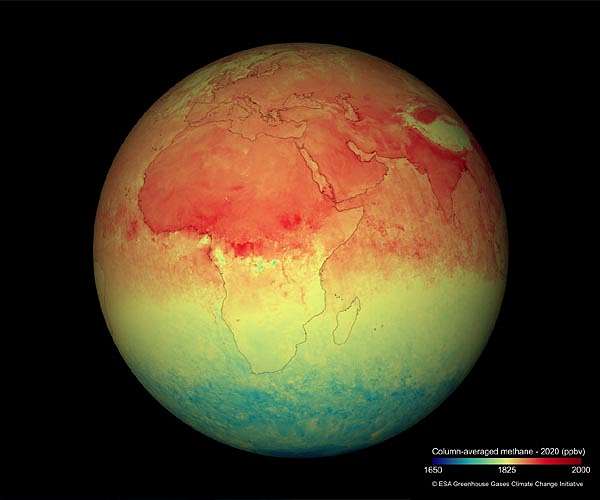
Methane remains in the atmosphere for roughly 10 years before it is broken down and removed, so understanding how much is removed is critical for determining what share of emissions is building up over time. That removal process is hard to pin down because it involves complex chemistry, and scientists have traditionally depended on chemistry climate models to estimate how quickly methane is destroyed.
A new study led by University of Washington researchers provides the first observationally based estimate of how much methane is destroyed in the stratosphere, the second layer of the atmosphere above the troposphere closest to Earth surface. Using satellite measurements instead of models, the team finds that methane loss in the stratosphere is higher than earlier simulations suggested, meaning more methane is being broken down aloft than previously assumed.
"Total methane emissions and removal are large values. Their difference, or imbalance, is a small, but critical value. It determines methane trends over time," said Qiang Fu, a professor of atmospheric and climate science at the University of Washington who led the work. The study appears in the Proceedings of the National Academy of Sciences.
Human activities are the main driver of methane emissions today, with agriculture, waste and fossil fuel use all releasing methane into the air. Natural systems such as wetlands also emit methane, while methane sinks in soils and chemical reactions in the atmosphere remove much of the gas contributed by various sources.
Removal occurs in both the lower troposphere and the overlying stratosphere. If sources and sinks balanced each other, atmospheric methane would not be increasing, but human driven emissions have shifted the system toward stronger sources so that methane is now accumulating.
Methane has become an attractive target for climate policy because it is both potent and short lived compared to carbon dioxide, which can stay in the atmosphere for hundreds of years. Since methane breaks down in about a decade, curbing human related emissions offers a way to slow warming more quickly than measures that focus only on carbon dioxide.
"Methane is a very powerful greenhouse gas with a short lifetime, which gives us more control over it. We will be in a better position, policy-wise, if we understand more about how it accumulates," Fu said. To track that accumulation, scientists use two main approaches.
One, a top down method, starts from observed methane concentrations in the atmosphere and infers the balance between emissions and removal. The other, a bottom up method, adds up individual sources and sinks at Earth surface and in the air. At present, those approaches do not line up: bottom up estimates indicate that global sources exceed sinks by a much larger margin than the imbalance inferred from atmospheric observations.
In the new work, Fu and graduate student Cong Dong used publicly available satellite data collected from 2007 to 2010 to calculate a fresh value for methane destruction in the stratosphere. They then rebuilt the global methane budget using this observational estimate in place of earlier model based values for stratospheric loss.
With the updated stratospheric sink, the gap between the top down and bottom up methane budgets nearly disappears, bringing the two methods into close agreement. "Narrowing it down improved our confidence in the methane budget and imbalance estimates, which determines the change in atmospheric methane levels," Fu said.
The implications extend beyond methane alone. Chemical reactions that destroy methane in the stratosphere generate water vapor, which is itself a greenhouse gas, and they influence ozone chemistry that helps control the thickness of the protective ozone layer. By tightening estimates of stratospheric methane loss, the study offers new insight into how these coupled processes may be affecting climate and ozone at high altitudes.
Research Report:Global Stratospheric Methane Loss from Satellite Observations
Related Links
University of Washington
Earth Observation News - Suppiliers, Technology and Application
| Subscribe Free To Our Daily Newsletters |
| Subscribe Free To Our Daily Newsletters |








