24/7 Space News
ENERGY TECH
Physicists map axion production paths inside deuterium tritium fusion reactors
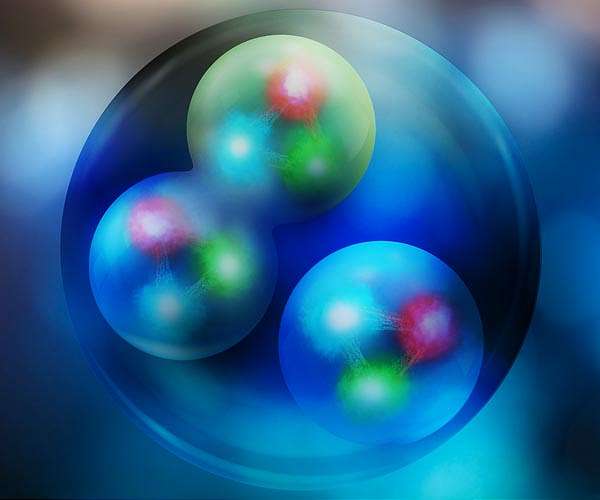
illustration only

Physicists map axion production paths inside deuterium tritium fusion reactors

by Clarence Oxford
Los Angeles CA (SPX) Jan 01, 2026
A University of Cincinnati physicist and collaborators from Fermi National Accelerator Laboratory MIT and Technion-Israel Institute of Technology have developed a theoretical framework showing how axions or axion like particles could be produced and studied in deuterium tritium fusion reactors lined with lithium.

Their analysis builds on a recurring joke arc in the television series The Big Bang Theory where fictional physicists Sheldon Cooper and Leonard Hofstadter struggle to work out axion production in a fusion device but never reach a solution.

Axions are hypothetical very light particles that are leading candidates to account for dark matter which appears to make up most of the matter in the universe while ordinary visible matter contributes only a smaller share.

Dark matter has not been directly detected yet it reveals itself through gravitational effects such as the motions of galaxies and stars that cannot be explained by visible matter alone.

In the new study published in the Journal of High Energy Physics the team considers a large scale fusion reactor fueled by deuterium and tritium with a lithium lined vessel similar to designs under development in southern France where a high flux of neutrons is expected during operation.

Jure Zupan explained that neutrons streaming from the fusion core will interact with materials in the reactor walls and trigger nuclear reactions that can generate new particles including possible axion like states.

A second production channel arises when neutrons scatter off other particles and lose energy emitting radiation through a process known as bremsstrahlung or braking radiation which can also lead to the creation of new light particles.

Zupan contrasted this with the whiteboard calculations shown in The Big Bang Theory episodes which estimated that axions produced in a fusion reactor by the same mechanisms operating in the sun would be much harder to detect than axions coming from the sun itself leading the fictional characters to mark their attempt with a sad face.

He noted that the sun is far larger and more powerful than any human built reactor so it naturally produces more of these hypothetical particles but reactors can still be useful if they rely on different processes from those in stellar interiors.

The television episodes do not mention axions explicitly and the equations appear only as visual references yet they served as an in joke for physicists familiar with solar axion models and dark matter searches.

"That's why it's fantastic to watch as a scientist," Zupan said. "There are many layers to the jokes."

Research Report:Searching for exotic scalars at fusion reactors

Related Links
University of Cincinnati
Powering The World in the 21st Century at Energy-Daily.com

Subscribe Free To Our Daily Newsletters
Tweet

RELATED CONTENT
ENERGY TECH
The Quantum Age will be Powered by Fusion
Gerroa, Australia (SPX) Dec 19, 2025
Fusion is the cosmic process that powers stars, shapes galaxies, and enables the chemical diversity needed for life. From the earliest stars to modern planetary systems, fusion converts hydrogen into heavier elements, forging the matter that makes up worlds, atmospheres, and living organisms. The Sun's steady fusion output governs Earth's climate and underlies all biological and technological energy flows, from photosynthesis to fossil fuels. ... read more

ENERGY TECH
ESA reaches new benchmark in autonomous formation flying

Hydrogen peroxide thruster qualifies for ESA launcher attitude control

China launches twin Shijian-29 satellites to test space-target detection tech

Billionaire Trump nominee confirmed to lead NASA amid Moon race

ENERGY TECH
AI systems proposed to boost launch cadence reliability and traffic management

China debuts Long March 12A reusable rocket in Jiuquan test flight

Japan's flagship H3 rocket fails to launch satellite

Hydrogen from ethanol reforming mapped as aviation fuel-cell pathway

ENERGY TECH
Curiosity Blog, Sols 4750-4762: See You on the Other Side of the Sun

Wind-Sculpted Landscapes: Investigating the Martian Megaripple 'Hazyview'

NASA team presses MAVEN recovery before Mars solar conjunction

Perseverance rover cleared for long distance Mars exploration

ENERGY TECH
China harnesses nationwide system to drive spaceflight and satellite navigation advances

Shenzhou 21 crew complete eight hour spacewalk outside Tiangong station

Foreign satellites ride Kinetica 1 on new CAS Space mission

Experts at Hainan symposium call for stronger global space partnership

ENERGY TECH
Southern Launch to Host Lux Aeterna Re-Entries South Australia

Smart modeling framework targets 6G spectrum chaos in space air and ground networks

Time-expanded network model cuts complexity in mega constellation launch planning

K2 Space raises 250m to scale Mega class high power satellites

ENERGY TECH
India space agency launches its heaviest satellite

Space ground fluid AI framework targets satellite powered 6G edge intelligence

Engineered interlayers boost satellite insulation and flexible electronics

Planet delivers first light image from Pelican 6 satellite capturing Lhasa Gonggar Airport

ENERGY TECH
Hubble pinpoints asteroid smash ups in nearby Fomalhaut system

Philosopher argues AI consciousness may remain unknowable

Evolution study finds history and environment shifts can steer species in very different directions

Webb maps carbon rich atmosphere on distorted pulsar planet

ENERGY TECH
Uranus and Neptune may be rock rich worlds

SwRI links Uranus radiation belt mystery to solar storm driven waves

Looking inside icy moons

Saturn moon mission planning shifts to flower constellation theory


The content herein, unless otherwise known to be public domain, are Copyright 1995-2026 - SpaceDaily.com. All websites are published in Australia and are solely subject to Australian law and governed by Fair Use principals for news reporting and research purposes. AFP, UPI and IANS news wire stories are copyright Agence France-Presse, United Press International and Indo-Asia News Service. ESA news reports are copyright European Space Agency. All NASA sourced material is public domain. Additional copyrights may apply in whole or part to other bona fide parties. All articles labeled "by Staff Writers" include reports supplied to Space Media Network by industry news wires, PR agencies, corporate press officers and the like. Such articles are individually curated and edited by Space Media Network staff on the basis of the report's information value to our industry and professional readership. Advertising does not imply endorsement, agreement or approval of any opinions, statements or information provided by Space Media Network on any Web page published or hosted by Space Media Network. General Data Protection Regulation (GDPR) Statement Our advertisers use various cookies and the like to deliver the best ad banner available at one time. All network advertising suppliers have GDPR policies (Legitimate Interest) that conform with EU regulations for data collection. By using our websites you consent to cookie based advertising. If you do not agree with this then you must stop using the websites from May 25, 2018. Privacy Statement. Additional information can be found here at About Us.
Subscribe Free To Our Daily Newsletters