24/7 Space News
AEROSPACE
NASA and Boeing advance control strategies for flexible long span airliner wings
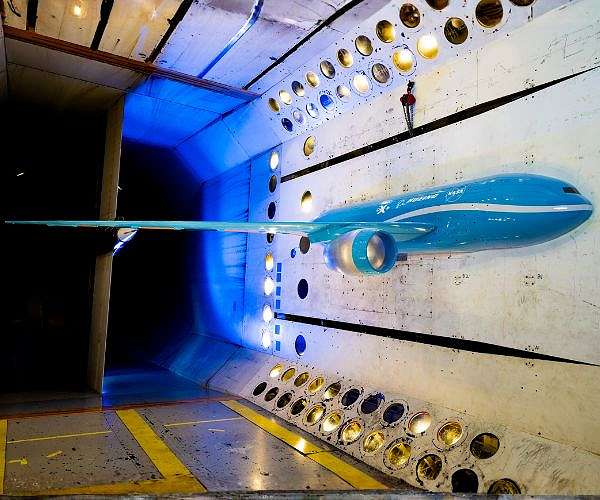
illustration only

NASA and Boeing advance control strategies for flexible long span airliner wings

by Clarence Oxford
Los Angeles CA (SPX) Jan 01, 2026
The airliners of coming decades may feature long, slender wings that change the look of commercial aircraft while improving ride quality and cutting fuel use.

Those high aspect ratio wings promise lower drag and better efficiency, but their increased flexibility introduces structural and control challenges that engineers must address before airlines can adopt them.

As part of the Integrated Adaptive Wing Technology Maturation collaboration, NASA and Boeing have carried out wind tunnel experiments on a higher aspect ratio wing model to investigate how to capture aerodynamic benefits while limiting unwanted motion.

"When you have a very flexible wing, you're getting into greater motions," said Jennifer Pinkerton, a NASA aerospace engineer at NASA Langley Research Center in Hampton, Virginia. "Things like gust loads and maneuver loads can cause even more of an excitation than with a smaller aspect ratio wing. Higher aspect ratio wings also tend to be more fuel efficient, so we're trying to take advantage of that while simultaneously controlling the aeroelastic response."

Without appropriate control systems and structural design, long, thin wings can bend significantly or enter wing flutter, a condition in which airflow interacts with the structure and excites natural frequencies, driving oscillations that can grow rapidly and threaten the airframe.

To map and manage these behaviors, NASA and Boeing set out to reduce the impact of wind gusts on the wing, lessen loads during turns and maneuvers, and suppress flutter across the operating envelope.

These factors directly influence aircraft performance, fuel consumption, and passenger comfort, but cannot be tested on full-size jetliners in a wind tunnel because no facility can accommodate an entire commercial aircraft.

Instead, the campaign used NASA Langley's Transonic Dynamics Tunnel in Hampton, Virginia, a facility with a 16-by-16-foot test section that has supported the development of U.S. commercial, military, launch vehicle, and spacecraft designs for more than six decades.

To create a suitable model, NASA and Boeing worked with NextGen Aeronautics, which designed and built a complex half-aircraft configuration mounted to the tunnel wall, featuring a single 13-foot wing representing a scaled transport.

Along the trailing edge of that wing, the team installed 10 movable control surfaces that could be adjusted to shape airflow and counteract aerodynamic forces responsible for wing vibration and structural loading.

Sensors and instruments embedded in the model measured both the aerodynamic forces applied to the structure and the resulting motions, providing data needed to understand the aeroelastic response under different test conditions.

This wing model extends earlier work from the Subsonic Ultra Green Aircraft Research program, which used a smaller configuration with fewer active surfaces to explore advanced transport concepts.

"The SUGAR model had two active control surfaces," said Patrick S. Heaney, principal investigator at NASA for the Integrated Adaptive Wing Technology Maturation collaboration. "And now on this particular model we have ten. We're increasing the complexity as well as expanding what our control objectives are."

A first test series in 2024 produced baseline measurements that researchers compared with NASA computational simulations, allowing them to tune analytical models and improve prediction accuracy.

A follow-on campaign in 2025 used the additional control surfaces in new arrangements, enabling trials of updated control laws and strategies for managing wing motion and loads.

The most visible gains were seen in runs aimed at alleviating the effects of gusting winds, where the active wing showed much less shaking than in uncontrolled cases, indicating that the control approach can substantially reduce gust response.

With the tunnel work finished, NASA and Boeing engineers are processing the results and preparing to brief the wider aviation sector so that airlines and airframe manufacturers can assess which elements to incorporate into future aircraft.

"Initial data analyses have shown that controllers developed by NASA and Boeing and used during the test demonstrated large performance improvements," Heaney said. "We're excited to continue analyzing the data and sharing results in the months to come."

NASA's Advanced Air Transport Technology project, within the Advanced Air Vehicles program of the Aeronautics Research Mission Directorate, leads this work to mature wing and control concepts that could be integrated into upcoming ultra-efficient transport designs.

Related Links
NASA Aeronautics Research Mission
Aerospace News at SpaceMart.com

Subscribe Free To Our Daily Newsletters
Tweet

RELATED CONTENT
AEROSPACE
US flew bombers, fighters and drones along Venezuela coast
Washington, United States (AFP) Dec 12, 2025
Fighter jets, bombers and surveillance drones: the United States military has flown a variety of aircraft along Venezuela's coast in recent weeks, an AFP analysis shows, amid growing fears of conflict between the countries. Washington has amassed a huge flotilla of warships in the Caribbean as part of what it bills as counter-narcotics efforts, and has since September carried out strikes targeting alleged drug-smuggling vessels that have left nearly 90 people dead. Regional tensions have flared ... read more

AEROSPACE
Overseas scholars drawn to China's scientific clout, funding

Hydrogen peroxide thruster qualifies for ESA launcher attitude control

Startups go public in litmus test for Chinese AI

Sprawling CES gadgetfest a world stage for AI and its hype

AEROSPACE
Starfighters completes supersonic tests for GE Aerospace ramjet program

Galileo satellites ride Ariane 6 to boost Europe navigation resilience

AI systems proposed to boost launch cadence reliability and traffic management

China debuts Long March 12A reusable rocket in Jiuquan test flight

AEROSPACE
Wind-Sculpted Landscapes: Investigating the Martian Megaripple 'Hazyview'

HiRISE camera aboard Mars Reconnaissance Orbiter passes 100000 image milestone

Search for life should be top science priority for first human landing on Mars report says

Curiosity Blog, Sols 4750-4762: See You on the Other Side of the Sun

AEROSPACE
China harnesses nationwide system to drive spaceflight and satellite navigation advances

Shenzhou 21 crew complete eight hour spacewalk outside Tiangong station

Foreign satellites ride Kinetica 1 on new CAS Space mission

Experts at Hainan symposium call for stronger global space partnership

AEROSPACE
Time-expanded network model cuts complexity in mega constellation launch planning

Southern Launch to Host Lux Aeterna Re-Entries South Australia

Smart modeling framework targets 6G spectrum chaos in space air and ground networks

K2 Space raises 250m to scale Mega class high power satellites

AEROSPACE
Momentus to flight test 3D printed fuel tank on Vigoride 7

Satellites lined up for shared space computing power networks

Planet delivers first light image from Pelican 6 satellite capturing Lhasa Gonggar Airport

From music to mind reading: AI startups bet on earbuds

AEROSPACE
Philosopher argues AI consciousness may remain unknowable

Creating hallucination-free, psychedelic-like molecules by shining light on life's basic building blocks

Giant amoeba virus ushikuvirus sheds light on how complex cells evolved

Clues to the migration path of hot Jupiters in their orbits

AEROSPACE
Uranus and Neptune may be rock rich worlds

SwRI links Uranus radiation belt mystery to solar storm driven waves

Looking inside icy moons

Saturn moon mission planning shifts to flower constellation theory


The content herein, unless otherwise known to be public domain, are Copyright 1995-2026 - SpaceDaily.com. All websites are published in Australia and are solely subject to Australian law and governed by Fair Use principals for news reporting and research purposes. AFP, UPI and IANS news wire stories are copyright Agence France-Presse, United Press International and Indo-Asia News Service. ESA news reports are copyright European Space Agency. All NASA sourced material is public domain. Additional copyrights may apply in whole or part to other bona fide parties. All articles labeled "by Staff Writers" include reports supplied to Space Media Network by industry news wires, PR agencies, corporate press officers and the like. Such articles are individually curated and edited by Space Media Network staff on the basis of the report's information value to our industry and professional readership. Advertising does not imply endorsement, agreement or approval of any opinions, statements or information provided by Space Media Network on any Web page published or hosted by Space Media Network. General Data Protection Regulation (GDPR) Statement Our advertisers use various cookies and the like to deliver the best ad banner available at one time. All network advertising suppliers have GDPR policies (Legitimate Interest) that conform with EU regulations for data collection. By using our websites you consent to cookie based advertising. If you do not agree with this then you must stop using the websites from May 25, 2018. Privacy Statement. Additional information can be found here at About Us.
Subscribe Free To Our Daily Newsletters