24/7 Space News
EARLY EARTH
Cosmic krypton timestamps reveal Australia landscape evolution and resources
illustration only

Cosmic krypton timestamps reveal Australia landscape evolution and resources

by Simon Mansfield
Sydney, Australia (SPX) Jan 14, 2026

Curtin University researchers have unveiled a new way to read the ancient history of Australian landscapes using tiny zircon grains that act as a cosmic clock for erosion and sediment storage.

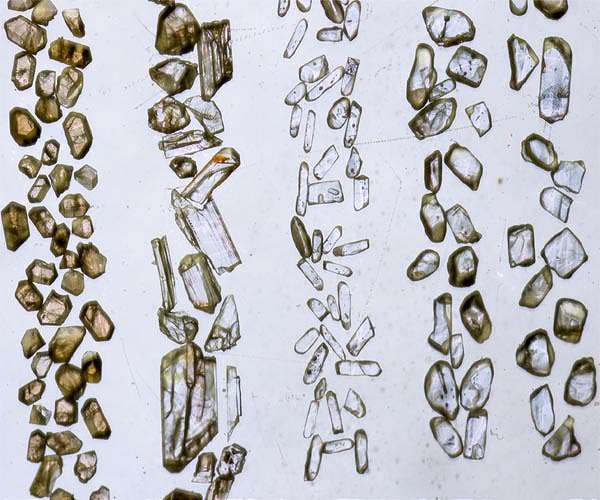
The international team, led by Curtin's Timescales of Mineral Systems Group in the School of Earth and Planetary Sciences, worked with colleagues from the University of Gottingen and the University of Cologne to study zircon crystals preserved in ancient beach sands. Zircon is one of the most resilient minerals on Earth and can survive weathering, erosion and repeated transport through river and coastal systems over millions of years, making it a durable archive of surface processes.

Inside these zircon grains the team measured a rare noble gas, krypton, that is produced when minerals at Earths surface are bombarded by cosmic rays, high energy charged particles arriving from space. By quantifying cosmogenic krypton in individual zircon crystals, the researchers were able to determine how long the grains had remained near the surface before burial, effectively turning each grain into a time stamp that records rates of landscape evolution over vast timescales.

Lead author and Adjunct Curtin Research Fellow Dr Maximilian Drollner, who is also based at the University of Gottingen, said the new approach makes it possible to study landscapes much older than those accessible with conventional techniques. He noted that the method opens a window onto how Earths surface has responded to changing climate and tectonic forces through deep time.

"Our planets history shows climate and tectonic forces can control how landscapes behave over very long timescales," Dr Drollner said. "This research helps us understand what happens when sea levels change and how deep seated Earth movements influence the evolution of landscapes."

The study shows that when regions are tectonically stable and sea levels remain relatively high, erosion can slow dramatically. Under these conditions, sediments may be stored and reworked near the surface for millions of years, rather than being rapidly flushed offshore or buried, and the cosmogenic krypton signal in zircon captures this prolonged residence time.

Co author and Timescales of Mineral Systems Group lead Professor Chris Kirkland said the findings are relevant not only for reconstructing how Earths surface has evolved over billions of years, but also for planning and managing modern environments. As human activity modifies rivers, coastlines and continental shelves, the balance between sediment storage and removal is expected to shift, with long term consequences for landscape form.

"As we modify natural systems, we can expect changes in how sediment is stored in river basins and along coastlines and continental shelves," Professor Kirkland said. "Our results show that these processes can fundamentally reshape landscapes, not just coastlines, over time."

Associate Professor Milo Barham, also a co author from the Timescales of Mineral Systems Group, said the work has important implications for understanding and exploring Australias mineral resources. Because zircon and other durable minerals can withstand prolonged recycling, long periods of sediment storage help concentrate economically important heavy minerals while less robust material breaks down.

"Climate does not just influence ecosystems and weather patterns, it also controls where mineral resources end up and how accessible they become," Associate Professor Barham said. "Extended periods of sediment storage allow durable minerals to gradually concentrate while less stable materials break down, explaining why Australia hosts some of the worlds most significant mineral sand deposits."

The researchers argue that linking cosmogenic krypton signals with sediment transport and storage histories can improve models that predict how environmental change will alter sedimentary systems and the distribution of critical resources. That perspective is becoming increasingly important as demand grows for minerals used in advanced technologies and the energy transition.

The study, "Ancient landscape evolution tracked through cosmogenic krypton in detrital zircon," was published in the journal Proceedings of the National Academy of Sciences and presents the first large scale application of cosmogenic krypton in detrital zircon to map landscape evolution over geological timescales.

Research Report:Ancient landscape evolution tracked through cosmogenic krypton in detrital zircon

Related Links
Timescales of Mineral Systems Group
Explore The Early Earth at TerraDaily.com

Subscribe Free To Our Daily Newsletters
Tweet

RELATED CONTENT
The following news reports may link to other Space Media Network websites.
EARLY EARTH
Signs of Ancient Life Turn Up in an Unexpected Place
Boulder CO (SPX) Jan 14, 2026
Dr. Rowan Martindale, a paleoecologist and geobiologist at the University of Texas at Austin, was walking through the Dades Valley in the Central High Atlas Mountains of Morocco when she saw something that literally stopped her in her tracks. Martindale and her colleagues, including Stephane Bodin of Aarhus University, were trekking through the rocky valley to study the ecology of the ancient reef systems that once sat below sea level there. To get to the reefs, they first had to traverse through ... read more

EARLY EARTH
International Space Station crew to return early after astronaut medical issue

Startups go public in litmus test for Chinese AI

Second ESCAPADE spacecraft completes key trajectory fix on path to Mars

Overseas scholars drawn to China's scientific clout, funding

EARLY EARTH
North Korea tests hypersonic missiles, says nuclear forces ready for war

Galileo satellites ride Ariane 6 to boost Europe navigation resilience

AI systems proposed to boost launch cadence reliability and traffic management

China debuts Long March 12A reusable rocket in Jiuquan test flight

EARLY EARTH
The electrifying science behind Martian dust

Sandblasting winds sculpt Mars landscape

Thin ice may have protected lake water on frozen Mars

Curiosity's Nevado Sajama postcard captures Mars on the eve of conjunction

EARLY EARTH
Tiangong science program delivers data surge

China tallies record launch year as lunar and asteroid plans advance

China harnesses nationwide system to drive spaceflight and satellite navigation advances

Shenzhou 21 crew complete eight hour spacewalk outside Tiangong station

EARLY EARTH
Disaster losses drop in 2025, picture still 'alarming': Munich Re

Time-expanded network model cuts complexity in mega constellation launch planning

Southern Launch to Host Lux Aeterna Re-Entries South Australia

Smart modeling framework targets 6G spectrum chaos in space air and ground networks

EARLY EARTH
Planet delivers first light image from Pelican 6 satellite capturing Lhasa Gonggar Airport

New tool narrows the search for ideal material structures

Chlorine and hydrogen from waste brines without external power

Fast FPGA pulse shaping clears neutron gamma pile ups in nuclear detectors

EARLY EARTH
Puffy young exoplanets reveal origin of super Earths

M dwarf plasma torus offers window into space weather and planetary habitability

We finally know how the most common types of planets are created

NASA selects industry partners to mature Habitable Worlds Observatory technologies

EARLY EARTH
Jupiter's moon Europa has a seafloor that may be quiet and lifeless

Uranus and Neptune may be rock rich worlds

SwRI links Uranus radiation belt mystery to solar storm driven waves

Looking inside icy moons

Subscribe Free To Our Daily Newsletters


The content herein, unless otherwise known to be public domain, are Copyright 1995-2024 - Space Media Network. All websites are published in Australia and are solely subject to Australian law and governed by Fair Use principals for news reporting and research purposes. AFP, UPI and IANS news wire stories are copyright Agence France-Presse, United Press International and Indo-Asia News Service. ESA news reports are copyright European Space Agency. All NASA sourced material is public domain. Additional copyrights may apply in whole or part to other bona fide parties. All articles labeled "by Staff Writers" include reports supplied to Space Media Network by industry news wires, PR agencies, corporate press officers and the like. Such articles are individually curated and edited by Space Media Network staff on the basis of the report's information value to our industry and professional readership. Advertising does not imply endorsement, agreement or approval of any opinions, statements or information provided by Space Media Network on any Web page published or hosted by Space Media Network. General Data Protection Regulation (GDPR) Statement Our advertisers use various cookies and the like to deliver the best ad banner available at one time. All network advertising suppliers have GDPR policies (Legitimate Interest) that conform with EU regulations for data collection. By using our websites you consent to cookie based advertising. If you do not agree with this then you must stop using the websites from May 25, 2018. Privacy Statement. Additional information can be found here at About Us.