24/7 Space News
EARLY EARTH
Signs of Ancient Life Turn Up in an Unexpected Place
Deep-water sediment layers reveal rare microbial wrinkle structures formed far from sunlight

Signs of Ancient Life Turn Up in an Unexpected Place

by Rudy Molinek, GSA Science Communication Fellow
Boulder CO (SPX) Jan 14, 2026

Dr. Rowan Martindale, a paleoecologist and geobiologist at the University of Texas at Austin, was walking through the Dades Valley in the Central High Atlas Mountains of Morocco when she saw something that literally stopped her in her tracks.

Martindale and her colleagues, including Stephane Bodin of Aarhus University, were trekking through the rocky valley to study the ecology of the ancient reef systems that once sat below sea level there. To get to the reefs, they first had to traverse through layers and layers of turbidites - deposits made by thick submarine debris flows. Ripple marks are common on turbidites, but Martindale had spotted crenulations superimposed on the ripples that seemed out of place.

"As we're walking up these turbidites, I'm looking around and this beautifully rippled bedding plane caught my eye," says Martindale. "I said, 'Stephane, you need to get back here. These are wrinkle structures!'"

Wrinkle structures are millimeter- to centimeter-scale ridges and pits that can form on sandy beds when algal and microbial communities form mats or aggregates. Wrinkles are usually obliterated by animal activity, and so they are rare in rocks younger than 540 million years ago, when there was an explosion of animal evolution. Today, wrinkle structures are commonly found in shallow tidal areas where photosynthetic algae thrive.

But the turbidites Martindale was walking across were deposited too deep in the water for light to reach, at least 180 meters below the surface, meaning the wrinkles could not have been made by the same type of algae that form them today. In fact, the few previous studies proposing wrinkle structures in ancient turbidite deposits were contested. Additionally, the rocks were only about 180 million years old, when animals were tearing up the delicate seafloor all over the world. By all accounts, the wrinkle structures should not have been there. Martindale realized she needed to get to work to make sure she could trust her instinct.

"Let's go through every single piece of evidence that we can find to be sure that these are wrinkle structures in turbidites," says Martindale, because wrinkle structures, usually photosynthetic in origin, "shouldn't be in this deep-water setting."

When the team closely examined the geologic evidence and determined that the sediment layers were indeed turbidites, the next step was to make sure the textures they observed were definitely biotic wrinkles. Analysis revealed the layers just below the wrinkles contained elevated levels of carbon - a signature of biotic origin. Furthermore, videos from remotely operated submersibles taken of the seafloor well below the photic zone showed that microbial mats could form from chemosynthetic bacteria - bacteria that get energy from chemical reactions rather than light.

Combining the evidence from the geologic setting, chemistry, and modern analogs satisfied the team that they had documented chemosynthetic wrinkle structures in the rock record. They determined that the turbidites bring nutrients and organic matter with them, reducing oxygen levels and creating conditions ripe for chemosynthetic life. Then, in the calm periods between turbidite deposition, those bacteria form mats atop the sediment that subsequently wrinkle into the distinctive texture Martindale observed in Morocco. Usually, the next turbidite erodes away the mat, but every once in a while, the mats and their wrinkles are preserved.

Going forward, Martindale hopes to conduct laboratory experiments to explore how these structures might form within turbidites. She also hopes that these findings spur other researchers to incorporate chemosynthetic mats in a paradigm that previously included only a photosynthetic mat origin for wrinkle structures. Then geologists could look for wrinkle structures in new places that were previously written off as fruitless settings in the search for early life on Earth.

"Wrinkle structures are really important pieces of evidence in the early evolution of life," says Martindale. By ignoring their possible presence in turbidites, "we might be missing out on a key piece of history of microbial life."

Research Report:\Chemosynthetic microbial communities formed wrinkle structures in ancient turbidites

Related Links
\Geological Society of America
Explore The Early Earth at TerraDaily.com

Subscribe Free To Our Daily Newsletters
Tweet

RELATED CONTENT
The following news reports may link to other Space Media Network websites.
EARLY EARTH
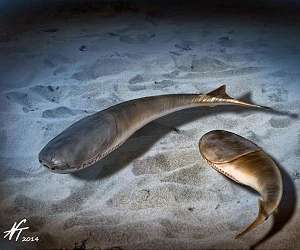
Ordovician mass extinction cleared the way for jawed fishes to rise
Tokyo, Japan (SPX) Jan 13, 2026
About 445 million years ago, a global environmental crisis reshaped life in the oceans, drying out many shallow seas and driving one of the largest mass extinctions in Earth's history. During this Late Ordovician Mass Extinction, or LOME, glaciers spread over the southern supercontinent Gondwana, ocean chemistry changed dramatically, and an estimated 85 percent of marine species disappeared. A new analysis of early vertebrate fossils shows that this biological catastrophe set the stage for the lat ... read more

EARLY EARTH
International Space Station crew to return early after astronaut medical issue

Startups go public in litmus test for Chinese AI

Second ESCAPADE spacecraft completes key trajectory fix on path to Mars

Overseas scholars drawn to China's scientific clout, funding

EARLY EARTH
North Korea tests hypersonic missiles, says nuclear forces ready for war

Galileo satellites ride Ariane 6 to boost Europe navigation resilience

AI systems proposed to boost launch cadence reliability and traffic management

China debuts Long March 12A reusable rocket in Jiuquan test flight

EARLY EARTH
The electrifying science behind Martian dust

Sandblasting winds sculpt Mars landscape

Thin ice may have protected lake water on frozen Mars

Curiosity's Nevado Sajama postcard captures Mars on the eve of conjunction

EARLY EARTH
Tiangong science program delivers data surge

China tallies record launch year as lunar and asteroid plans advance

China harnesses nationwide system to drive spaceflight and satellite navigation advances

Shenzhou 21 crew complete eight hour spacewalk outside Tiangong station

EARLY EARTH
Disaster losses drop in 2025, picture still 'alarming': Munich Re

Time-expanded network model cuts complexity in mega constellation launch planning

Southern Launch to Host Lux Aeterna Re-Entries South Australia

Smart modeling framework targets 6G spectrum chaos in space air and ground networks

EARLY EARTH
Planet delivers first light image from Pelican 6 satellite capturing Lhasa Gonggar Airport

New tool narrows the search for ideal material structures

Chlorine and hydrogen from waste brines without external power

Fast FPGA pulse shaping clears neutron gamma pile ups in nuclear detectors

EARLY EARTH
Puffy young exoplanets reveal origin of super Earths

M dwarf plasma torus offers window into space weather and planetary habitability

We finally know how the most common types of planets are created

NASA selects industry partners to mature Habitable Worlds Observatory technologies

EARLY EARTH
Jupiter's moon Europa has a seafloor that may be quiet and lifeless

Uranus and Neptune may be rock rich worlds

SwRI links Uranus radiation belt mystery to solar storm driven waves

Looking inside icy moons

Subscribe Free To Our Daily Newsletters


The content herein, unless otherwise known to be public domain, are Copyright 1995-2024 - Space Media Network. All websites are published in Australia and are solely subject to Australian law and governed by Fair Use principals for news reporting and research purposes. AFP, UPI and IANS news wire stories are copyright Agence France-Presse, United Press International and Indo-Asia News Service. ESA news reports are copyright European Space Agency. All NASA sourced material is public domain. Additional copyrights may apply in whole or part to other bona fide parties. All articles labeled "by Staff Writers" include reports supplied to Space Media Network by industry news wires, PR agencies, corporate press officers and the like. Such articles are individually curated and edited by Space Media Network staff on the basis of the report's information value to our industry and professional readership. Advertising does not imply endorsement, agreement or approval of any opinions, statements or information provided by Space Media Network on any Web page published or hosted by Space Media Network. General Data Protection Regulation (GDPR) Statement Our advertisers use various cookies and the like to deliver the best ad banner available at one time. All network advertising suppliers have GDPR policies (Legitimate Interest) that conform with EU regulations for data collection. By using our websites you consent to cookie based advertising. If you do not agree with this then you must stop using the websites from May 25, 2018. Privacy Statement. Additional information can be found here at About Us.