24/7 Space News
STELLAR CHEMISTRY
AI tool mines Hubble archive for hundreds of strange cosmic objects
illustration only

AI tool mines Hubble archive for hundreds of strange cosmic objects

by Clarence Oxford
Los Angeles CA (SPX) Jan 29, 2026
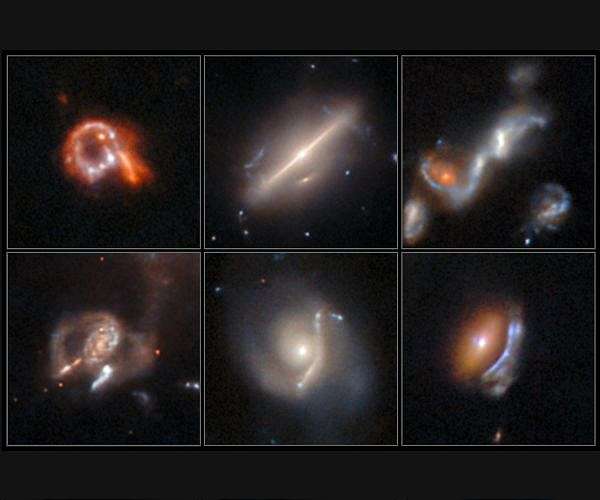
A team of astronomers has used a new artificial intelligence assisted technique to uncover rare astronomical phenomena in archived data from NASA's Hubble Space Telescope. They sifted through nearly 100 million small image cutouts from the Hubble Legacy Archive, each only a few dozen pixels across, and identified more than 1,300 unusually shaped objects in just two and a half days, including over 800 that had never been documented in scientific literature.

Most of the newly cataloged anomalies are galaxies in the midst of mergers or interactions that display distorted shapes or long, trailing streams of stars and gas. Others are examples of gravitational lensing, where the gravity of a foreground galaxy warps spacetime and bends light from a background galaxy into bright arcs or nearly complete rings. The search also revealed galaxies packed with massive star forming clumps, jellyfish like systems with gaseous tentacles, and edge on planet forming disks in the Milky Way that resemble hamburgers, along with several dozen objects that did not fit any existing classification.

The explosion of data from Hubble and other observatories has made it increasingly difficult to find rare or unexpected objects with traditional methods. Hubble's three and a half decades of observations have produced a vast archive, and never before have astronomers had access to such a large volume of sky images that might hide subtle or unusual phenomena. Manually inspecting every image in this archive is no longer practical, even for large teams of experts.

To tackle this challenge, David O'Ryan and Pablo Gomez of ESA developed an AI tool designed to scan millions of astronomical images far faster than human experts can. Their neural network, called AnomalyMatch, was trained to recognize patterns and identify rare or unusual sources, in a way that mimics how the human brain processes visual information but at a much greater scale. By automating the first pass over the data, the system filters out the most promising anomalies for astronomers to examine in detail.

When AnomalyMatch was applied to the full Hubble Legacy Archive, it marked the first systematic search for astrophysical anomalies across the entire dataset. The algorithm produced a ranked list of candidates, and the researchers then manually inspected the highest rated sources to verify their nature. This combined AI and human review process confirmed more than 1,300 true anomalies, demonstrating that the archive still holds many surprises despite decades of intensive study.

Citizen science projects and visual inspections by professional astronomers have previously identified some unusual Hubble images, but they cannot keep pace with the growing volume of data. The new results show that AI can complement these efforts by efficiently surfacing rare phenomena that might otherwise remain buried in the archive. As Gomez noted, the discovery of so many previously undocumented anomalies in Hubble data highlights how tools like AnomalyMatch can significantly enhance the scientific return from existing observations.

Hubble is only one of several observatories whose archives are expected to benefit from AI driven analysis. NASA's upcoming Nancy Grace Roman Space Telescope, ESA's Euclid mission, and the National Science Foundation and Department of Energy's Vera C. Rubin Observatory will all produce enormous datasets that far exceed Hubble's in size. Automated anomaly detection will be essential for navigating this data deluge, helping astronomers quickly pinpoint unusual objects and phenomena that merit follow up.

The success of AnomalyMatch hints at the kinds of discoveries that may emerge as these next generation facilities begin operations. By rapidly scanning images for outliers while astronomers focus on interpretation, AI tools can open new windows on the universe and possibly reveal types of objects that have never been seen before. The approach also shows how archived observations remain a rich resource for discovery when paired with modern data analysis techniques.

The Hubble Space Telescope itself has been operating for more than three decades and continues to reshape our understanding of the cosmos. It is a project of international cooperation between NASA and ESA, with NASA's Goddard Space Flight Center in Greenbelt, Maryland managing the observatory and mission operations. Lockheed Martin Space in Denver supports operations at Goddard, and the Space Telescope Science Institute in Baltimore, operated by the Association of Universities for Research in Astronomy, conducts Hubble science operations for NASA.

Related Links
Hubble Telescope
Stellar Chemistry, The Universe And All Within It

Subscribe Free To Our Daily Newsletters
Tweet

RELATED CONTENT
STELLAR CHEMISTRY
Hubble confirms dark starless relic cloud near galaxy M94
Paris, France (SPX) Jan 06, 2026
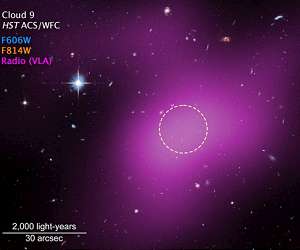
A team using NASA's Hubble Space Telescope has identified a new type of astronomical object, a starless gas-rich dark-matter cloud considered a relic of early galaxy formation and nicknamed "Cloud-9." The object is the first confirmed example of a Reionization-Limited H I Cloud, or RELHIC, a neutral hydrogen cloud from the early universe that never formed stars. Program principal investigator Alejandro Benitez-Llambay of the Milano-Bicocca University in Milan, Italy, described Cloud-9 as "a tale o ... read more

STELLAR CHEMISTRY
NASA astronaut stuck in space for nine months retires

Tourists hit record in Japan, despite plunge from China

What happens when fire ignites in space? 'A ball of flame'

ISS astronauts splash down on Earth after first-ever medical evacuation

STELLAR CHEMISTRY
NASA moves moon rocket to launch pad ahead of Artemis 2 mission

Interstellar raises major Series F funding to expand launch and satellite business

NASA Testing Advances Space Nuclear Propulsion Capabilities

NASA and GE run hybrid jet engine test toward commercial flight

STELLAR CHEMISTRY
Ancient deltas reveal vast Martian ocean across northern hemisphere

Tiny Mars' big impact on Earth's climate

The electrifying science behind Martian dust

Sandblasting winds sculpt Mars landscape

STELLAR CHEMISTRY
Retired EVA workhorse to guide China's next-gen spacesuit and lunar gear

China prepares offshore test base for reusable liquid rocket launches

Tiangong science program delivers data surge

China tallies record launch year as lunar and asteroid plans advance

STELLAR CHEMISTRY
Aerospacelab expands Pulsar navigation constellation work with new Xona satellite order

ThinkOrbital raises seed funding to advance orbital defense and construction systems

China outlines mega constellations in ITU satellite filings

Multiple satellite filings demonstrate transparency, responsibility and ambition: China Daily editorial

STELLAR CHEMISTRY
Understanding USDT How Stablecoins Maintain Value in Volatile Markets

Top 7 Free Coin Value Apps for Android and iPhone

Seismic networks offer new way to track space junk reentering atmosphere

Comtech wins multi-million dollar follow-on contract for civil space components

STELLAR CHEMISTRY
Hidden magma oceans could shield rocky exoplanets from harmful radiation

Cosmic dust chemistry forges peptide building blocks in deep space

Hidden magma oceans could shield rocky exoplanets from harmful radiation

Metal rich winds detected in giant dusty cloud around distant star

STELLAR CHEMISTRY
Computer models let scientists peer into the mystery beneath Jupiter's clouds

Polar weather on Jupiter and Saturn hints at the planets' interior details

Europa ice delamination may deliver nutrients to hidden ocean

Birth conditions fixed water contrast on Jupiters moons


The content herein, unless otherwise known to be public domain, are Copyright 1995-2026 - SpaceDaily.com. All websites are published in Australia and are solely subject to Australian law and governed by Fair Use principals for news reporting and research purposes. AFP, UPI and IANS news wire stories are copyright Agence France-Presse, United Press International and Indo-Asia News Service. ESA news reports are copyright European Space Agency. All NASA sourced material is public domain. Additional copyrights may apply in whole or part to other bona fide parties. All articles labeled "by Staff Writers" include reports supplied to Space Media Network by industry news wires, PR agencies, corporate press officers and the like. Such articles are individually curated and edited by Space Media Network staff on the basis of the report's information value to our industry and professional readership. Advertising does not imply endorsement, agreement or approval of any opinions, statements or information provided by Space Media Network on any Web page published or hosted by Space Media Network. General Data Protection Regulation (GDPR) Statement Our advertisers use various cookies and the like to deliver the best ad banner available at one time. All network advertising suppliers have GDPR policies (Legitimate Interest) that conform with EU regulations for data collection. By using our websites you consent to cookie based advertising. If you do not agree with this then you must stop using the websites from May 25, 2018. Privacy Statement. Additional information can be found here at About Us.
Subscribe Free To Our Daily Newsletters