24/7 Space News
MICROSAT BLITZ
SunRISE small satellites clear vibration tests ahead of launch
illustration only

SunRISE small satellites clear vibration tests ahead of launch

by Clarence Oxford
Los Angeles CA (SPX) Jan 21, 2026

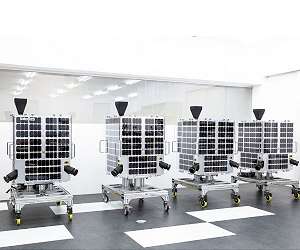
When NASA's Sun Radio Interferometer Space Experiment (SunRISE) launches later this year, six toaster-oven-size spacecraft will work together in orbit to form a single powerful radio observatory focused on the Sun's outer atmosphere.

The mission has moved a step closer to that milestone after the full suite of small satellites, or SmallSats, completed a rigorous test campaign at Utah State University's Space Dynamics Laboratory (SDL) in Logan, Utah, where they were built. Engineers designed the tests to confirm that the spacecraft can survive the harsh conditions of launch and operate as intended during their one-year prime mission studying solar radio bursts.

The SunRISE constellation will investigate radio emissions generated by solar energetic particle events originating in the Sun's corona. These events can, in extreme cases, expose astronauts and spacecraft to intense radiation, and the radio waves they produce carry information about how and where the particles are accelerated. By tracking these radio bursts, SunRISE will help scientists better understand and ultimately mitigate the effects of hazardous space weather.

To prepare the spacecraft for this task, SDL engineers first subjected each SmallSat to thermal vacuum testing that mimicked the vacuum and temperature extremes it will encounter in orbit. They then performed electromagnetic compatibility testing to verify that onboard electronics and subsystems will not interfere with the mission's sensitive radio science instruments when operating together in the confined volume of each spacecraft.

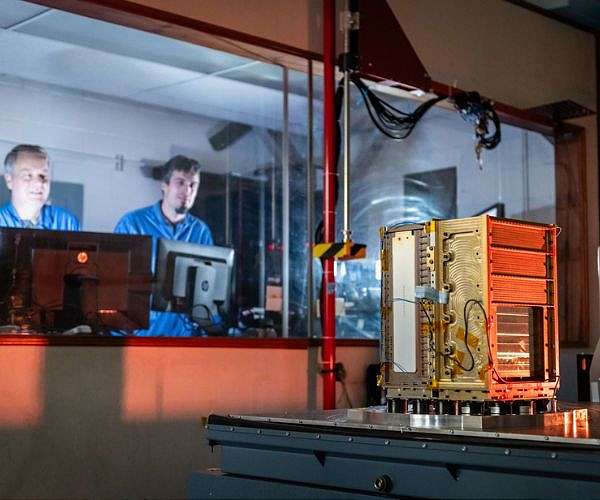
The final major hurdle was vibration testing, which replicated the mechanical loads the SmallSats will experience during ascent on their specific launch vehicle. The team configured the tests using a vibration profile tailored to the United Launch Alliance Vulcan Centaur rocket and the overall rideshare payload stack that will carry SunRISE into space from Cape Canaveral Space Force Station in Florida.

"Each spacecraft was loaded with propellant to match launch mass and subjected to vibration testing in all three axes. The objective was to make the simulated vibrations as true to the conditions of launch as possible," said Jim Lux, SunRISE project manager at NASA's Jet Propulsion Laboratory in Southern California. "Pre- and post-test functional checks were performed, and all six spacecraft aced them."

After launch, the SunRISE SmallSats will be deployed to an orbit slightly above geosynchronous altitude, at roughly 22,000 miles, or about 35,000 kilometers, above Earth. Once on station, each spacecraft will extend four telescoping antenna booms, each roughly 10 feet, or about 2.5 meters, long, forming an X-shaped configuration optimized for low-frequency radio observations.

Flying in a loose formation up to 10 miles, or about 16 kilometers, apart, the six spacecraft together will synthesize the resolving power of a single large radio telescope. Using interferometry techniques and communications relayed via NASA's Deep Space Network, scientists will combine the individual measurements into detailed maps of solar radio bursts and the associated magnetic field structures stretching from the outer corona into interplanetary space.

"Solar radio bursts are triggered after vast quantities of energy stored in the Sun's magnetic field accelerate solar particles to high speeds," said Sue Lepri, SunRISE principal investigator at the University of Michigan in Ann Arbor. "Tracking these events will not only help space agencies mitigate their damaging effects on astronauts and spacecraft but will also add new science to our growing knowledge base of how space weather is generated and propagates throughout the solar system."

By providing continuous, dedicated observations of low-frequency radio emissions from the Sun, SunRISE will complement measurements from other NASA heliophysics missions. These include the Solar TErrestrial RElations Observatory, Parker Solar Probe, and Solar Orbiter, an international cooperative mission between ESA (European Space Agency) and NASA that is exploring the Sun and inner heliosphere from different vantage points.

SunRISE is a Mission of Opportunity under the Heliophysics Division of NASA's Science Mission Directorate at agency headquarters in Washington and is part of the Explorers Program managed by NASA's Goddard Space Flight Center in Greenbelt, Maryland. The University of Michigan in Ann Arbor leads the science investigation and operates the science operations center, while NASA's Jet Propulsion Laboratory, a division of Caltech in Pasadena, California, manages the project and operates the mission operations center.

The Space Dynamics Laboratory built the SunRISE spacecraft and conducted the environmental test campaign that has now cleared them for integration with their launch vehicle rideshare system. With testing complete and operations centers in place, the mission team is preparing for launch and the start of a new window on solar radio activity and the dynamics of space weather.

Related Links
SunRISE at NASA
Microsat News and Nanosat News at SpaceMart.com

Subscribe Free To Our Daily Newsletters
Tweet

RELATED CONTENT
The following news reports may link to other Space Media Network websites.
MICROSAT BLITZ
Axelspace sets multi launch framework with Exolaunch for AxelLiner mission growth
Los Angeles CA (SPX) Dec 26, 2025
Axelspace Corporation has signed a multi-launch agreement with Exolaunch to support a series of missions using Axelspace microsatellites. The framework covers multiple launches and is intended to secure launch access and mission management for Axelspace programs, including new spacecraft assigned to in-orbit demonstration services. Under the agreement, one satellite is scheduled to launch as part of the AxelLiner business in-orbit demonstration service known as AxelLiner Laboratory. In addition, E ... read more

MICROSAT BLITZ
Explore the World with These Travel Tips

The Quiet Transformation of GPS - What's Coming by 2026

NASA Back for Seconds with New Food System Design Challenge

New orbital mapping system targets Earth Moon libration traffic

MICROSAT BLITZ
NASA moves moon rocket to launch pad ahead of Artemis 2 mission

Interstellar raises major Series F funding to expand launch and satellite business

GE and Lockheed validate compact rotating detonation ramjet for hypersonic missiles

China tests Long March 12B reusable first stage at Jiuquan

MICROSAT BLITZ
Tiny Mars' big impact on Earth's climate

Ancient deltas reveal vast Martian ocean across northern hemisphere

The electrifying science behind Martian dust

Sandblasting winds sculpt Mars landscape

MICROSAT BLITZ
Tiangong science program delivers data surge

China tallies record launch year as lunar and asteroid plans advance

China harnesses nationwide system to drive spaceflight and satellite navigation advances

Shenzhou 21 crew complete eight hour spacewalk outside Tiangong station

MICROSAT BLITZ
ThinkOrbital raises seed funding to advance orbital defense and construction systems

Aerospacelab expands Pulsar navigation constellation work with new Xona satellite order

Multiple satellite filings demonstrate transparency, responsibility and ambition: China Daily editorial

China outlines mega constellations in ITU satellite filings

MICROSAT BLITZ
The decentralized future of space transactions

Top 5 Best Live Sports Betting Sites For North Carolina Sports Fans

How IVRT Testing Ensures Consistent Product Quality

How Path Social's AI Targeting Really Works: A Deep Dive into the Tech

MICROSAT BLITZ
Hidden magma oceans could shield rocky exoplanets from harmful radiation

Frozen hydrogen cyanide crystals may have helped spark early chemistry for life

Berkeley Scientists set to home in on 100 signals from Seti at Home

Scientist wins 'Environment Nobel' for shedding light on hidden fungal networks

MICROSAT BLITZ
Computer models let scientists peer into the mystery beneath Jupiter's clouds

Jupiter's moon Europa has a seafloor that may be quiet and lifeless

Uranus and Neptune may be rock rich worlds

SwRI links Uranus radiation belt mystery to solar storm driven waves

Subscribe Free To Our Daily Newsletters


The content herein, unless otherwise known to be public domain, are Copyright 1995-2024 - Space Media Network. All websites are published in Australia and are solely subject to Australian law and governed by Fair Use principals for news reporting and research purposes. AFP, UPI and IANS news wire stories are copyright Agence France-Presse, United Press International and Indo-Asia News Service. ESA news reports are copyright European Space Agency. All NASA sourced material is public domain. Additional copyrights may apply in whole or part to other bona fide parties. All articles labeled "by Staff Writers" include reports supplied to Space Media Network by industry news wires, PR agencies, corporate press officers and the like. Such articles are individually curated and edited by Space Media Network staff on the basis of the report's information value to our industry and professional readership. Advertising does not imply endorsement, agreement or approval of any opinions, statements or information provided by Space Media Network on any Web page published or hosted by Space Media Network. General Data Protection Regulation (GDPR) Statement Our advertisers use various cookies and the like to deliver the best ad banner available at one time. All network advertising suppliers have GDPR policies (Legitimate Interest) that conform with EU regulations for data collection. By using our websites you consent to cookie based advertising. If you do not agree with this then you must stop using the websites from May 25, 2018. Privacy Statement. Additional information can be found here at About Us.