24/7 Space News
STELLAR CHEMISTRY
Sulfur ring molecule in galactic cloud links space chemistry to life
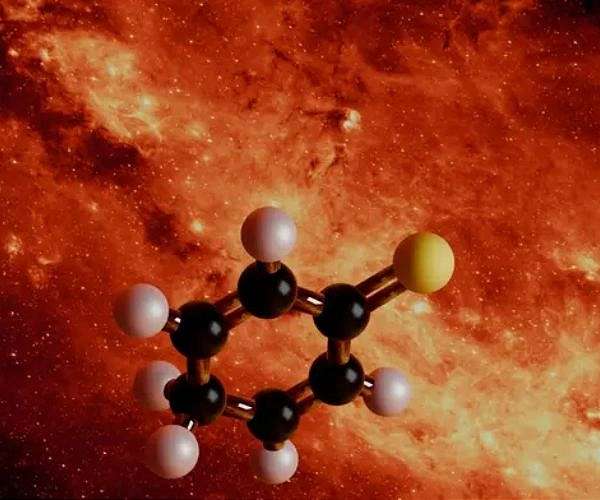
illustration only

Sulfur ring molecule in galactic cloud links space chemistry to life

by Robert Schreiber
Berlin, Germany (SPX) Jan 26, 2026

Researchers at the Max Planck Institute for Extraterrestrial Physics, working with colleagues at the Centro de Astrobiologia in Spain, have identified the largest sulfur-bearing molecule yet seen in interstellar space. The compound, 2,5-cyclohexadiene-1-thione (C6H6S), was detected in the molecular cloud G+0.693-0.027 near the center of the Milky Way, about 27,000 light years from Earth. With a stable six-membered ring and a total of 13 atoms, it is the first unambiguous detection of a complex, ring-shaped sulfur molecule in an interstellar environment.

The discovery stands out because astronomers had previously only identified relatively small sulfur compounds in space, typically with six atoms or fewer. Sulfur plays an essential role in proteins and enzymes on Earth, so scientists have long suspected that larger sulfur-bearing molecules should exist in the interstellar medium. Until now, however, this class of molecules had remained missing from radio surveys, creating a gap between simple sulfur chemistry in space and the complex organic inventory measured in comets and meteorites.

The team reports that the newly detected C6H6S is structurally related to molecules recovered from extraterrestrial samples within our own solar system. As a result, it provides a direct chemical bridge between the molecular content of a starless interstellar cloud and the materials incorporated into comets and meteorites. This bridge strengthens the idea that some of the building blocks of life may be assembled long before planets form.

To find the molecule, the researchers first had to create and characterize it in the laboratory. They synthesized 2,5-cyclohexadiene-1-thione by applying a 1,000 volt electrical discharge to liquid thiophenol (C6H5SH), a substance noted for its strong odor. Using a self-developed laboratory spectrometer, they then measured the molecule's radio emission frequencies with very high precision, establishing a unique spectral fingerprint with more than seven significant digits.

Armed with this fingerprint, the team searched through existing astronomical survey data of the molecular cloud G+0.693-0.027. The observations, collected with the IRAM 30 meter and Yebes 40 meter radio telescopes in Spain, contained a forest of spectral lines from many different molecules. By matching the laboratory spectrum of C6H6S to lines in the cloud's radio emission, the scientists were able to identify the molecule's presence and determine that it is abundant enough to be detected clearly.

According to the researchers, the detection of a 13 atom sulfur-bearing ring molecule in a young, starless molecular cloud shows that complex chemistry is already underway before stars and planetary systems emerge. They argue that this is evidence that the chemical groundwork for life, including key sulfur-containing organics, can originate in the cold, dense regions of interstellar space. Such regions later collapse to form stars and planetary systems, potentially carrying this preassembled chemistry into new environments.

The result implies that many additional complex sulfur compounds may be hiding in interstellar spectra, still unassigned because their laboratory fingerprints are not yet available. Extending laboratory spectroscopy to other sulfur-bearing ring systems and related molecules could therefore reveal a richer inventory of prebiotic chemistry in space. The authors see this as an important step toward connecting interstellar molecules, cometary materials and the emergence of biochemistry on young planets.

Research Report:Sulfur-Bearing Cyclic Hydrocarbons in Space

Related Links
Max Planck Institute for Extraterrestrial Physics
Stellar Chemistry, The Universe And All Within It

Subscribe Free To Our Daily Newsletters
Tweet

RELATED CONTENT
The following news reports may link to other Space Media Network websites.
STELLAR CHEMISTRY
Barred spiral galaxy spotted 11.5 billion years in the past
Los Angeles CA (SPX) Jan 09, 2026
Research led by Daniel Ivanov, a physics and astronomy graduate student in the Kenneth P. Dietrich School of Arts and Sciences at the University of Pittsburgh, has identified a contender for one of the earliest known spiral galaxies containing a stellar bar, a structure that plays a role in how galaxies evolve. The system, designated COSMOS-74706, appears as a barred spiral galaxy from a time when the universe was about 2 billion years old, and the Milky Way is also classified as a barred spiral. ... read more

STELLAR CHEMISTRY
NASA astronaut stuck in space for nine months retires

Tourists hit record in Japan, despite plunge from China

What happens when fire ignites in space? 'A ball of flame'

ISS astronauts splash down on Earth after first-ever medical evacuation

STELLAR CHEMISTRY
NASA moves moon rocket to launch pad ahead of Artemis 2 mission

Starfighters completes key wind tunnel campaign for STARLAUNCH 1 air launch vehicle

Interstellar raises major Series F funding to expand launch and satellite business

Major equity deal backs Gilmour Space expansion of sovereign launch capability

STELLAR CHEMISTRY
Ancient deltas reveal vast Martian ocean across northern hemisphere

Tiny Mars' big impact on Earth's climate

The electrifying science behind Martian dust

Sandblasting winds sculpt Mars landscape

STELLAR CHEMISTRY
China prepares offshore test base for reusable liquid rocket launches

Retired EVA workhorse to guide China's next-gen spacesuit and lunar gear

Tiangong science program delivers data surge

China tallies record launch year as lunar and asteroid plans advance

STELLAR CHEMISTRY
Aerospacelab expands Pulsar navigation constellation work with new Xona satellite order

ThinkOrbital raises seed funding to advance orbital defense and construction systems

China outlines mega constellations in ITU satellite filings

Multiple satellite filings demonstrate transparency, responsibility and ambition: China Daily editorial

STELLAR CHEMISTRY
Seismic networks offer new way to track space junk reentering atmosphere

Comtech wins multi-million dollar follow-on contract for civil space components

China lofts AlSat 3A imaging craft for Algeria

China starts large scale production of T1000 carbon fiber

STELLAR CHEMISTRY
Hidden magma oceans could shield rocky exoplanets from harmful radiation

Cosmic dust chemistry forges peptide building blocks in deep space

Hidden magma oceans could shield rocky exoplanets from harmful radiation

Icy cycles may have driven early protocell evolution

STELLAR CHEMISTRY
Computer models let scientists peer into the mystery beneath Jupiter's clouds

Polar weather on Jupiter and Saturn hints at the planets' interior details

Europa ice delamination may deliver nutrients to hidden ocean

Birth conditions fixed water contrast on Jupiters moons

Subscribe Free To Our Daily Newsletters


The content herein, unless otherwise known to be public domain, are Copyright 1995-2024 - Space Media Network. All websites are published in Australia and are solely subject to Australian law and governed by Fair Use principals for news reporting and research purposes. AFP, UPI and IANS news wire stories are copyright Agence France-Presse, United Press International and Indo-Asia News Service. ESA news reports are copyright European Space Agency. All NASA sourced material is public domain. Additional copyrights may apply in whole or part to other bona fide parties. All articles labeled "by Staff Writers" include reports supplied to Space Media Network by industry news wires, PR agencies, corporate press officers and the like. Such articles are individually curated and edited by Space Media Network staff on the basis of the report's information value to our industry and professional readership. Advertising does not imply endorsement, agreement or approval of any opinions, statements or information provided by Space Media Network on any Web page published or hosted by Space Media Network. General Data Protection Regulation (GDPR) Statement Our advertisers use various cookies and the like to deliver the best ad banner available at one time. All network advertising suppliers have GDPR policies (Legitimate Interest) that conform with EU regulations for data collection. By using our websites you consent to cookie based advertising. If you do not agree with this then you must stop using the websites from May 25, 2018. Privacy Statement. Additional information can be found here at About Us.