24/7 Space News
MERCURY RISING
Mercury and Earth chorus waves show shared plasma behavior across magnetospheres
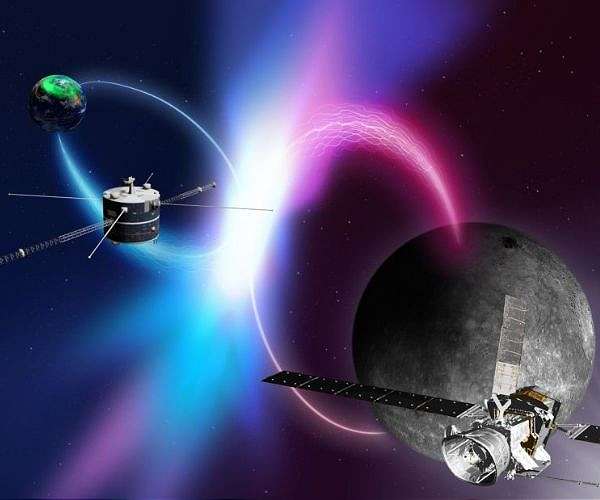
illustration only

Mercury and Earth chorus waves show shared plasma behavior across magnetospheres

by Riko Seibo
Tokyo, Japan (SPX) Jan 21, 2026
An international team has shown that natural electromagnetic chorus waves, long known in Earths magnetosphere, also occur in Mercurys much weaker magnetosphere with strikingly similar frequency behavior. The work uses coordinated observations from the BepiColombo Mercury Magnetospheric Orbiter Mio during six Mercury flybys between 2021 and 2025, together with decades of data from Earths GEOTAIL satellite.

Chorus emissions are plasma waves generated when magnetospheric electrons interact resonantly with electromagnetic waves, producing characteristic rising and falling tones in the audible frequency range often described as birdsong. On Earth, these emissions play a key role in forming and depleting the Van Allen radiation belts and can interfere with radio communications, making their detailed properties important for space weather forecasting and satellite radiation protection strategies.

GEOTAIL, launched jointly by Japan and the United States in 1992, spent more than 30 years observing electromagnetic waves and plasma in Earths magnetotail, building a long-term reference data set on chorus generation, spatial distribution, and frequency behavior. Until recently, similar processes at Mercury were largely unconstrained because the planet has a magnetic field only about one hundredth as strong as Earths and an extremely tenuous atmosphere.

The Plasma Wave Investigation instrument aboard BepiColombos Mio spacecraft has now recorded natural plasma waves in the audible range during multiple close Mercury encounters. These measurements suggested that chorus-like emissions and associated low-energy, or cold, electrons could exist in Mercurys magnetosphere, contrary to earlier expectations that such electrons would be absent around an almost airless planet.

Researchers deliberately applied decades of knowledge from Earths magnetosphere to interpret the new Mercury data. GEOTAILs vantage point in the distant magnetotail, roughly ten Earth radii from the planet, provides conditions that resemble the compact magnetosphere of Mercury, making it an effective benchmark for comparative analysis of plasma wave phenomena.

Quantitative comparison showed that Mercurys plasma wave signatures match key properties of chorus emissions observed with GEOTAIL at Earth. The team identified rapid rising and falling frequency sweeps, indicating nonlinear coupling between electrons and waves, as well as a similar spatial concentration of emissions in the dawnside sector where energetic electrons preferentially stream through the magnetosphere.

These results demonstrate that the mechanisms responsible for generating chorus emissions can operate in very different planetary environments and magnetic field strengths, revealing a universal plasma process across magnetospheres. The findings also support earlier theoretical work from 2025 that predicted the presence of cold electrons around Mercury based on wave analyses, and they highlight new priorities for Mio once it begins orbital operations in 2027.

Previous studies have established that at Earth, hazardous radiation belt electrons can be efficiently accelerated by chorus waves, posing risks to spacecraft and satellites. Extending this understanding to Mercury enhances the broader framework for space weather prediction and radiation protection in the inner solar system and for missions that operate in strong particle environments.

Although Mercurys weak magnetic field was thought to preclude the formation of stable radiation belts, the confirmed presence of chorus emissions with clear frequency variation indicates that efficient electron acceleration processes are active there as well. Mio is scheduled to enter Mercury orbit in late 2026, enabling detailed investigations of how these emissions vary with location, how they interact with cold electron populations, and how they shape the local space environment.

The new observations open a path to systematic comparative studies of auroral and radiation processes at multiple planets, including Mars, Jupiter, and Saturn. By examining how chorus emissions, cold electrons, and magnetospheric structure interplay across different planetary systems, scientists aim to build a unified picture of universal plasma wave phenomena in planetary space environments.

Credits for the visual materials used in this research include Mercury imagery from NASA, the Johns Hopkins University Applied Physics Laboratory, and the Carnegie Institution of Washington, BepiColombo spacecraft imagery from ESA, and Earth imagery from NASA.

Research Report:Nonlinear spatiotemporal signatures of whistler-mode wave activity around Mercury during six flybys of BepiColombo mission

Related Links
Kanazawa University
News Flash at Mercury
Mars News and Information at MarsDaily.com
Lunar Dreams and more

Subscribe Free To Our Daily Newsletters
Tweet

RELATED CONTENT
MERCURY RISING
BepiColombo nears Mercury orbital arrival after seven year journey
Paris, France (SPX) Nov 25, 2025
The ESA and JAXA BepiColombo mission is entering its final year of approach to Mercury, on track to reach orbit in November 2026 after launching in October 2018. The dual-spacecraft mission has already completed one flyby of Earth, two of Venus, and six of Mercury, collecting solar activity and magnetosphere data en route. Throughout its cruise, BepiColombo measured planetary magnetic environments, monitoring the Sun's influence on radio signals as well as Mercury's changing magnetic bubble. The m ... read more

MERCURY RISING
NASA astronaut stuck in space for nine months retires

Tourists hit record in Japan, despite plunge from China

What happens when fire ignites in space? 'A ball of flame'

ISS astronauts splash down on Earth after first-ever medical evacuation

MERCURY RISING
NASA moves moon rocket to launch pad ahead of Artemis 2 mission

Starfighters completes key wind tunnel campaign for STARLAUNCH 1 air launch vehicle

Interstellar raises major Series F funding to expand launch and satellite business

Major equity deal backs Gilmour Space expansion of sovereign launch capability

MERCURY RISING
Ancient deltas reveal vast Martian ocean across northern hemisphere

Tiny Mars' big impact on Earth's climate

The electrifying science behind Martian dust

Sandblasting winds sculpt Mars landscape

MERCURY RISING
China prepares offshore test base for reusable liquid rocket launches

Retired EVA workhorse to guide China's next-gen spacesuit and lunar gear

Tiangong science program delivers data surge

China tallies record launch year as lunar and asteroid plans advance

MERCURY RISING
Aerospacelab expands Pulsar navigation constellation work with new Xona satellite order

ThinkOrbital raises seed funding to advance orbital defense and construction systems

China outlines mega constellations in ITU satellite filings

Multiple satellite filings demonstrate transparency, responsibility and ambition: China Daily editorial

MERCURY RISING
Seismic networks offer new way to track space junk reentering atmosphere

Comtech wins multi-million dollar follow-on contract for civil space components

China lofts AlSat 3A imaging craft for Algeria

China starts large scale production of T1000 carbon fiber

MERCURY RISING
Hidden magma oceans could shield rocky exoplanets from harmful radiation

Cosmic dust chemistry forges peptide building blocks in deep space

Hidden magma oceans could shield rocky exoplanets from harmful radiation

Icy cycles may have driven early protocell evolution

MERCURY RISING
Computer models let scientists peer into the mystery beneath Jupiter's clouds

Polar weather on Jupiter and Saturn hints at the planets' interior details

Europa ice delamination may deliver nutrients to hidden ocean

Birth conditions fixed water contrast on Jupiters moons


The content herein, unless otherwise known to be public domain, are Copyright 1995-2026 - SpaceDaily.com. All websites are published in Australia and are solely subject to Australian law and governed by Fair Use principals for news reporting and research purposes. AFP, UPI and IANS news wire stories are copyright Agence France-Presse, United Press International and Indo-Asia News Service. ESA news reports are copyright European Space Agency. All NASA sourced material is public domain. Additional copyrights may apply in whole or part to other bona fide parties. All articles labeled "by Staff Writers" include reports supplied to Space Media Network by industry news wires, PR agencies, corporate press officers and the like. Such articles are individually curated and edited by Space Media Network staff on the basis of the report's information value to our industry and professional readership. Advertising does not imply endorsement, agreement or approval of any opinions, statements or information provided by Space Media Network on any Web page published or hosted by Space Media Network. General Data Protection Regulation (GDPR) Statement Our advertisers use various cookies and the like to deliver the best ad banner available at one time. All network advertising suppliers have GDPR policies (Legitimate Interest) that conform with EU regulations for data collection. By using our websites you consent to cookie based advertising. If you do not agree with this then you must stop using the websites from May 25, 2018. Privacy Statement. Additional information can be found here at About Us.
Subscribe Free To Our Daily Newsletters