





The Ring Nebula, also known as Messier 57 and NGC 6720, is a planetary nebula in the constellation Lyra formed when a Sun-like star expelled its outer layers as it neared the end of its life. Located about 2,600 light years, or 787 parsecs, from Earth, the nebula is thought to have formed roughly 4,000 years ago and has become a benchmark target for studying how stars shed material into interstellar space.
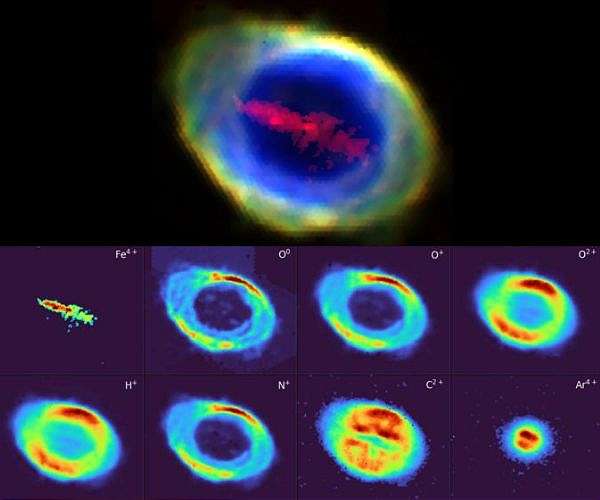
The newly discovered iron cloud appears as a narrow bar or strip that sits entirely within the nebula's bright inner shell. Its length is about 500 times the radius of Pluto's orbit around the Sun, and analysis of the emission indicates that the total mass of iron atoms in the bar is similar to the mass of the planet Mars.
Researchers detected the bar using the Large Integral Field Unit (LIFU) mode of the WHT Enhanced Area Velocity Explorer, or WEAVE, a new instrument on the 4.2 metre William Herschel Telescope on La Palma in the Canary Islands. The LIFU uses hundreds of optical fibres to obtain spectra at every point across the nebula, enabling scientists to map its chemical make-up and physical conditions in unprecedented detail across all optical wavelengths.
By assembling spectra from the entire face of the Ring Nebula, the team can generate images at individual wavelengths corresponding to specific ions and emission lines. This technique revealed that the familiar outer ring is dominated by light from three different ions of oxygen, while the central bar is highlighted by emission from four-times-ionised iron atoms, seen in the [Fe V] spectral line at a wavelength of 4227 angstroms, or 422.7 nanometres.
In the composite emission-line image, the bar-shaped [Fe V] emission appears in red, along with auroral [O I] 6300 angstrom emission from neutral oxygen in the main ring. Emission from singly ionised oxygen, [O II] at 3727 angstroms, appears in green, and emission from doubly ionised oxygen, [O III] at 4959 angstroms, appears in blue, together tracing the complex ionisation structure of the nebula.
The image constructed from these WEAVE/LIFU data spans 120 by 110 arcseconds on the sky, corresponding to physical dimensions of about 95,000 by 87,000 astronomical units at the distance of the Ring Nebula. One astronomical unit is the mean distance from the Sun to the Earth, and the immense scale of the structure underlines how much material a Sun-like star can shed as it evolves.
Lead author Roger Wesson of University College London and Cardiff University said WEAVE has allowed the team to observe the Ring Nebula in a significantly more detailed way than previous instruments. By obtaining a continuous spectrum across the nebula, they can derive the chemical composition at each position and create tailored images that isolate different ions and physical processes.
When the researchers processed the WEAVE data and examined the emission-line images, the iron feature immediately stood out as a distinct bar of ionised plasma cutting across the nebula's interior. Despite decades of observations with telescopes including the Hubble Space Telescope and the James Webb Space Telescope, this iron bar had gone unnoticed because earlier instruments lacked the combination of spectral coverage and spatial sampling now provided by WEAVE's LIFU.
How the iron bar formed remains an open question, and the team is now planning more detailed observations to investigate possible origins. One scenario is that the feature records an asymmetry in the way the progenitor star expelled its outer layers, perhaps guided by magnetic fields or a companion star, leaving a dense, iron-rich structure along a preferred direction.
Another possibility, which the researchers describe as particularly intriguing, is that the iron bar represents plasma created by the vaporisation of a rocky planet that was engulfed as the star expanded into a red giant. If confirmed, this would offer a rare direct view of the destruction of a planetary body and provide clues to the fate of planets in systems like the Solar System when their host stars evolve.
Co-author Janet Drew of UCL Physics and Astronomy said that pinning down the bar's origin will require knowing whether other chemical elements are concentrated alongside the iron. Detecting a specific pattern of co-existing elements would help distinguish between models involving stellar ejection processes and those involving disrupted planetary material.
To that end, the team plans follow-up observations of the Ring Nebula with WEAVE's LIFU operating at higher spectral resolution. Higher resolution spectra will allow the astronomers to resolve finer velocity structures and subtle line ratios, offering insights into the bar's temperature, density and motion relative to the surrounding gas.
WEAVE is designed to carry out eight major spectroscopic surveys over a five year period, covering targets from nearby white dwarf stars to distant galaxies in the early Universe. The Stellar, Circumstellar and Interstellar Physics component of the WEAVE survey, led by Professor Drew, includes observations of many ionised nebulae across the northern Milky Way, using the same techniques applied to the Ring Nebula.
Team members expect that the Ring Nebula's iron bar is unlikely to be unique and anticipate discovering similar features in other planetary nebulae as the WEAVE surveys progress. Identifying additional examples would allow researchers to determine how common such iron-dominated structures are, and whether they arise primarily from stellar evolution processes or from interactions with planetary systems.
WEAVE Project Scientist Scott Trager of the University of Groningen said the discovery highlights the instrument's capabilities for revealing new structures in well-known astronomical objects. The detection of the iron bar in one of the northern sky's most famous planetary nebulae underscores the scientific potential of combining wide spectral coverage with integral-field spectroscopy on a large telescope.
Research Report: WEAVE imaging spectroscopy of NGC 6720: an iron bar in the Ring
Related Links
University College London
Stellar Chemistry, The Universe And All Within It
| Subscribe Free To Our Daily Newsletters |
| Subscribe Free To Our Daily Newsletters |








