





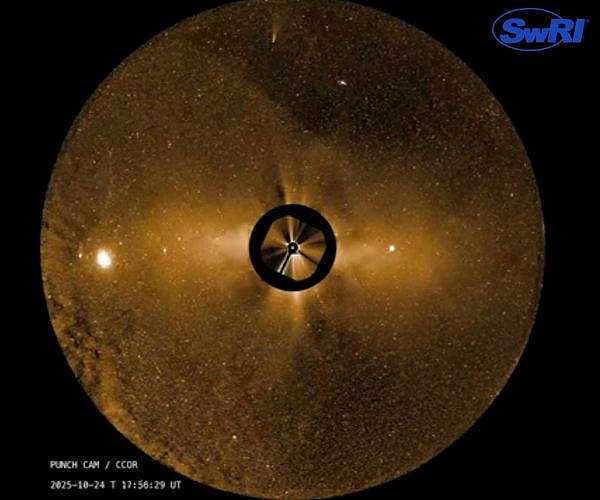
SwRI's Dr. Craig DeForest outlined the mission's early achievements during a media roundtable at the AGU25 conference on December 16, highlighting how the four-spacecraft constellation observes the outer solar atmosphere as it becomes the solar wind and follows its interaction with objects across the sky.
"PUNCH imaging gives us a unique view on the pageantry of the planets and reveals the grandeur of our Sun in the cosmos," said DeForest, PUNCH mission principal investigator. "Seeing solar activity sweeping across the moon, planets and even passing comets gives us a sense of place in our solar system. It reminds me of the impact of the blue marble image of the Apollo era, though PUNCH data is more of a golden fishbowl view of our neighborhood in the cosmos. We live here."
Since launch on March 11, the four small suitcase-sized PUNCH spacecraft have been phased to operate as a single virtual instrument spanning about 8,000 miles, enabling continuous coverage of the Sun's outer atmosphere as it transitions into the solar wind. The observatory has already tracked large coronal mass ejections (CMEs) as they loft solar particles across the sky and pass over Earth.
"PUNCH can actually show us directly the violence of space weather as clouds of electrons cross the solar system," DeForest said. "Viewing the corona and solar wind as a single system provides a big-picture perspective essential to helping scientists better understand and predict space weather. This forecasting is critical to protecting astronauts, space satellites and electric grid technology from these events."
Wide Field Imagers developed and led by SwRI fly on three of the four PUNCH spacecraft, where they collect high-resolution images that capture entire CMEs with greater detail than was previously achievable. These instruments are optimized to detect the faint outermost regions of the Sun's atmosphere and the solar wind, while the mission team works to incorporate data from the coronagraph, the Narrow Field Imager supplied by the Naval Research Laboratory on the fourth spacecraft, into the combined data products.
"The NASA Small Explorer's mission had a bird's-eye view of the CME in early November that lit up skies across the nation with colorful aurora," DeForest said. "And we've discovered some incredible bonus science that PUNCH performs, tracking comets and other objects. We were able to track the third identified interstellar comet 3I/ATLAS as it traveled through the inner solar system while bright sunlight rendered it invisible to other telescopes and space assets."
PUNCH has also carried out what may be the longest continuous observation of a comet to date, following Comet SWAN every four minutes for nearly 40 days, from August 25 to October 2, and clearly recording its passage. The mission is additionally monitoring Comet Lemmon, which made its closest approach to Earth on October 21.
SwRI's Solar System Science and Exploration Division leads the PUNCH mission and operates the four spacecraft from its facilities in Boulder, Colorado, as part of the Institute's Space Sector based in San Antonio, Texas. Mission management is provided by the Explorers Program Office at NASA's Goddard Space Flight Center in Greenbelt, Maryland, for the Science Mission Directorate at NASA Headquarters in Washington.
Related Links
Southwest Research Institute
Solar Science News at SpaceDaily
| Subscribe Free To Our Daily Newsletters |
| Subscribe Free To Our Daily Newsletters |








