

24/7 Space News
EXO WORLDS
RISTRETTO spectrograph cleared for Proxima b atmospheric hunt
illustration only

RISTRETTO spectrograph cleared for Proxima b atmospheric hunt

by Robert Schreiber
Geneva, Switzerland (SPX) Dec 09, 2025

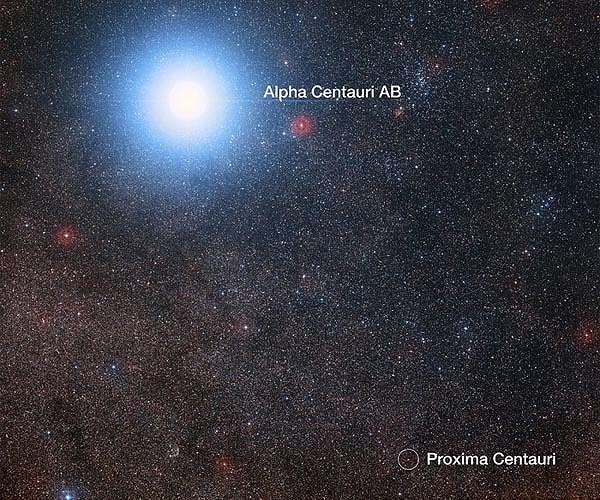
The RISTRETTO project at the University of Geneva has reached a key stage, with several core elements of its high-precision spectrograph now prototyped and tested for observations of the nearby exoplanet Proxima b. The instrument is designed to study the faint reflected light of this Earth-sized planet, which orbits Proxima Centauri at a temperature compatible with liquid water but remains outshone by its host star by a factor of about 10 million. Two new studies in Astronomy and Astrophysics present both the instrumental developments and simulations that examine how RISTRETTO can detect Proxima b and search for signatures of oxygen or water in its atmosphere.

Large distances between stars make it difficult for astronomers to resolve exoplanets as distinct sources from their host stars. Only a small number of planetary systems can currently be separated by major observatories such as the European Southern Observatory's Very Large Telescope. The extreme brightness contrast between a star like Proxima Centauri and its planet further complicates the task, with the challenge described as comparable to identifying the glow of a firefly orbiting a lighthouse in New York as seen from the summit of the Matterhorn.

Researchers in the Department of Astronomy at the University of Geneva are addressing this problem through the RISTRETTO high-precision spectrograph, which will operate on the VLT using new instrumental techniques. To suppress the star's light, the team has developed a coronagraphic Integral Field Unit that covers the entrance to the instrument with an array of hexagonal lenses. Optical fibers route light from these microlenses into the spectrograph, where careful control of the light's propagation allows a partial extinction of the stellar signal and improves access to the planet's contribution.

"We have developed a fully functional prototype that we have just tested at the Geneva Observatory," comments Nicolas Blind, research engineer in the Department of Astronomy at the UNIGE Faculty of Science and lead author of the paper on this cutting-edge instrumental development. "The performance meets our expectations and confirms our initial decision to develop this technology for RISTRETTO."

This coronagraphic advance builds on earlier work on another core subsystem, the extreme adaptive optics. The XAO system corrects for distortions introduced by Earth's atmosphere, which would otherwise blur images and reduce the contrast needed to separate the planet from the star. Several XAO components were validated during tests at the Haute-Provence Observatory in early October, demonstrating that the system can deliver the image quality required for RISTRETTO.

Using these technical results, the team then constructed detailed computer models of RISTRETTO's performance on the VLT to assess its ability to detect Proxima b, which is similar to Earth in size and temperature. "We incorporated synthetic observations of the star Proxima and its planet into our RISTRETTO simulation," says Maddalena Bugatti, a doctoral student in the Department of Astronomy at the UNIGE Faculty of Science and lead author of the research article on these simulations. "With only 55 hours of observations with the VLT, we can detect the planet, and in 85 hours we can tell if there is oxygen or water in the planet's atmosphere."

The project recently received financial backing from Swiss watchmaker Swatch, funding that will support completion of the high-precision instrument ahead of its planned installation on the VLT in 2030. RISTRETTO is expected to act as a pathfinder for second-generation instruments on the Extremely Large Telescope, the 39-meter facility now under construction in Chile, by demonstrating techniques such as high-dispersion coronagraphy combined with extreme adaptive optics for the study of nearby rocky exoplanets.

"These initial successes and results are very encouraging," says Christophe Lovis, associate professor in the Department of Astronomy at the UNIGE Faculty of Science, head of the RISTRETTO project and co-author of the various studies. "The next steps include testing the spectrograph in a clean room and then in real observation conditions with the 152 cm telescope at the Haute-Provence Observatory, as well as the complete design of the extreme adaptive optics."

Research Report:Simulating RISTRETTO: Proxima b detectability in reflected light

Related Links
Universite de Geneve
Lands Beyond Beyond - extra solar planets - news and science
Life Beyond Earth

Subscribe Free To Our Daily Newsletters
Tweet

RELATED CONTENT
The following news reports may link to other Space Media Network websites.
EXO WORLDS
SPHERE debris disk survey maps hidden asteroid and comet belts in young planetary systems
Berlin, Germany (SPX) Dec 05, 2025
Observations with the SPHERE instrument on ESO's Very Large Telescope have produced a large gallery of debris disks around nearby young stars, revealing where unseen asteroid- and comet-scale bodies are colliding and generating dust. Gael Chauvin, SPHERE project scientist and co-author, said: "This data set is an astronomical treasure. It provides exceptional insights into the properties of debris disks, and allows for deductions of smaller bodies like asteroids and comets in these systems, which are im ... read more

EXO WORLDS
Why Practical Skills Matter More Than Ever in an Unpredictable World

Micro nano robots aim to cut carbon buildup in closed life support systems

ISS to change commanders before Soyuz crew leaves orbit

Lodestar Space wins SECP support to advance AI satellite awareness system

EXO WORLDS
European rocket puts S.Korean satellite in orbit

Space shuttle design study maps path to breakthrough inventions

Sea based rocket net recovery platform enters service for Chinese reusable launchers

LandSpace reviews booster loss after Zhuque-3 reusable rocket test

EXO WORLDS
Martian butterfly crater reveals low angle impact and buried lava history

Martian sound study models acoustic signals in Jezero crater

Bacterial partnership offers pathway to produce Mars regolith bricks for future habitats

Chinese team runs long term Martian dust cycle simulation with GoMars model

EXO WORLDS
Wenchang spaceport hits record cadence with double-digit launches in 2025

China consolidates new commercial space regulator and industry roadmap

Beijing space lab targets orbital data centers for AI era

China supports private space firms to expand global reach

EXO WORLDS
Applied Aerospace and PCX create US flight and space hardware group

EIB launches Space TechEU finance program for European space sector

Satellite surge threatens space telescopes, astronomers warn

MDA Space plans C250 million senior unsecured note issue maturing 2030

EXO WORLDS
Digital twin successfully launched and deployed into space

Power grid agreement to supply energy for Loft Orbital satellites

Shenzhou XX capsule to return without crew after debris incident

Orbit Fab to lead ESA backed ASTRAL refuelling demo in orbit

EXO WORLDS
Subaru OASIS survey uncovers massive planet and brown dwarf

The bacteria that wont wake up found in spacecraft cleanrooms

Supernova mixing traced as source of key life elements

NASA backs WHOI effort to read organic signals from ocean worlds

EXO WORLDS
SwRI links Uranus radiation belt mystery to solar storm driven waves

Looking inside icy moons

Saturn moon mission planning shifts to flower constellation theory

Could these wacky warm Jupiters help astronomers solve the planet formation puzzle?

Subscribe Free To Our Daily Newsletters


The content herein, unless otherwise known to be public domain, are Copyright 1995-2024 - Space Media Network. All websites are published in Australia and are solely subject to Australian law and governed by Fair Use principals for news reporting and research purposes. AFP, UPI and IANS news wire stories are copyright Agence France-Presse, United Press International and Indo-Asia News Service. ESA news reports are copyright European Space Agency. All NASA sourced material is public domain. Additional copyrights may apply in whole or part to other bona fide parties. All articles labeled "by Staff Writers" include reports supplied to Space Media Network by industry news wires, PR agencies, corporate press officers and the like. Such articles are individually curated and edited by Space Media Network staff on the basis of the report's information value to our industry and professional readership. Advertising does not imply endorsement, agreement or approval of any opinions, statements or information provided by Space Media Network on any Web page published or hosted by Space Media Network. General Data Protection Regulation (GDPR) Statement Our advertisers use various cookies and the like to deliver the best ad banner available at one time. All network advertising suppliers have GDPR policies (Legitimate Interest) that conform with EU regulations for data collection. By using our websites you consent to cookie based advertising. If you do not agree with this then you must stop using the websites from May 25, 2018. Privacy Statement. Additional information can be found here at About Us.






