





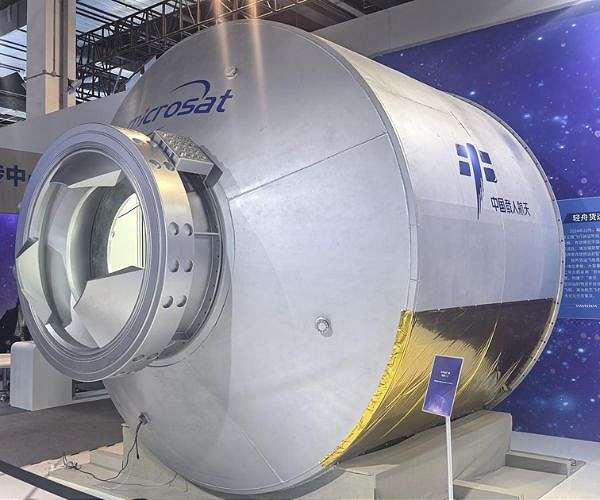
Designed with a focus on low cost, high reliability, high adaptability and high intelligence, the compact spacecraft delivers expanded cargo capabilities for China's crewed orbital complex.
The spacecraft weighs approximately 5 tonnes. Its cargo module has a stowage volume of 9 cubic meters within a total internal volume of 27 cubic meters. The module uses a four-tier rack system with 40 standard slots that can be configured for crew supplies and scientific equipment to meet space station logistics demands.
An intelligent onboard cargo management system enables automated identification, tracing and management of goods. Astronauts can locate items through voice commands, which improves retrieval efficiency and reduces in-orbit workload.
For special supplies, the spacecraft is equipped with modular space refrigerators, each providing 60 liters of cold-chain capacity. The units can be grouped up to a combined 300 liters, and precise temperature control keeps sensitive cargo within required limits during transport.
Qingzhou adopts an integrated single-module design that reduces external dimensions, improves internal space utilization and maintains compatibility with multiple launch vehicles to support rapid deployment.
The spacecraft's launch system has been developed as an optimized, integrated transportation solution, with a current transportation cost of about 100,000 yuan, or 14,134 dollars, per kilogram of payload, a figure expected to decrease with mass production and expanded commercial cooperation.
Related Links
Chinese Academy of Sciences Innovation Academy for Microsatellites
The Chinese Space Program - News, Policy and Technology
China News from SinoDaily.com
| Subscribe Free To Our Daily Newsletters |
| Subscribe Free To Our Daily Newsletters |







