24/7 Space News
SOLAR SCIENCE
Sun boundary map tracks shifting Alfven surface over solar cycle
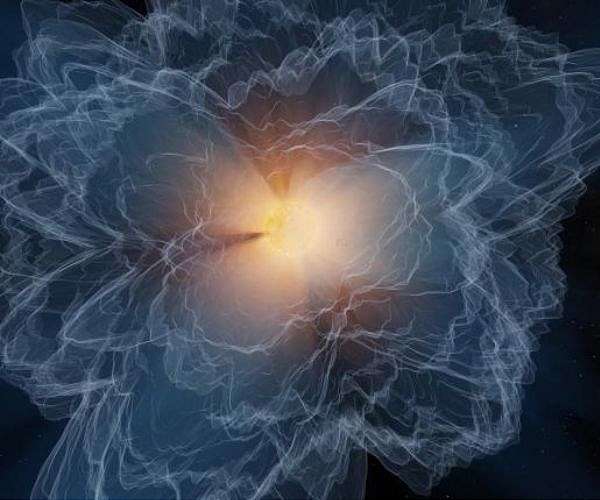
illustration only

Sun boundary map tracks shifting Alfven surface over solar cycle

by Clarence Oxford
Cambridge, MA (SPX) Dec 14, 2025

Astronomers have assembled the first continuous, two-dimensional maps of the outer edge of the Sun's atmosphere, tracing the boundary where the solar wind escapes the Sun's magnetic control. By combining these global maps with close-up measurements, researchers at the Center for Astrophysicshysics | Harvard and Smithsonian report that this boundary expands and becomes more irregular and spiky as solar activity increases, with implications for models of how the Sun influences Earth and other stars.

The team mapped the region known as the Alfven surface, where the outward flow of the solar wind exceeds the speed at which magnetic waves can travel, creating a practical outer edge to the Sun's atmosphere. Beyond this point, escaping material cannot fall back, providing a natural laboratory for studying how solar activity shapes conditions throughout the solar system, including effects on space weather and technology near Earth.

To build and test the maps, scientists used NASA's Parker Solar Probe, which repeatedly flies deep into the Sun's atmosphere, together with measurements from near-Earth spacecraft. The study shows that as the Sun moves toward the active phase of its roughly 11-year cycle, the Alfven surface grows in size, becomes rougher, and develops pronounced spikes.

"Parker Solar Probe data from deep below the Alfven surface could help answer big questions about the Sun's corona, like why it's so hot. But to answer those questions, we first need to know exactly where the boundary is," said Sam Badman, an astrophysicist at the CfA and the paper's lead author. The team directly validated the new maps using Parker's closest passes through the Sun's atmosphere and reported the results in Astrophysical Journal Letters.

Using Parker's Solar Wind Electrons Alphas and Protons (SWEAP) instrument, developed at the CfA with the University of California, Berkeley, researchers collected data from deep within the sub-Alfvenic region near the Sun. Michael Stevens, a CfA astronomer and principal investigator for SWEAP, said, "This work shows without a doubt that Parker Solar Probe is diving deep with every orbit into the region where the solar wind is born. We are now headed for an exciting period where it will witness firsthand how those processes change as the Sun goes into the next phase of its activity cycle."

Badman noted that until now scientists could only estimate the Sun's outer boundary from afar with limited ways to verify those estimates. "Before, we could only estimate the sun's boundary from far away without a way to test if we got the right answer, but now we have an accurate map that we can use to navigate it as we study it," Badman said, adding that repeated mapping allows the team to track boundary changes and compare them directly with close-up measurements.

Earlier work suggested that the Alfven surface shifts with the solar cycle, moving outward and becoming more structured and complex during solar maximum and shrinking and smoothing during solar minimum. The new maps confirm that as solar activity rises, the shape and height of this boundary increase and become more sharply structured, matching previous predictions.

The data set provides new constraints on the physics operating deep in the corona and can feed into improved solar wind and space weather models. These enhanced models should refine forecasts of how solar eruptions and changing solar wind conditions propagate through interplanetary space and affect planetary environments.

The results also inform studies of other stars, where similar processes may govern how stellar winds evolve and interact with orbiting planets. Understanding how the Sun's boundary changes over time can help researchers assess how stellar activity influences planetary atmospheres and potential habitability across the galaxy.

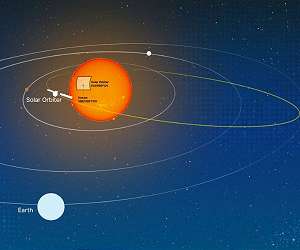
The project relied on a coordinated multi-spacecraft strategy that combined Parker's close passes with more distant observations from missions such as Solar Orbiter, a joint NASA-ESA project, and NASA's Wind spacecraft. The team plans to repeat the campaign during the next solar minimum to capture how the Alfven surface evolves over an entire solar cycle.

Research Report:Multi-spacecraft measurements of the evolving geometry of the Solar Alfven surface over half a solar cycle

Related Links
Center for Astrophysics | Harvard and Smithsonian
Solar Science News at SpaceDaily

Subscribe Free To Our Daily Newsletters
Tweet

RELATED CONTENT
The following news reports may link to other Space Media Network websites.
SOLAR SCIENCE
Stereo solar campaign links Inouye and Solar Orbiter data on tiny 'campfires'
Los Angeles CA (SPX) Dec 12, 2025
The Sun is not just a glowing ball in the sky. From large magnetic loops hundreds of times larger than Earth, to tiny features that blink in and out of existence, our home star is far more dynamic than most of us realize. According to Krzysztof Barczynski, a solar physicist who worked on this research while at ETH Zurich and is now at PMOD/WRC in Davos, "the Sun is an incredibly active and dynamic place, filled with countless tiny features that, despite their small size, play an important role in shapin ... read more

SOLAR SCIENCE
Lodestar Space wins SECP support to advance AI satellite awareness system

ISS to change commanders before Soyuz crew leaves orbit

Micro nano robots aim to cut carbon buildup in closed life support systems

NASA extends ISS National Lab management contract through 2030

SOLAR SCIENCE
LandSpace reviews booster loss after Zhuque-3 reusable rocket test

UK plasma thruster test positions Pulsar Fusion for larger satellite propulsion

Neutron Hungry Hippo fairing completes qualification ahead of first launch

EU dismisses 'completely crazy statements' after Musk attack

SOLAR SCIENCE
Martian sound study models acoustic signals in Jezero crater

NASA JPL Unveils Rover Operations Center for Moon, Mars Missions

Maven stays silent after routine pass behind Mars

Martian butterfly crater reveals low angle impact and buried lava history

SOLAR SCIENCE
Experts at Hainan symposium call for stronger global space partnership

Foreign satellites ride Kinetica 1 on new CAS Space mission

Triple Long March launches mark record day for Chinese space program

China prepares Qingzhou cargo ship for low cost resupply flights

SOLAR SCIENCE
Beyond Gravity positions new modular satellite platform for European LEO missions

From 1Mbps to 200: Starlink's Gaming Speed Revolution Explained

Private capital targets mission-critical software power and platforms in new space economy

MDA Space plans C250 million senior unsecured note issue maturing 2030

SOLAR SCIENCE
What is the appeal of playing space-themed video games?

ONE Bow River backs Odyssey Space Research growth in flight software and mission engineering

D-Orbit launches dual orbital transportation missions, passes 200-payload milestone

Space operators urged to share costs of clearing orbital debris

SOLAR SCIENCE
Subaru OASIS survey uncovers massive planet and brown dwarf

The bacteria that wont wake up found in spacecraft cleanrooms

Supernova mixing traced as source of key life elements

RISTRETTO spectrograph cleared for Proxima b atmospheric hunt

SOLAR SCIENCE
Uranus and Neptune may be rock rich worlds

SwRI links Uranus radiation belt mystery to solar storm driven waves

Looking inside icy moons

Saturn moon mission planning shifts to flower constellation theory

Subscribe Free To Our Daily Newsletters


The content herein, unless otherwise known to be public domain, are Copyright 1995-2024 - Space Media Network. All websites are published in Australia and are solely subject to Australian law and governed by Fair Use principals for news reporting and research purposes. AFP, UPI and IANS news wire stories are copyright Agence France-Presse, United Press International and Indo-Asia News Service. ESA news reports are copyright European Space Agency. All NASA sourced material is public domain. Additional copyrights may apply in whole or part to other bona fide parties. All articles labeled "by Staff Writers" include reports supplied to Space Media Network by industry news wires, PR agencies, corporate press officers and the like. Such articles are individually curated and edited by Space Media Network staff on the basis of the report's information value to our industry and professional readership. Advertising does not imply endorsement, agreement or approval of any opinions, statements or information provided by Space Media Network on any Web page published or hosted by Space Media Network. General Data Protection Regulation (GDPR) Statement Our advertisers use various cookies and the like to deliver the best ad banner available at one time. All network advertising suppliers have GDPR policies (Legitimate Interest) that conform with EU regulations for data collection. By using our websites you consent to cookie based advertising. If you do not agree with this then you must stop using the websites from May 25, 2018. Privacy Statement. Additional information can be found here at About Us.