24/7 Space News
EARTH OBSERVATION
New European Infrared Sounder Maps Atmosphere In Three Dimensions
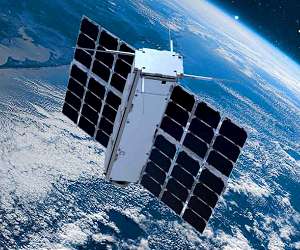
illustration only

New European Infrared Sounder Maps Atmosphere In Three Dimensions

by Robert Schreiber
Berlin, Germany (SPX) Jan 28, 2026

The first images from Europe s pioneering meteorological infrared sounder were unveiled at the EU Space Conference in Brussels, marking a significant advance in observing the atmosphere in three dimensions ahead of severe weather.

The new data come from the Infrared Sounder instrument on Meteosat Third Generation Sounder 1, the first European geostationary satellite to carry a hyperspectral infrared sounding capability designed specifically for meteorology.

From its geostationary orbit, the Infrared Sounder scans the atmosphere over Europe and adjacent regions every 30 minutes across nearly 2,000 narrow infrared channels, retrieving vertical profiles of temperature, humidity and trace gases throughout the troposphere and lower stratosphere.

These three dimensional measurements allow meteorologists to detect subtle changes in temperature and moisture that signal atmospheric instability, often hours before clouds develop, providing earlier insight into where thunderstorms and other hazardous weather systems may form.

The instrument provides continuous half hourly coverage at a spatial sampling of about 7 kilometers over Europe, supporting detailed monitoring of atmospheric dynamics on timescales relevant to nowcasting and short range numerical weather prediction.

In addition to its role in forecasting storms, the Infrared Sounder delivers information on key atmospheric pollutants and constituents, including ozone and related gases, improving air quality analysis and supporting services for public health and environmental monitoring in densely populated areas.

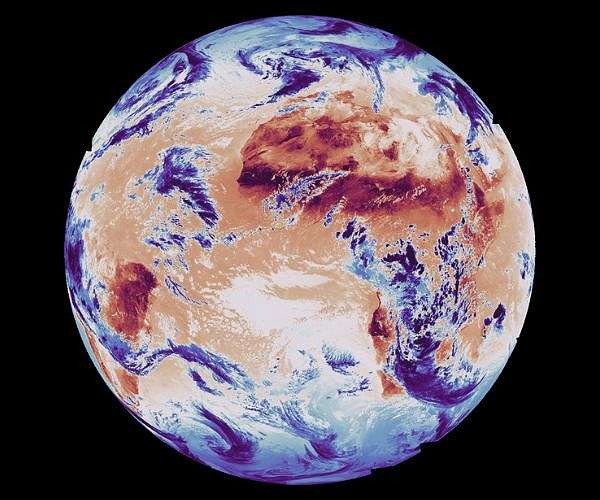
One of the first data products released is a full Earth disc image from a channel sensitive to surface temperature, acquired between 12:45 and 15:30 UTC on 15 November 2025, in which warm land and sea surfaces and cold cloud tops are clearly distinguished.

In this view, hot desert regions appear as red tones, temperate ocean areas show as intermediate colors, and high, cold cloud tops appear in blue hues, making frontal systems, storm clusters and cloud streets stand out clearly across the Atlantic, Europe and Africa.

Phil Evans, Director General of EUMETSAT, said that the new capability marks a step change for European meteorology, explaining that by revealing atmospheric instability in three dimensions before clouds form, the Infrared Sounder will allow forecasters to monitor how the atmosphere evolves and anticipate severe weather more effectively.

He noted that this type of hyperspectral sounding from geostationary orbit has previously been available only over parts of the globe, and that the Meteosat Third Generation system now brings this advanced observing capability to Europe and its neighboring regions on an operational basis.

Meteosat Third Generation Sounder 1 forms part of the wider MTG constellation, which also includes imaging satellites such as Meteosat 12 that provide high resolution visible and infrared images of cloud systems, as well as lightning imagers that track electrical activity inside storms.

Together, the sounder, imager and lightning instruments will allow meteorologists to follow the full life cycle of convective systems from the earliest signs of instability, through rapid development phases, to mature thunderstorms and severe weather outbreaks impacting Europe.

EUMETSAT operates MTG S1 from its control center in Darmstadt, Germany, where flight operations, mission planning and data processing are conducted in partnership with European national meteorological services.

The Infrared Sounder and the MTG S1 satellite platform were developed for the European Space Agency by a European industrial team led by Thales Alenia Space and OHB System AG, under requirements defined by EUMETSAT in close consultation with its member states.

The development involved advanced infrared detector technology, complex cryogenic cooling systems and high performance on board processing to handle the large data volumes generated by hyperspectral measurements from geostationary orbit.

EUMETSAT has made the first Infrared Sounder images and associated demonstration data products available through an online portal, allowing forecasters, researchers and technical users to explore how the new information can be integrated into weather, air quality and climate applications.

A dedicated press and media page offers downloadable versions of the first full disc images and explanatory material, while the main EUMETSAT website provides broader background on the Meteosat Third Generation programme, its objectives and its role in Europe s operational meteorological satellite system.

Over time, the Infrared Sounder time series will also support studies of climate variability and trends in atmospheric temperature and humidity, complementing data from polar orbiting sounders and contributing to long term climate data records.

Related Links
EUMETSAT
Earth Observation News - Suppiliers, Technology and Application

Subscribe Free To Our Daily Newsletters
Tweet

RELATED CONTENT
The following news reports may link to other Space Media Network websites.
EARTH OBSERVATION
Spire adds hyperspectral sounder and Myriota payloads on SpaceX Twilight launch
Los Angeles CA (SPX) Jan 13, 2026
Spire Global Inc has successfully launched nine satellites on SpaceXs Twilight mission from Vandenberg Space Force Base, further expanding its space based sensing and Internet of Things service portfolio. The mission carried Spires Hyperspectral Microwave Sounder, or HyMS, a compact satellite based demonstrator designed to advance global weather forecasting from orbit. HyMS is engineered to provide detailed internal views of the Earths atmosphere, capturing temperature, humidity and precipitation ... read more

EARTH OBSERVATION
NASA astronaut stuck in space for nine months retires

Tourists hit record in Japan, despite plunge from China

What happens when fire ignites in space? 'A ball of flame'

ISS astronauts splash down on Earth after first-ever medical evacuation

EARTH OBSERVATION
NASA moves moon rocket to launch pad ahead of Artemis 2 mission

Interstellar raises major Series F funding to expand launch and satellite business

Starfighters completes key wind tunnel campaign for STARLAUNCH 1 air launch vehicle

Major equity deal backs Gilmour Space expansion of sovereign launch capability

EARTH OBSERVATION
Ancient deltas reveal vast Martian ocean across northern hemisphere

Tiny Mars' big impact on Earth's climate

The electrifying science behind Martian dust

Sandblasting winds sculpt Mars landscape

EARTH OBSERVATION
Retired EVA workhorse to guide China's next-gen spacesuit and lunar gear

China prepares offshore test base for reusable liquid rocket launches

Tiangong science program delivers data surge

China tallies record launch year as lunar and asteroid plans advance

EARTH OBSERVATION
Aerospacelab expands Pulsar navigation constellation work with new Xona satellite order

ThinkOrbital raises seed funding to advance orbital defense and construction systems

China outlines mega constellations in ITU satellite filings

Multiple satellite filings demonstrate transparency, responsibility and ambition: China Daily editorial

EARTH OBSERVATION
Understanding USDT How Stablecoins Maintain Value in Volatile Markets

Top 7 Free Coin Value Apps for Android and iPhone

Seismic networks offer new way to track space junk reentering atmosphere

Comtech wins multi-million dollar follow-on contract for civil space components

EARTH OBSERVATION
Hidden magma oceans could shield rocky exoplanets from harmful radiation

Cosmic dust chemistry forges peptide building blocks in deep space

Hidden magma oceans could shield rocky exoplanets from harmful radiation

Metal rich winds detected in giant dusty cloud around distant star

EARTH OBSERVATION
Computer models let scientists peer into the mystery beneath Jupiter's clouds

Polar weather on Jupiter and Saturn hints at the planets' interior details

Europa ice delamination may deliver nutrients to hidden ocean

Birth conditions fixed water contrast on Jupiters moons

Subscribe Free To Our Daily Newsletters


The content herein, unless otherwise known to be public domain, are Copyright 1995-2024 - Space Media Network. All websites are published in Australia and are solely subject to Australian law and governed by Fair Use principals for news reporting and research purposes. AFP, UPI and IANS news wire stories are copyright Agence France-Presse, United Press International and Indo-Asia News Service. ESA news reports are copyright European Space Agency. All NASA sourced material is public domain. Additional copyrights may apply in whole or part to other bona fide parties. All articles labeled "by Staff Writers" include reports supplied to Space Media Network by industry news wires, PR agencies, corporate press officers and the like. Such articles are individually curated and edited by Space Media Network staff on the basis of the report's information value to our industry and professional readership. Advertising does not imply endorsement, agreement or approval of any opinions, statements or information provided by Space Media Network on any Web page published or hosted by Space Media Network. General Data Protection Regulation (GDPR) Statement Our advertisers use various cookies and the like to deliver the best ad banner available at one time. All network advertising suppliers have GDPR policies (Legitimate Interest) that conform with EU regulations for data collection. By using our websites you consent to cookie based advertising. If you do not agree with this then you must stop using the websites from May 25, 2018. Privacy Statement. Additional information can be found here at About Us.