24/7 Space News
SOLAR SCIENCE
Ionospheric gradients tracked in real time to sharpen space weather monitoring
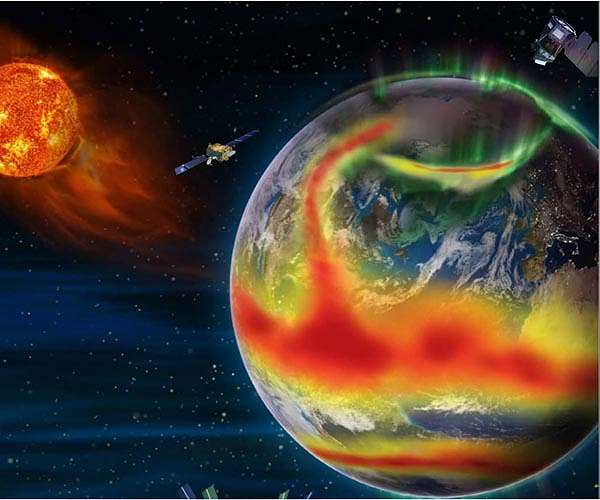
illustration only

Ionospheric gradients tracked in real time to sharpen space weather monitoring

by Riko Seibo
Tokyo, Japan (SPX) Dec 17, 2025
Accurate, real-time tracking of ionospheric structure is becoming critical for protecting satellite-based navigation and communications, and a new observation framework now directly measures how electron density changes across space and time. The method captures rapid and fine-scale ionospheric variations by estimating spatial and temporal gradients of total electron content, instead of relying on smoothed maps or sparse point measurements. It uses a stable configuration between geostationary satellites and ground-based receivers, which provides high spatial resolution and continuous temporal coverage without the need for interpolation or corrections for satellite motion. This makes it possible to observe ionospheric features from slow, daily evolution to fast-developing disturbances and yields a more detailed view of ionospheric behavior than many current monitoring systems.

The ionosphere is shaped by solar radiation, geomagnetic activity, and atmospheric processes, and its changing state can disrupt satellite navigation and radio links. Traditional monitoring approaches involve trade-offs: measurements from low-Earth and medium-Earth orbit satellites often lack continuous temporal coverage over one region, while ground-based instruments typically cover only limited areas. Global ionospheric maps offer broad coverage but tend to smooth out short-lived or fine-scale disturbances. These limitations mean that key processes such as equatorial ionization anomalies, plasma instabilities, and traveling ionospheric disturbances remain difficult to capture in real time with sufficient resolution. The new work responds to this need by designing a monitoring framework that resolves ionospheric dynamics across both space and time with much finer detail.

Researchers from Sun Yat-sen University and the Aerospace Information Research Institute of the Chinese Academy of Sciences, working with international partners, describe the approach in the journal Satellite Navigation in 2025. They report a fixed-geometry observation network that combines geostationary Earth orbit satellites with dense arrays of ground-based GNSS receivers. By focusing on ionospheric gradient measurements instead of isolated total electron content values, the study presents a way to follow ionospheric evolution with high and consistent spatiotemporal resolution.

The framework exploits the stationary geometry between geostationary satellites and ground receivers to build a dense grid of fixed ionospheric pierce points. These pierce points are linked by geometry-invariant baselines, and each baseline serves as an independent sensing unit. In this configuration, the team can directly estimate spatial and temporal gradients of total electron content with a spatial resolution finer than 0.25 degrees and a time step of 30 seconds. Unlike many conventional methods, the technique avoids errors introduced by satellite motion and by interpolation processes that can smooth out real structures.

Case studies show that the system can resolve complex ionospheric phenomena across multiple scales. During the daily evolution of the equatorial ionization anomaly, the method detects sharp gradient structures and follows the migration of the anomaly crests in near real time. For equatorial plasma bubbles, the framework identifies steep density gradients and nonlinear plasma instabilities, tracking their growth, drift, and eventual dissipation with high precision. It also characterizes large-scale traveling ionospheric disturbances during geomagnetic storms, including their propagation speeds, wavelengths, and interactions with background ionospheric structures. Together, these examples indicate that gradient-based monitoring can reveal both linear and nonlinear ionospheric processes that are often obscured in traditional observations.

"This framework fundamentally changes how we observe the ionosphere," said one of the study's authors. "By focusing on geometry-consistent gradient measurements, we can directly track how plasma structures evolve in space and time, rather than inferring them from sparse snapshots. This allows us to distinguish between gradual transport processes and rapidly developing instabilities, offering a much clearer physical interpretation of ionospheric behavior, especially during disturbed space weather conditions."

The authors describe the approach as a scalable and cost-effective foundation for ionospheric monitoring and real-time space weather diagnostics over continental scales. Its combination of high spatial resolution and continuous temporal coverage makes it useful for early warning of ionospheric disturbances that degrade GNSS positioning accuracy and communication reliability. Beyond operational services, the framework offers a tool for studying ionospheric coupling processes, validating numerical models of the ionosphere, and improving mapping functions used in navigation systems. As GNSS and geostationary satellite infrastructure continues to expand globally, this technique could support long-term, high-resolution ionospheric datasets that benefit both scientific research and practical space weather applications.

Research Report:Ionospheric gradient estimation using ground-based GEO observations for monitoring multi-scale ionospheric dynamics

Related Links
Aerospace Information Research Institute Chinese Academy of Sciences
Solar Science News at SpaceDaily

Subscribe Free To Our Daily Newsletters
Tweet

RELATED CONTENT
SOLAR SCIENCE
Sun boundary map tracks shifting Alfven surface over solar cycle
Cambridge, MA (SPX) Dec 14, 2025
Astronomers have assembled the first continuous, two-dimensional maps of the outer edge of the Sun's atmosphere, tracing the boundary where the solar wind escapes the Sun's magnetic control. By combining these global maps with close-up measurements, researchers at the Center for Astrophysicshysics | Harvard and Smithsonian report that this boundary expands and becomes more irregular and spiky as solar activity increases, with implications for models of how the Sun influences Earth and other stars. ... read more

SOLAR SCIENCE
ISS to change commanders before Soyuz crew leaves orbit

Lodestar Space wins SECP support to advance AI satellite awareness system

Micro nano robots aim to cut carbon buildup in closed life support systems

NASA extends ISS National Lab management contract through 2030

SOLAR SCIENCE
Musk signals plan to launch IPO for SpaceX

Southern Launch to host INNOSPACE missions from South Australian spaceports

Rocket Lab completes first dedicated JAXA mission with Electron launch

Neutron Hungry Hippo fairing completes qualification ahead of first launch

SOLAR SCIENCE
GoMars model simulates Martian dust storms to improve mission safety

NASA JPL Unveils Rover Operations Center for Moon, Mars Missions

Ancient Martian brines left bromine rich fingerprints in jarosite minerals

Maven stays silent after routine pass behind Mars

SOLAR SCIENCE
Experts at Hainan symposium call for stronger global space partnership

Foreign satellites ride Kinetica 1 on new CAS Space mission

Triple Long March launches mark record day for Chinese space program

China prepares Qingzhou cargo ship for low cost resupply flights

SOLAR SCIENCE
Smart modeling framework targets 6G spectrum chaos in space air and ground networks

K2 Space raises 250m to scale Mega class high power satellites

Private capital targets mission-critical software power and platforms in new space economy

Beyond Gravity positions new modular satellite platform for European LEO missions

SOLAR SCIENCE
Galactic Slots: Space-Themed Games with Out-of-This-World Bonus Features

X-MAT introduces X-FOAM: A game-changing ceramic foam for extreme environments

Bible 1.0: How Ancient Canon Became Our First Large Language Models

Digital twin successfully launched and deployed into space

SOLAR SCIENCE
RISTRETTO spectrograph cleared for Proxima b atmospheric hunt

Clues to the migration path of hot Jupiters in their orbits

Can scientists detect life without knowing what it looks like

Ultra hot super Earth shows dense atmosphere over magma ocean

SOLAR SCIENCE
Uranus and Neptune may be rock rich worlds

SwRI links Uranus radiation belt mystery to solar storm driven waves

Looking inside icy moons

Saturn moon mission planning shifts to flower constellation theory


The content herein, unless otherwise known to be public domain, are Copyright 1995-2026 - SpaceDaily.com. All websites are published in Australia and are solely subject to Australian law and governed by Fair Use principals for news reporting and research purposes. AFP, UPI and IANS news wire stories are copyright Agence France-Presse, United Press International and Indo-Asia News Service. ESA news reports are copyright European Space Agency. All NASA sourced material is public domain. Additional copyrights may apply in whole or part to other bona fide parties. All articles labeled "by Staff Writers" include reports supplied to Space Media Network by industry news wires, PR agencies, corporate press officers and the like. Such articles are individually curated and edited by Space Media Network staff on the basis of the report's information value to our industry and professional readership. Advertising does not imply endorsement, agreement or approval of any opinions, statements or information provided by Space Media Network on any Web page published or hosted by Space Media Network. General Data Protection Regulation (GDPR) Statement Our advertisers use various cookies and the like to deliver the best ad banner available at one time. All network advertising suppliers have GDPR policies (Legitimate Interest) that conform with EU regulations for data collection. By using our websites you consent to cookie based advertising. If you do not agree with this then you must stop using the websites from May 25, 2018. Privacy Statement. Additional information can be found here at About Us.
Subscribe Free To Our Daily Newsletters