





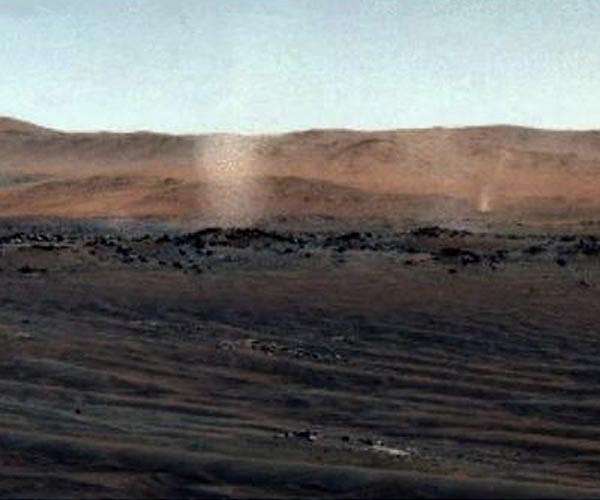
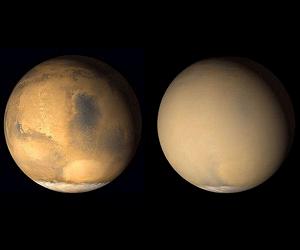
Mars is dominated by a dry, dusty desert landscape where winds and rotating columns of air lift fine particles into the atmosphere and later return them to the surface. The resulting dust cycle depends on surface - atmosphere interactions, seasonal changes, and the development of occasional planet-encircling dust storms.
A team from the Institute of Atmospheric Physics at the Chinese Academy of Sciences in Beijing ran a half-century simulation with the Global Open Planetary Atmospheric Model for Mars, or GoMars, to examine how dust moves through the Martian atmosphere. The model, independently developed by Chinese scientists, is designed to reproduce key characteristics of the Martian dust cycle and the occurrence of global dust storms.
The study appeared on December 13, 2025, in the journal Advances in Atmospheric Sciences. The authors describe the Martian dust cycle as a system with strong day - night, seasonal, and year-to-year variability, and note that accurately capturing this behavior remains a central challenge for Mars general circulation models used to support future Mars missions.
To evaluate GoMars, the team compared its atmospheric predictions with data from the Mars Climate Database and observations from the Mars Climate Sounder instrument. When direct observations were unavailable, GoMars output was assessed against other Mars general circulation models such as MarsWRF. These comparisons indicate that GoMars reproduces the seasonal and spatial patterns of the Martian dust cycle found in other models and datasets.
In its 50-year run, GoMars generated 11 spontaneous global dust storms at irregular intervals using a fully interactive dust scheme, reflecting the variability seen in observations. According to the authors, the simulation captures the multi-timescale variability of the dust cycle and shows that the model can consistently and realistically reproduce the timing and evolution of several types of global dust storms, a long-standing goal in international Mars atmospheric modeling.
The simulation also resolves smaller-scale processes such as dust devil lifting, in which heated, swirling columns of air move dust from the surface into the atmosphere. GoMars indicates that peak dust devil lifting occurs between 12:00 and 13:00 local time, in agreement with measurements from the Mars Pathfinder mission. The model further identifies strong dust devil activity in the Amazonis region, matching its status as a known dust devil hotspot.
The researchers emphasize that GoMars is still under development and outline several directions for improvement. Planned upgrades include higher spatial resolution, refinements to the model's dynamical core, and better physical parameterizations. The team also intends to incorporate more realistic surface dust and sand source information and to improve how dust-related physical processes are represented.
Future versions of GoMars will expand simulation of the Martian water cycle alongside dust processes. The long-term aim is to build a numerical prediction system for Mars that can assimilate observational data from exploration missions, providing weather-style forecasts tailored to Martian conditions. The researchers ultimately seek to reproduce the full diversity of Martian dust storms and to clarify the mechanisms driving them, thereby supplying meteorological support for future Mars exploration activities.
Research Report:The Fully Interactive Martian Dust Cycle Simulations by the GoMars Model
Related Links
Institute of Atmospheric Physics Chinese Academy of Sciences
Mars News and Information at MarsDaily.com
Lunar Dreams and more
| Subscribe Free To Our Daily Newsletters |
| Subscribe Free To Our Daily Newsletters |







