24/7 Space News
EXO WORLDS
Hidden circumbinary giant planet emerges from decade old Gemini data
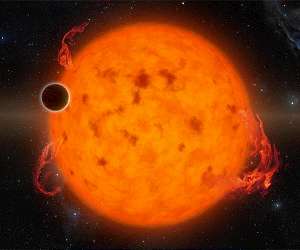
illustration only

Hidden circumbinary giant planet emerges from decade old Gemini data

by Robert Schreiber
Berlin, Germany (SPX) Dec 14, 2025

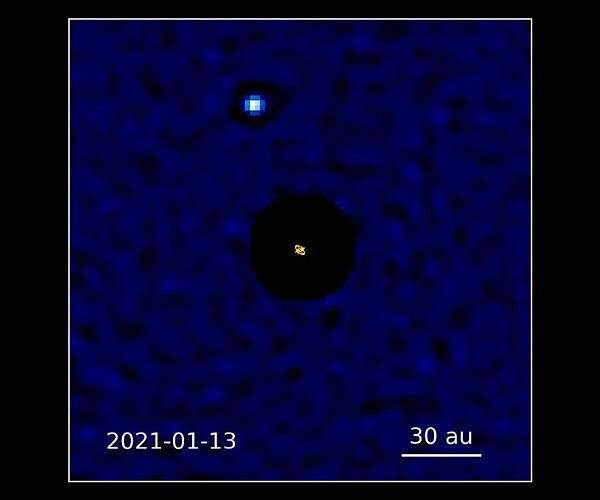
Astronomers have directly imaged a giant exoplanet orbiting a pair of stars, in a configuration reminiscent of the fictional Tatooine system but with the closest-known directly imaged planet to its twin suns in a binary system. The planet orbits a spectroscopic binary in the Scorpius-Centaurus association and was found buried in data taken nearly a decade ago with the Gemini Planet Imager (GPI) on the Gemini South telescope in Chile.

The newly confirmed world, designated HD 143811 AB b, is about six times the mass of Jupiter and lies roughly 446 light years from Earth. Its age is estimated at about 13 million years, meaning it formed around 50 million years after the extinction of the dinosaurs and still retains heat from its formation, which makes it detectable in direct imaging.

In this system, the two host stars orbit each other every 18 Earth days, while the planet requires about 300 years to complete a single orbit around the pair. That orbital period is slightly longer than Pluto's path around the Sun, yet among directly imaged planets in binary systems this planet orbits its stars at the smallest known separation, about six times closer than comparable systems.

Northwestern University's Jason Wang, an assistant professor of physics and astronomy and a member of the Center for Interdisciplinary Exploration and Research in Astrophysics (CIERA), specializes in imaging exoplanets and co-led the study. Graduate researcher Nathalie Jones, the CIERA Board of Visitors Graduate Fellow at Northwestern's Weinberg College of Arts and Sciences, led the analysis that uncovered the planet in archival datasets.

Wang originally helped commission GPI as a Ph.D. student, using its adaptive optics and coronagraph to block starlight and search for faint companions around more than 500 stars, work that yielded only one new planet at the time and underscored the rarity of directly imaged exoplanets. With GPI now being upgraded and prepared for installation on the Gemini North telescope on Mauna Kea in Hawaii, Wang asked Jones to perform a deeper reanalysis of the earlier observations to close out the survey.

Jones examined GPI data from 2016 to 2019 and combined it with observations from the W. M. Keck Observatory obtained through Northwestern's institutional access, looking for faint sources that consistently moved with their parent star across the sky. She identified a dim object that tracked the host star's motion and showed a light signature more consistent with a planet than a star, indicating it was gravitationally bound to the binary rather than a background interloper.

Follow-up comparison with a European team's independent reanalysis, led by University of Exeter astronomers and reported in Astronomy and Astrophysics, confirmed that both groups had detected the same planet in the archival data. The system's configuration, with a tight inner binary and a massive, slowly orbiting outer planet, provides an observational testbed for models of planet formation and orbital dynamics in multiple-star environments.

Although the exact formation pathway for HD 143811 AB b is still uncertain, researchers propose that the two stars formed first and the planet subsequently condensed out of the surrounding material in a circumbinary disk. Only a few dozen planets are known in such arrangements, and very few have been directly imaged alongside both stars and planet, limiting astronomers' ability to fully constrain theories for these systems.

The team plans to seek additional telescope time to monitor the motion of both the binary stars and the planet, refining their orbits and probing interactions between the stellar pair and the circumbinary companion. Continued analysis of archival images may reveal more faint candidates, illustrating how existing datasets can still yield major discoveries when revisited with refined techniques.

Research Report:GPI+SPHERE detection of a 6.1 MJup circumbinary planet around HD 143811

Related Links
Northwestern University
Lands Beyond Beyond - extra solar planets - news and science
Life Beyond Earth

Subscribe Free To Our Daily Newsletters
Tweet

RELATED CONTENT
The following news reports may link to other Space Media Network websites.
EXO WORLDS
TRAPPIST 1 flares mapped to probe planetary habitability
Boulder CO (SPX) Dec 05, 2025
TRAPPIST-1, a small star about 40 light-years from Earth in the constellation Aquarius, produces flares roughly six times per day, and this activity complicates efforts to evaluate whether its planets could be habitable. A team led by the University of Colorado Boulder used NASAs James Webb Space Telescope together with detailed computer simulations to study how these flares arise and how they might influence the systems seven Earth-sized planets, including three that orbit in the habitable zone w ... read more

EXO WORLDS
Lodestar Space wins SECP support to advance AI satellite awareness system

ISS to change commanders before Soyuz crew leaves orbit

Micro nano robots aim to cut carbon buildup in closed life support systems

NASA extends ISS National Lab management contract through 2030

EXO WORLDS
LandSpace reviews booster loss after Zhuque-3 reusable rocket test

UK plasma thruster test positions Pulsar Fusion for larger satellite propulsion

Neutron Hungry Hippo fairing completes qualification ahead of first launch

EU dismisses 'completely crazy statements' after Musk attack

EXO WORLDS
Martian sound study models acoustic signals in Jezero crater

NASA JPL Unveils Rover Operations Center for Moon, Mars Missions

Maven stays silent after routine pass behind Mars

Martian butterfly crater reveals low angle impact and buried lava history

EXO WORLDS
Experts at Hainan symposium call for stronger global space partnership

Foreign satellites ride Kinetica 1 on new CAS Space mission

Triple Long March launches mark record day for Chinese space program

China prepares Qingzhou cargo ship for low cost resupply flights

EXO WORLDS
Beyond Gravity positions new modular satellite platform for European LEO missions

From 1Mbps to 200: Starlink's Gaming Speed Revolution Explained

Private capital targets mission-critical software power and platforms in new space economy

MDA Space plans C250 million senior unsecured note issue maturing 2030

EXO WORLDS
What is the appeal of playing space-themed video games?

ONE Bow River backs Odyssey Space Research growth in flight software and mission engineering

D-Orbit launches dual orbital transportation missions, passes 200-payload milestone

Space operators urged to share costs of clearing orbital debris

EXO WORLDS
Subaru OASIS survey uncovers massive planet and brown dwarf

The bacteria that wont wake up found in spacecraft cleanrooms

Supernova mixing traced as source of key life elements

RISTRETTO spectrograph cleared for Proxima b atmospheric hunt

EXO WORLDS
Uranus and Neptune may be rock rich worlds

SwRI links Uranus radiation belt mystery to solar storm driven waves

Looking inside icy moons

Saturn moon mission planning shifts to flower constellation theory

Subscribe Free To Our Daily Newsletters


The content herein, unless otherwise known to be public domain, are Copyright 1995-2024 - Space Media Network. All websites are published in Australia and are solely subject to Australian law and governed by Fair Use principals for news reporting and research purposes. AFP, UPI and IANS news wire stories are copyright Agence France-Presse, United Press International and Indo-Asia News Service. ESA news reports are copyright European Space Agency. All NASA sourced material is public domain. Additional copyrights may apply in whole or part to other bona fide parties. All articles labeled "by Staff Writers" include reports supplied to Space Media Network by industry news wires, PR agencies, corporate press officers and the like. Such articles are individually curated and edited by Space Media Network staff on the basis of the report's information value to our industry and professional readership. Advertising does not imply endorsement, agreement or approval of any opinions, statements or information provided by Space Media Network on any Web page published or hosted by Space Media Network. General Data Protection Regulation (GDPR) Statement Our advertisers use various cookies and the like to deliver the best ad banner available at one time. All network advertising suppliers have GDPR policies (Legitimate Interest) that conform with EU regulations for data collection. By using our websites you consent to cookie based advertising. If you do not agree with this then you must stop using the websites from May 25, 2018. Privacy Statement. Additional information can be found here at About Us.