24/7 Space News
MICROSAT BLITZ
DiskSat flat satellite platform targets high power missions and very low Earth orbit
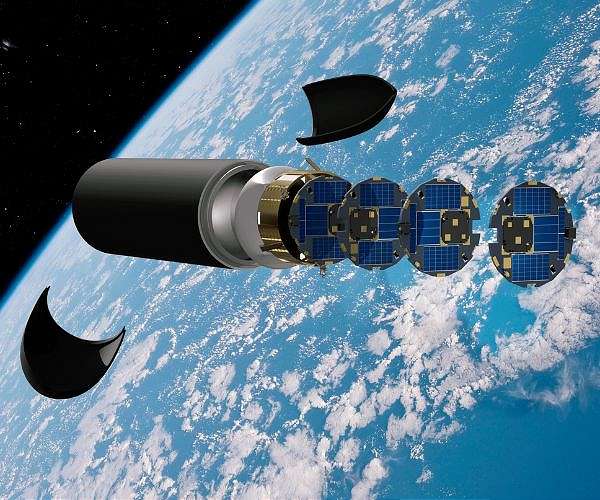
illustration only

DiskSat flat satellite platform targets high power missions and very low Earth orbit

by Clarence Oxford
Los Angeles CA (SPX) Dec 17, 2025
The Aerospace Corporation's DiskSat concept introduces a flat, disk-shaped small satellite bus designed to provide more power, surface area, and payload volume than a traditional CubeSat while keeping a standardized, containerized launch interface. A representative DiskSat demonstrator measures about 1 meter in diameter and roughly 2.5 centimeters thick, with an internal volume comparable to a 20U CubeSat and structural mass under 3 kilograms.

NASA's Small Spacecraft and Distributed Systems program is funding the design and flight of a four-satellite DiskSat technology demonstration to validate the new form factor and its launch dispenser. For launch, multiple DiskSats are stacked inside a fully enclosed container that rides as a secondary payload and then deploys the spacecraft one at a time once on orbit, an approach aimed at supporting future constellations of up to 20 or more DiskSats in a single mission.

The large, continuous surface area of the DiskSat allows mounting more than 200 watts of solar cells without deployable arrays, supporting missions that require high power and large apertures for antennas or instruments. The flat layout also simplifies access to internal components during integration and test, while still accommodating standard CubeSat-class subsystems within the disk volume.

A key design feature is the ability to fly with one face continuously pointed toward Earth in a low-drag attitude, which, combined with electric propulsion, enables operations in very low Earth orbit below about 300 kilometers. This configuration is intended to offset atmospheric drag, extend mission lifetimes at low altitude, and support applications such as high-resolution Earth observation, low-latency communications, and space situational awareness while reducing long-term debris because satellites in these orbits naturally deorbit faster.

The DiskSat program positions the platform as a rideshare-compatible option for missions needing high power-to-mass ratio, flexible pointing, and rapid constellation deployment, and is being developed with an eye toward broader adoption by government, commercial, and academic users after the initial NASA-backed demonstration flight.

Related Links
The Aerospace Corporation DiskSat Program
Microsat News and Nanosat News at SpaceMart.com

Subscribe Free To Our Daily Newsletters
Tweet

RELATED CONTENT
MICROSAT BLITZ
Arab Satellite 813 launch deepens UAE China space partnership
Tokyo, Japan (SPX) Dec 16, 2025
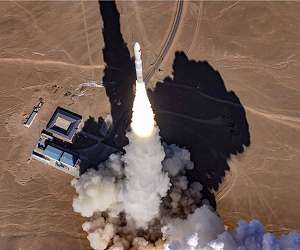
A Kinetica 1 rocket has placed the Arab Satellite 813 into orbit from the Jiuquan Satellite Launch Center, marking a new phase of cooperation between the United Arab Emirates and China in space activities, according to the Shanghai Engineering Center for Microsatellites. The satellite, described as a multirole mission platform, was launched from the Gobi Desert site in northwestern China and injected into its planned orbit on Wednesday. Arab Satellite 813 carries a hyperspectral imager, a pa ... read more

MICROSAT BLITZ
ISS to change commanders before Soyuz crew leaves orbit

Lodestar Space wins SECP support to advance AI satellite awareness system

Micro nano robots aim to cut carbon buildup in closed life support systems

NASA extends ISS National Lab management contract through 2030

MICROSAT BLITZ
Musk signals plan to launch IPO for SpaceX

Southern Launch to host INNOSPACE missions from South Australian spaceports

Rocket Lab completes first dedicated JAXA mission with Electron launch

Neutron Hungry Hippo fairing completes qualification ahead of first launch

MICROSAT BLITZ
GoMars model simulates Martian dust storms to improve mission safety

NASA JPL Unveils Rover Operations Center for Moon, Mars Missions

Ancient Martian brines left bromine rich fingerprints in jarosite minerals

Maven stays silent after routine pass behind Mars

MICROSAT BLITZ
Experts at Hainan symposium call for stronger global space partnership

Foreign satellites ride Kinetica 1 on new CAS Space mission

Triple Long March launches mark record day for Chinese space program

China prepares Qingzhou cargo ship for low cost resupply flights

MICROSAT BLITZ
Smart modeling framework targets 6G spectrum chaos in space air and ground networks

K2 Space raises 250m to scale Mega class high power satellites

Private capital targets mission-critical software power and platforms in new space economy

Beyond Gravity positions new modular satellite platform for European LEO missions

MICROSAT BLITZ
Galactic Slots: Space-Themed Games with Out-of-This-World Bonus Features

X-MAT introduces X-FOAM: A game-changing ceramic foam for extreme environments

Bible 1.0: How Ancient Canon Became Our First Large Language Models

Digital twin successfully launched and deployed into space

MICROSAT BLITZ
RISTRETTO spectrograph cleared for Proxima b atmospheric hunt

Clues to the migration path of hot Jupiters in their orbits

Can scientists detect life without knowing what it looks like

Ultra hot super Earth shows dense atmosphere over magma ocean

MICROSAT BLITZ
Uranus and Neptune may be rock rich worlds

SwRI links Uranus radiation belt mystery to solar storm driven waves

Looking inside icy moons

Saturn moon mission planning shifts to flower constellation theory


The content herein, unless otherwise known to be public domain, are Copyright 1995-2026 - SpaceDaily.com. All websites are published in Australia and are solely subject to Australian law and governed by Fair Use principals for news reporting and research purposes. AFP, UPI and IANS news wire stories are copyright Agence France-Presse, United Press International and Indo-Asia News Service. ESA news reports are copyright European Space Agency. All NASA sourced material is public domain. Additional copyrights may apply in whole or part to other bona fide parties. All articles labeled "by Staff Writers" include reports supplied to Space Media Network by industry news wires, PR agencies, corporate press officers and the like. Such articles are individually curated and edited by Space Media Network staff on the basis of the report's information value to our industry and professional readership. Advertising does not imply endorsement, agreement or approval of any opinions, statements or information provided by Space Media Network on any Web page published or hosted by Space Media Network. General Data Protection Regulation (GDPR) Statement Our advertisers use various cookies and the like to deliver the best ad banner available at one time. All network advertising suppliers have GDPR policies (Legitimate Interest) that conform with EU regulations for data collection. By using our websites you consent to cookie based advertising. If you do not agree with this then you must stop using the websites from May 25, 2018. Privacy Statement. Additional information can be found here at About Us.
Subscribe Free To Our Daily Newsletters