





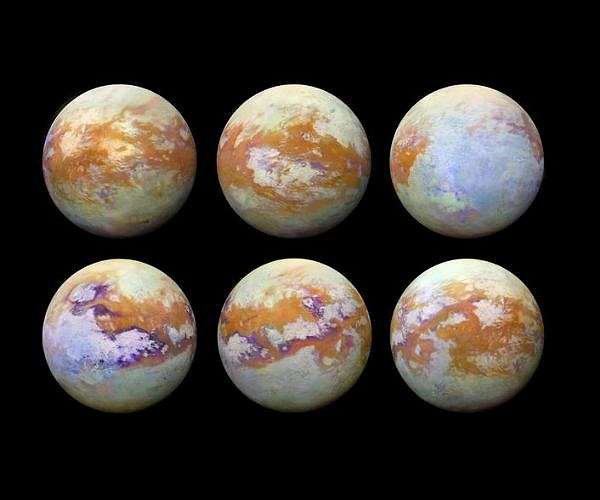
NASA's Cassini mission, launched in 1997 and operated for nearly 20 years, provided detailed gravity and radio-tracking data on Saturn and its 274 known moons, including Titan. Titan is veiled by a dense, hazy atmosphere and is the only known world besides Earth with stable surface liquids, with temperatures near minus 297 degrees Fahrenheit that allow methane, rather than water, to form lakes and fall as rain.
Earlier analyses of Cassini tracking data showed that Titan's shape changes as it moves along its elliptical orbit around Saturn, stretching and compressing under the planet's gravity. In 2008, researchers concluded that these deformations implied a global subsurface ocean, because a thick liquid layer would allow the crust to flex more than a fully frozen interior.
"The degree of deformation depends on Titan's interior structure. A deep ocean would permit the crust to flex more under Saturn's gravitational pull, but if Titan were entirely frozen, it wouldn't deform as much," said Baptiste Journaux, a University of Washington assistant professor of Earth and space sciences. "The deformation we detected during the initial analysis of the Cassini mission data could have been compatible with a global ocean, but now we know that isn't the full story."
The new study introduces timing into the interpretation of Titan's tidal response, focusing on a roughly 15-hour lag between the peak of Saturn's gravitational pull and Titan's maximum deformation. This delay indicates that Titan's interior resists shape change more like a viscous, honey-like material than liquid water, allowing scientists to infer how much energy is required to deform the moon and, in turn, the likely viscosity structure at depth.
The team found that energy dissipation inside Titan is much stronger than expected for a simple global ocean model. "Nobody was expecting very strong energy dissipation inside Titan. That was the smoking gun indicating that Titan's interior is different from what was inferred from previous analyses," said Flavio Petricca, a postdoctoral fellow at NASA's Jet Propulsion Laboratory, who led the study.
To match the observed dissipation and lag, the researchers propose an interior in which much of the putative ocean is instead a thick slush of ice and water with far less free liquid. Slush can still deform under Saturn's gravitational pull but does so more sluggishly than an open ocean, producing the observed delay while maintaining a substantial water-rich layer.
Petricca derived Titan's tidal behavior by tracking subtle shifts in the frequency of Cassini's radio signal during close flybys, which revealed how the moon's gravity field changed over time. Journaux then used thermodynamic modeling of water and minerals at extreme pressures to connect those gravity measurements to plausible interior structures.
"The watery layer on Titan is so thick, the pressure is so immense, that the physics of water changes. Water and ice behave in a different way than sea water here on Earth," Journaux said. His planetary cryo-mineral physics laboratory at the University of Washington has developed experimental methods to reproduce such conditions and supplied a dataset of predicted physical properties for water and ice deep within Titan.
"We could help them determine what gravitational signal they should expect to see based on the experiments made here at UW," Journaux said. "It was very rewarding." Using those laboratory constraints, the team could rule out interior models dominated by a low-viscosity global ocean and favor those containing thick slushy regions and localized melt zones.
"The discovery of a slushy layer on Titan also has exciting implications for the search for life beyond our solar system," said UW graduate student Ula Jones, a co-author on the study. "It expands the range of environments we might consider habitable."
Although the earlier ocean hypothesis had encouraged hopes for life in a Titan-wide sea, the new model suggests that smaller pockets of freshwater within the slushy interior could reach temperatures near 68 degrees Fahrenheit. In such confined reservoirs, nutrients could accumulate in a limited volume of water rather than being diluted across an open ocean, which might favor the development and persistence of simple organisms if they are present.
Any existing biosphere on Titan would not resemble a large marine ecosystem; the researchers note that it is improbable to find fish in the slush-filled channels envisioned for the interior. Instead, potential life there might parallel microbial or simple communities found in polar environments on Earth, which inhabit brines and melt channels within ice.
Journaux is part of the science team for NASA's Dragonfly mission to Titan, scheduled for launch in 2028, which will send a rotorcraft to explore the moon's surface and atmosphere. The new constraints on Titan's internal structure will help guide Dragonfly's measurements, and the mission could eventually provide evidence of present or past life and a clearer answer about the extent of any subsurface liquid water.
Co-authors on the paper include Steven D. Vance, Marzia Parisi, Dustin Buccino, Gael Cascioli, Julie Castillo-Rogez, Mark Panning and Jonathan I. Lunine from NASA; Brynna G. Downey from Southwest Research Institute; Francis Nimmo and Gabriel Tobie from the University of Nantes; Andrea Magnanini from the University of Bologna; Amirhossein Bagheri from the California Institute of Technology; and Antonio Genova from Sapienza University of Rome. This research received funding from NASA, the Swiss National Science Foundation and the Italian Space Agency.
Research Report:Titan's strong tidal dissipation precludes a subsurface ocean
Related Links
University of Washington
Explore The Ring World of Saturn and her moons
Jupiter and its Moons
The million outer planets of a star called Sol
News Flash at Mercury
| Subscribe Free To Our Daily Newsletters |

| Subscribe Free To Our Daily Newsletters |








