24/7 Space News
EARTH OBSERVATION
Third COSMO-SkyMed Second Generation radar satellite enters service ramp-up
illustration only

Third COSMO-SkyMed Second Generation radar satellite enters service ramp-up

by Erica Marchand
Paris, France (SPX) Jan 06, 2026

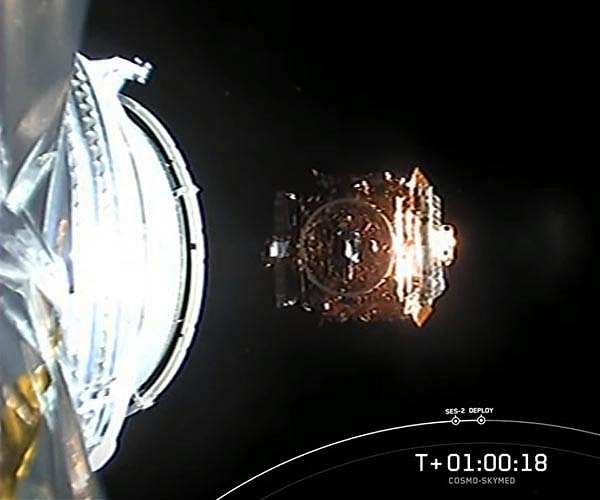
The third satellite in the COSMO-SkyMed Second Generation radar constellation has been launched from Vandenberg Space Force Base in California on a SpaceX Falcon 9 for the Italian Space Agency and the Italian Ministry of Defense, extending Italy's dual-use Earth observation capability.

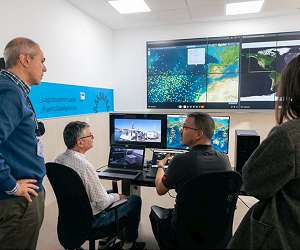
Built by Thales Alenia Space, a joint venture between Thales and Leonardo, and operated in orbit by Telespazio, the satellite joins a system designed to support both civilian and defense users with X-band synthetic-aperture radar data. Fifty-nine minutes after separation, controllers at Telespazio's Fucino Space Center in Abruzzo, Italy, acquired the signal and began the launch and early orbit phase, which is expected to last about nine days.

Massimo Claudio Comparini, Managing Director of Leonardo's Space Division, stated: " Each COSMO-SkyMed launch represents a significant achievement for the Italian national space system and its supply chain. The program, developed to meet the requirements of the Italian Space Agency and the Italian Ministry of Defense, reflects the technological and industrial excellence led by Leonardo together with the joint ventures Thales Alenia Space, Telespazio and e-GEOS. Earth observation and the data it provides are a strategic asset for security and sustainability, enabling increasingly targeted and timely services and interventions. This commitment strengthens Italy's role in space and helps generate value for the country and the international community."

Giampiero Di Paolo, CEO of Thales Alenia Space in Italy and Senior Vice President Earth Observation, Exploration and Navigation, commented: "Being responsible for the overall COSMO-SkyMed Second Generation program, Thales Alenia Space is extremely proud of this successful launch, which further demonstrates the company's excellence in radar technology and highlights the dedication of our teams. Once fully deployed with its four satellites, it will provide substantial technological and performance progress, strengthening Thales Alenia Space's global leadership in space-based Earth observation infrastructure."

COSMO-SkyMed, short for Constellation of Satellites for the Mediterranean basin Observation, is a dual-use Earth observation system owned by the Italian Space Agency and the Italian Ministry of Defense, with Leonardo and its joint ventures Thales Alenia Space, Telespazio and e-GEOS leading industrial contributions alongside numerous small and medium-sized enterprises. The third Second Generation satellite, like its predecessors, carries a synthetic-aperture radar payload that maintains service continuity while improving image quality, coverage and system flexibility.

With three Second Generation satellites now in orbit, the new series is progressively replacing the first-generation constellation of four satellites, of which two remain operational. In its planned four-satellite configuration, the upgraded system is intended to raise overall performance and broaden the portfolio of radar-based applications, including through enhancements to the ground segment.

The COSMO-SkyMed system, including spacecraft and ground infrastructure, is designed to deliver high-accuracy radar imagery and adaptable user services for a wide range of observation modes. System performance targets include fine spatial resolution, wide-area coverage options and rapid tasking to support time-critical monitoring.

Since the first COSMO-SkyMed satellite was launched in 2007, the constellation has acquired and archived about 4.3 million images, supporting environmental and land monitoring, security operations and emergency response. These data sets have been used in applications such as tracking land deformation, observing coastal and maritime activity, and assessing damage after natural hazards.

As a contributing mission to the European Union's Copernicus program, COSMO-SkyMed provides radar imagery for the European Commission's Emergency Rapid Mapping service operated by e-GEOS. This service generates satellite maps of disaster-affected or crisis zones, often within hours, to support civil protection and humanitarian actors.

Italian industry has a central role in COSMO-SkyMed, with Leonardo, Thales Alenia Space, Telespazio and e-GEOS working with a network of Italian small and medium-sized enterprises. Thales Alenia Space is responsible for the Second Generation end-to-end space segment, including satellite development, manufacturing and overall system design, integration and commissioning.

Telespazio leads the design and development of the CSG ground segment and provides integrated logistics and operations services, with its Fucino Space Center managing launch and early orbit operations, in-orbit testing, commissioning and routine phases for the new satellite. Leonardo contributes attitude control hardware and units for power management and distribution on the satellites.

COSMO-SkyMed data are commercialized globally by e-GEOS, a company owned by the Italian Space Agency (20 percent) and Telespazio (80 percent), which holds exclusive distribution rights. e-GEOS processes the radar data into products and services supporting emergency management, security, infrastructure monitoring, maritime traffic tracking, precision agriculture and the monitoring of natural resources and ecosystems.

Related Links
Thales Group Space
Earth Observation News - Suppiliers, Technology and Application

Subscribe Free To Our Daily Newsletters
Tweet

RELATED CONTENT
The following news reports may link to other Space Media Network websites.
EARTH OBSERVATION
Maintaining the Gold Standard: The Future of Landsat Calibration and Validation
Greenbelt MD (SPX) Dec 17, 2025
The Landsat Calibration and Validation (Cal/Val) group helps uphold Landsat's reputation as the gold standard of satellite imagery. They ensure that the Operational Land Imager (OLI) and the Thermal Infrared Sensor (TIRS) aboard Landsats 8 and 9 provide high-quality scientific measurements to users around the world. In 2025, the Cal/Val group contributed over 60 pages to the second edition of "Comprehensive Remote Sensing" (Kaita et. al, 2026), organizing content from NASA, USGS, academia, and industry ... read more

EARTH OBSERVATION
ESA reaches new benchmark in autonomous formation flying

Hydrogen peroxide thruster qualifies for ESA launcher attitude control

China launches twin Shijian-29 satellites to test space-target detection tech

Billionaire Trump nominee confirmed to lead NASA amid Moon race

EARTH OBSERVATION
AI systems proposed to boost launch cadence reliability and traffic management

China debuts Long March 12A reusable rocket in Jiuquan test flight

Japan's flagship H3 rocket fails to launch satellite

North Korea tests hypersonic missiles, says nuclear forces ready for war

EARTH OBSERVATION
Curiosity Blog, Sols 4750-4762: See You on the Other Side of the Sun

Wind-Sculpted Landscapes: Investigating the Martian Megaripple 'Hazyview'

NASA team presses MAVEN recovery before Mars solar conjunction

Perseverance rover cleared for long distance Mars exploration

EARTH OBSERVATION
China harnesses nationwide system to drive spaceflight and satellite navigation advances

Shenzhou 21 crew complete eight hour spacewalk outside Tiangong station

Foreign satellites ride Kinetica 1 on new CAS Space mission

Experts at Hainan symposium call for stronger global space partnership

EARTH OBSERVATION
Southern Launch to Host Lux Aeterna Re-Entries South Australia

Smart modeling framework targets 6G spectrum chaos in space air and ground networks

Time-expanded network model cuts complexity in mega constellation launch planning

K2 Space raises 250m to scale Mega class high power satellites

EARTH OBSERVATION
India space agency launches its heaviest satellite

Space ground fluid AI framework targets satellite powered 6G edge intelligence

Engineered interlayers boost satellite insulation and flexible electronics

Planet delivers first light image from Pelican 6 satellite capturing Lhasa Gonggar Airport

EARTH OBSERVATION
Deep Arctic gas hydrate mounds host ultra deep cold seep ecosystem

Joint ground- and space-based observations reveal Saturn-mass rogue planet

Hubble pinpoints asteroid smash ups in nearby Fomalhaut system

Evolution study finds history and environment shifts can steer species in very different directions

EARTH OBSERVATION
Uranus and Neptune may be rock rich worlds

SwRI links Uranus radiation belt mystery to solar storm driven waves

Looking inside icy moons

Saturn moon mission planning shifts to flower constellation theory

Subscribe Free To Our Daily Newsletters


The content herein, unless otherwise known to be public domain, are Copyright 1995-2024 - Space Media Network. All websites are published in Australia and are solely subject to Australian law and governed by Fair Use principals for news reporting and research purposes. AFP, UPI and IANS news wire stories are copyright Agence France-Presse, United Press International and Indo-Asia News Service. ESA news reports are copyright European Space Agency. All NASA sourced material is public domain. Additional copyrights may apply in whole or part to other bona fide parties. All articles labeled "by Staff Writers" include reports supplied to Space Media Network by industry news wires, PR agencies, corporate press officers and the like. Such articles are individually curated and edited by Space Media Network staff on the basis of the report's information value to our industry and professional readership. Advertising does not imply endorsement, agreement or approval of any opinions, statements or information provided by Space Media Network on any Web page published or hosted by Space Media Network. General Data Protection Regulation (GDPR) Statement Our advertisers use various cookies and the like to deliver the best ad banner available at one time. All network advertising suppliers have GDPR policies (Legitimate Interest) that conform with EU regulations for data collection. By using our websites you consent to cookie based advertising. If you do not agree with this then you must stop using the websites from May 25, 2018. Privacy Statement. Additional information can be found here at About Us.