24/7 Space News
STELLAR CHEMISTRY
Supernova at edge of observable universe spotted by James Webb Space Telescope
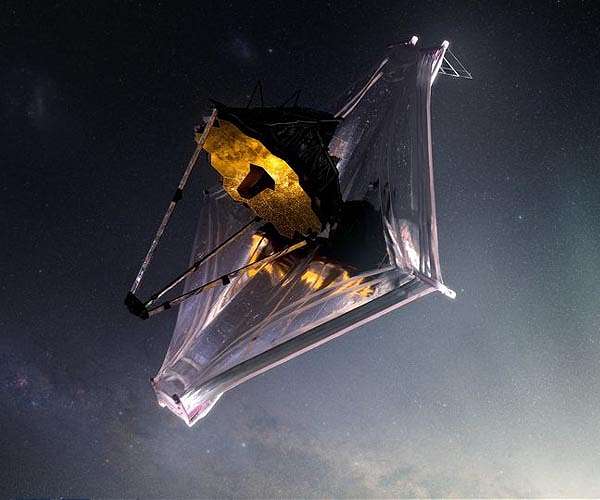
illustration only

Supernova at edge of observable universe spotted by James Webb Space Telescope

by Robert Schreiber
Berlin, Germany (SPX) Dec 17, 2025
An international collaboration of astronomers has used the James Webb Space Telescope (JWST) to detect a supernova at an unprecedented distance in the early universe, tied to a long-duration gamma-ray burst. The team observed the explosive death of a massive star when the universe was about 730 million years old, placing the event deep in the era of reionisation. The discovery offers a direct view of the final stages of a massive star at a time when the first generations of stars and galaxies were emerging.

The explosion, designated SN in GRB 250314A, was first identified on March 14, 2025 as a bright burst of high-energy radiation detected by the space-based multi-band astronomical Variable Objects Monitor (SVOM). Follow-up spectroscopy with the European Southern Observatory's Very Large Telescope (ESO/VLT) confirmed the gamma-ray burst originated at a redshift of about 7.3, corresponding to the very early universe.

The critical evidence for the supernova came from targeted observations with JWST's Near-Infrared Camera (NIRCam) about 110 days after the initial burst. At that time, researchers were able to disentangle the light from the fading explosion and the much fainter underlying host galaxy, isolating the supernova's contribution.

Co-author and UCD School of Physics astrophysicist Dr Antonio Martin-Carrillo said: "The key observation, or smoking gun, that connects the death of massive stars with gamma-ray bursts is the discovery of a supernova emerging at the same sky location. Almost every supernova ever studied has been relatively nearby to us, with just a handful of exceptions to date. When we confirmed the age of this one, we saw a unique opportunity to probe how the Universe was there and what type of stars existed and died back then.

"Using models based on the population of supernovae associated with GRBs in our local universe, we made some predictions of what the emission should be and used it to proposed a new observation with the James Webb Space Telescope. To our surprise, our model worked remarkably well and the observed supernova seems to match really well the death of stars that we see regularly. We were also able to get a glimpse of the galaxy that hosted this dying star."

Photometric and spectral analysis show that the distant supernova's brightness and spectral characteristics are closely aligned with those of the prototype gamma-ray-burst-associated supernova SN 1998bw in the nearby universe. This match indicates that the massive star that collapsed to produce GRB 250314A and its supernova was not markedly different from progenitor stars seen in the local cosmos, even though it formed under the lower metallicity conditions expected in the early universe. The team also ruled out a more luminous class of explosions, such as a superluminous supernova, for this event.

These results challenge expectations that stars in the early universe, formed in extremely metal-poor environments, would produce supernovae that differ strongly in luminosity or colour from those observed today. Instead, the observations suggest a surprising continuity in the core-collapse processes powering gamma-ray-burst-associated supernovae across more than 13 billion years of cosmic history. The finding provides a key anchor point for models of stellar evolution and death during the reionisation era.

The researchers plan to obtain a second epoch of JWST observations within the next one to two years, once the supernova has faded by more than two magnitudes. Those deeper observations will allow them to characterise the faint host galaxy in detail and firmly separate the residual galaxy light from any remaining supernova emission. The extended dataset will refine measurements of the host's properties and further test how typical this early-universe stellar explosion is compared with local counterparts.

Research Report:JWST reveals a supernova following a gamma-ray burst at z ~7.3

Related Links
UCD Research and Innovation
Stellar Chemistry, The Universe And All Within It

Subscribe Free To Our Daily Newsletters
Tweet

RELATED CONTENT
STELLAR CHEMISTRY
Nova images capture complex stellar blast behavior
Los Angeles CA (SPX) Dec 09, 2025
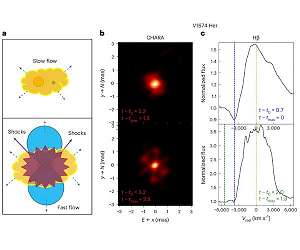
An international group of astronomers led by Texas Tech University assistant professor Elias Aydi published a paper titled Multiple outflows and delayed ejections revealed by early imaging of novae in Nature Astronomy on Dec. 5. The team used interferometry with the Center for High Angular Resolution Astronomy (CHARA) Array in California, combining light from multiple telescopes to obtain the high spatial resolution needed to directly image rapidly changing nova explosions. The study captured deta ... read more

STELLAR CHEMISTRY
ISS to change commanders before Soyuz crew leaves orbit

Lodestar Space wins SECP support to advance AI satellite awareness system

Micro nano robots aim to cut carbon buildup in closed life support systems

NASA extends ISS National Lab management contract through 2030

STELLAR CHEMISTRY
Musk signals plan to launch IPO for SpaceX

Southern Launch to host INNOSPACE missions from South Australian spaceports

Rocket Lab completes first dedicated JAXA mission with Electron launch

Neutron Hungry Hippo fairing completes qualification ahead of first launch

STELLAR CHEMISTRY
GoMars model simulates Martian dust storms to improve mission safety

NASA JPL Unveils Rover Operations Center for Moon, Mars Missions

Ancient Martian brines left bromine rich fingerprints in jarosite minerals

Maven stays silent after routine pass behind Mars

STELLAR CHEMISTRY
Experts at Hainan symposium call for stronger global space partnership

Foreign satellites ride Kinetica 1 on new CAS Space mission

Triple Long March launches mark record day for Chinese space program

China prepares Qingzhou cargo ship for low cost resupply flights

STELLAR CHEMISTRY
Smart modeling framework targets 6G spectrum chaos in space air and ground networks

K2 Space raises 250m to scale Mega class high power satellites

Private capital targets mission-critical software power and platforms in new space economy

Beyond Gravity positions new modular satellite platform for European LEO missions

STELLAR CHEMISTRY
Galactic Slots: Space-Themed Games with Out-of-This-World Bonus Features

X-MAT introduces X-FOAM: A game-changing ceramic foam for extreme environments

Bible 1.0: How Ancient Canon Became Our First Large Language Models

Digital twin successfully launched and deployed into space

STELLAR CHEMISTRY
RISTRETTO spectrograph cleared for Proxima b atmospheric hunt

Clues to the migration path of hot Jupiters in their orbits

Can scientists detect life without knowing what it looks like

Ultra hot super Earth shows dense atmosphere over magma ocean

STELLAR CHEMISTRY
Uranus and Neptune may be rock rich worlds

SwRI links Uranus radiation belt mystery to solar storm driven waves

Looking inside icy moons

Saturn moon mission planning shifts to flower constellation theory


The content herein, unless otherwise known to be public domain, are Copyright 1995-2026 - SpaceDaily.com. All websites are published in Australia and are solely subject to Australian law and governed by Fair Use principals for news reporting and research purposes. AFP, UPI and IANS news wire stories are copyright Agence France-Presse, United Press International and Indo-Asia News Service. ESA news reports are copyright European Space Agency. All NASA sourced material is public domain. Additional copyrights may apply in whole or part to other bona fide parties. All articles labeled "by Staff Writers" include reports supplied to Space Media Network by industry news wires, PR agencies, corporate press officers and the like. Such articles are individually curated and edited by Space Media Network staff on the basis of the report's information value to our industry and professional readership. Advertising does not imply endorsement, agreement or approval of any opinions, statements or information provided by Space Media Network on any Web page published or hosted by Space Media Network. General Data Protection Regulation (GDPR) Statement Our advertisers use various cookies and the like to deliver the best ad banner available at one time. All network advertising suppliers have GDPR policies (Legitimate Interest) that conform with EU regulations for data collection. By using our websites you consent to cookie based advertising. If you do not agree with this then you must stop using the websites from May 25, 2018. Privacy Statement. Additional information can be found here at About Us.
Subscribe Free To Our Daily Newsletters