





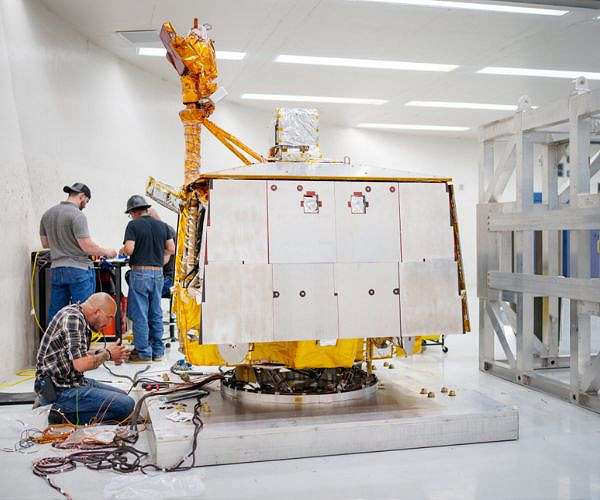
"We've built a rover that is designed to go and prospect for water on the moon, but the vehicle must be certified for mission," said Dave Petri, NASA VIPER system integration and test lead. "We need to be sure its structure is properly designed and built to survive the mission, including the launch environment."
To support that certification, NASA brought VIPER to Sandia's Large Centrifuge, known as the Superfuge, an underground 29-foot-radius facility capable of subjecting test articles to inertial forces up to 300 Gs while handling payloads of up to 16,000 pounds. The Superfuge can combine vibration, spin, thermal and shock environments in a single test sequence to replicate conditions from launch through reentry.
Because of VIPER's size and configuration, the team evaluated several potential test approaches, including a drop tower and rocket sled, before selecting Sandia's centrifuge-based method. The rover's design includes solar panels in key locations and a central drill assembly that could be damaged by traditional static qualification tests that rely on pistons pushing on specific structural points.
"This is a 1,000-pound article and it has to be oriented in a number of ways throughout the testing process," said Ben Quasius, VIPER lead stress analyst. "In many cases we would do a static qualification test where we use pistons to push on certain locations of the article to test flex of the body, but there are sensitive things in the way. You have solar panels in prime locations and a drill in the middle that can't be compromised during flight."
NASA's team spent three weeks at Sandia running VIPER through a series of centrifuge tests that captured structural responses across the rover. The Superfuge crew spent months preparing for the effort, engineering the test plan, defining load paths and mounting configurations, and determining the spin profiles and angles needed to reproduce the expected launch and flight conditions.
"There is not another machine in the world that has the capabilities we do here," said Orlando Abeyta, Sandia operations engineer at the Superfuge. "We have tested weapons systems, components of weapons systems, aerospace tanks, and even the Jupiter fuel tank for NASA."
Abeyta explained that running the Superfuge requires more than operating controls, because each new article demands tailored instrumentation, mounting and contingency planning. On VIPER, the team instrumented 48 measurement points to collect data for later analysis of loads, deflections and dynamic behavior under high-G conditions.
"You can model anything you want, but until you put it on that arm you don't know what you are going to get," Abeyta said. "As a centrifuge operator, anyone can push a button, but you need to know what is happening when you push that button - if it doesn't work, then what? That's what I've learned to do here."
Test lead Leticia Mercado, who holds a master's degree in mechanical engineering with a concentration in space systems, described managing the VIPER campaign as a career milestone. A native of Farmington, New Mexico, she initially expected to leave the state, but an internship at Sandia that included work at the Drop Towers and Mechanical Shock Complex ultimately led her to the Superfuge facility.
"I worked at the Drop Towers and the Mechanical Shock Complex and then this became my home facility," Mercado said. "Personally, I am just excited to be part of this test and to lead it. I have such a unique job."
The Sandia team now looks ahead to VIPER's planned journey to the lunar surface, currently targeted for late 2027. NASA announced in September that it had selected Blue Origin of Kent, Washington, to deliver the rover to the Moon's South Pole using a Blue Moon MK1 lander that is now in production.
Once on the Moon, VIPER will map the distribution of water ice and other volatiles to help determine whether concentrations are high enough to support future resource use. "We know there is water on the moon, but we don't know the concentrations of water," Petri said. "It's like prospecting for gold here on Earth. You need enough concentration for it to be worthwhile to mine. It's the same with the moon."
The rover carries three scientific instruments - a mass spectrometer, a near-infrared spectrometer and a neutron spectrometer - that together can detect water and other volatiles that evaporate or boil off when heated. VIPER also has a drill that can reach about one meter below the surface to collect subsurface samples that may contain preserved water remnants.
Mission planners intend for VIPER to operate in permanently shadowed craters near the lunar South Pole where temperatures remain low and water is less likely to boil away, increasing the chances of finding higher concentrations of ice. The Sandia team views the mission's potential science return as significant and notes that their contribution aligns with a long record of testing aerospace hardware in the Superfuge.
"I got a compliment from a manager for the VIPER testing saying they had never had an experience like they did here," Abeyta said. "If something happens, we have an answer for it. We know how this equipment works. There are so many great people here, everybody helps each other and that's what makes this place work so well. On Sunday nights I am excited to come to work on Monday to see what I get to do next."
Related Links
Sandia National Laboratories
Mars News and Information at MarsDaily.com
Lunar Dreams and more
| Subscribe Free To Our Daily Newsletters |
| Subscribe Free To Our Daily Newsletters |








