24/7 Space News
STELLAR CHEMISTRY
Roman infrared survey to chart hidden structure of Milky Way
illustration only

Roman infrared survey to chart hidden structure of Milky Way

by Ashley Balzer
Greenbelt MD (SPX) Dec 12, 2025

NASA's Nancy Grace Roman Space Telescope team has released detailed plans for a major survey that will reveal our home galaxy, the Milky Way, in unprecedented detail. In one month of observations spread across two years, the survey will unveil tens of billions of stars and explore previously uncharted structures.

"The Galactic Plane Survey will revolutionize our understanding of the Milky Way," said Julie McEnery, Roman's senior project scientist at NASA's Goddard Space Flight Center in Greenbelt, Maryland. "We'll be able to explore the mysterious far side of our galaxy and its star-studded heart. Because of the survey's breadth and depth, it will be a scientific mother lode."

The Galactic Plane Survey is Roman's first selected general astrophysics survey - one of many observation programs Roman will do in addition to its three core surveys and Coronagraph technology demonstration. At least 25% of Roman's five-year primary mission is reserved for astronomers worldwide to propose more surveys beyond the core programs, fully leveraging Roman's capabilities to conduct groundbreaking science. Roman is slated to launch by May 2027, but the team is on track for launch as early as fall 2026.

While ESA's (European Space Agency's) retired Gaia spacecraft mapped around 2 billion Milky Way stars in visible light, many parts of the galaxy remain hidden by dust. By surveying in infrared light, Roman will use powerful heat vision that can pierce this veil to see what lies beyond.

"It blows my mind that we will be able to see through the densest part of our galaxy and explore it properly for the first time," said Rachel Street, a senior scientist at Las Cumbres Observatory in Santa Barbara, California, and a co-chair of the committee that selected the Galactic Plane Survey design.

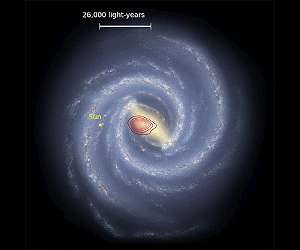
The survey will cover nearly 700 square degrees (a region of sky as large as about 3,500 full moons) along the glowing band of the Milky Way - our edge-on view of the disk-shaped structure containing most of our galaxy's stars, gas, and dust. Scientists expect the survey to map up to 20 billion stars and detect tiny shifts in their positions with repeated high-resolution observations. And it will only take 29 days spread over the course of the mission's first two years.

Cosmic Cradles

Stars are born from parent clouds of gas and dust. Roman will peer through the haze of these nesting grounds to see millions of stellar embryos, newborn stars still swaddled in shrouds of dust, tantrumming toddler stars that flare unpredictably, and young stars that may have planetary systems forming around them. Astronomers will study stellar birth rates across a wide range of masses and stitch together videos that show how stars change over time.

"This survey will study such a huge number of stars in so many different stellar environments that we'll be sampling every phase of a star's evolution," Street said.

Observing so many stars in various stages of early development will shed light on the forces that shape them. Star formation is like a four way tug-of-war between gravity, radiation, magnetism, and turbulence. Roman will help us study how these forces influence whether gas clouds collapse into full-fledged stars, smaller brown dwarfs - in-between objects that are much heavier than planets but not massive enough to ignite like stars - or new worlds.

Some stars are born in enormous litters called clusters. Roman will study nearly 2,000 young, loosely bound open clusters to see how the galaxy's spiral arms trigger star formation. The survey will also map dozens of ancient, densely packed globular clusters near the center of the galaxy that could help astronomers reconstruct the Milky Way's early history.

Comparing Roman's snapshots of clusters scattered throughout the galaxy will enable scientists to study nature versus nurture on a cosmic scale. Because a cluster's stars generally share the same age, origin, and chemical makeup, analyzing them allows astronomers to isolate environmental effects very precisely.

Pulse Check

When they run out of fuel, Sun-like stars leave behind cores called white dwarfs and heavier stars collapse to form neutron stars and black holes. Roman will find these stellar embers even when they're alone thanks to wrinkles in space-time.

Anything that has mass warps the underlying fabric of the universe. When light from a background star passes through the gravitational well around an intervening object on its journey toward Earth, its path slightly curves around the object. This phenomenon, called microlensing, can temporarily brighten the star. By studying these signals, astronomers can learn the mass and size of otherwise invisible foreground objects.

A separate survey - Roman's Galactic Bulge Time-Domain Survey - will conduct deep microlensing observations over a smaller area in the heart of the Milky Way. The Galactic Plane Survey will conduct repeated observations over a shorter interval but across the whole center of the galaxy, giving us the first complete view of this complex galactic environment. An unobscured view of the galaxy's central bar will help astronomers answer the question of its origin, and Roman's videos of stars in this region will enable us to study some ultratight binary objects at the very ends of their lives thanks to their interactions with close companions.

"Compact binaries are particularly interesting because they're precursors to gravitational-wave sources," said Robert Benjamin, a visiting professor at the University of Wisconsin-Whitewater, and a co-chair of the committee that selected the Galactic Plane Survey design. When neutron stars and black holes merge, the collision is so powerful that it sends ripples through the fabric of space-time. "Scientists want to know more about the pathways that lead to those mergers."

Roman's repeated observations will also monitor stars that flicker. Ground-based surveys detect thousands of bright stellar outbursts, but often can't see the faint, dust-obscured stars that produce them. Roman will pinpoint the culprits plus take high-resolution snapshots of the aftermath.

Some stars throb rhythmically, and the speed of their pulsing is directly linked to their intrinsic brightness. By comparing their true brightness to how bright they appear from Earth, astronomers can measure distances across the galaxy. Roman will find these blinking stars farther away than ever before and track them over time, helping astronomers improve their cosmic measuring sticks.

"Pairing Roman's Galactic Plane Survey with other Milky Way observations will create the best portrait of the galaxy we've ever had," Benjamin said.

Related Links
Roman Space Telescope
Stellar Chemistry, The Universe And All Within It

Subscribe Free To Our Daily Newsletters
Tweet

RELATED CONTENT
The following news reports may link to other Space Media Network websites.
STELLAR CHEMISTRY
Milky Way chemical map shows diverse paths to galactic evolution
London, UK (SPX) Dec 12, 2025
A new analysis of simulated Milky Way analogues links the galaxy's unusual chemical patterns to how its disc formed and evolved over time. The work examines why stars near the Sun split into two distinct chemical groups despite occupying overlapping ranges in overall metallicity. Astronomers have long noted that solar-neighbourhood stars fall into two main sequences when plotted by their iron and magnesium content, a feature known as chemical bimodality. The new study, published in Monthly Notices ... read more

STELLAR CHEMISTRY
Lodestar Space wins SECP support to advance AI satellite awareness system

ISS to change commanders before Soyuz crew leaves orbit

Micro nano robots aim to cut carbon buildup in closed life support systems

NASA extends ISS National Lab management contract through 2030

STELLAR CHEMISTRY
LandSpace reviews booster loss after Zhuque-3 reusable rocket test

UK plasma thruster test positions Pulsar Fusion for larger satellite propulsion

Neutron Hungry Hippo fairing completes qualification ahead of first launch

EU dismisses 'completely crazy statements' after Musk attack

STELLAR CHEMISTRY
Martian sound study models acoustic signals in Jezero crater

NASA JPL Unveils Rover Operations Center for Moon, Mars Missions

Maven stays silent after routine pass behind Mars

Martian butterfly crater reveals low angle impact and buried lava history

STELLAR CHEMISTRY
Experts at Hainan symposium call for stronger global space partnership

Foreign satellites ride Kinetica 1 on new CAS Space mission

Triple Long March launches mark record day for Chinese space program

China prepares Qingzhou cargo ship for low cost resupply flights

STELLAR CHEMISTRY
Beyond Gravity positions new modular satellite platform for European LEO missions

From 1Mbps to 200: Starlink's Gaming Speed Revolution Explained

Private capital targets mission-critical software power and platforms in new space economy

MDA Space plans C250 million senior unsecured note issue maturing 2030

STELLAR CHEMISTRY
What is the appeal of playing space-themed video games?

ONE Bow River backs Odyssey Space Research growth in flight software and mission engineering

D-Orbit launches dual orbital transportation missions, passes 200-payload milestone

Space operators urged to share costs of clearing orbital debris

STELLAR CHEMISTRY
Subaru OASIS survey uncovers massive planet and brown dwarf

The bacteria that wont wake up found in spacecraft cleanrooms

Supernova mixing traced as source of key life elements

RISTRETTO spectrograph cleared for Proxima b atmospheric hunt

STELLAR CHEMISTRY
Uranus and Neptune may be rock rich worlds

SwRI links Uranus radiation belt mystery to solar storm driven waves

Looking inside icy moons

Saturn moon mission planning shifts to flower constellation theory

Subscribe Free To Our Daily Newsletters


The content herein, unless otherwise known to be public domain, are Copyright 1995-2024 - Space Media Network. All websites are published in Australia and are solely subject to Australian law and governed by Fair Use principals for news reporting and research purposes. AFP, UPI and IANS news wire stories are copyright Agence France-Presse, United Press International and Indo-Asia News Service. ESA news reports are copyright European Space Agency. All NASA sourced material is public domain. Additional copyrights may apply in whole or part to other bona fide parties. All articles labeled "by Staff Writers" include reports supplied to Space Media Network by industry news wires, PR agencies, corporate press officers and the like. Such articles are individually curated and edited by Space Media Network staff on the basis of the report's information value to our industry and professional readership. Advertising does not imply endorsement, agreement or approval of any opinions, statements or information provided by Space Media Network on any Web page published or hosted by Space Media Network. General Data Protection Regulation (GDPR) Statement Our advertisers use various cookies and the like to deliver the best ad banner available at one time. All network advertising suppliers have GDPR policies (Legitimate Interest) that conform with EU regulations for data collection. By using our websites you consent to cookie based advertising. If you do not agree with this then you must stop using the websites from May 25, 2018. Privacy Statement. Additional information can be found here at About Us.