24/7 Space News
STELLAR CHEMISTRY
Milky Way chemical map shows diverse paths to galactic evolution
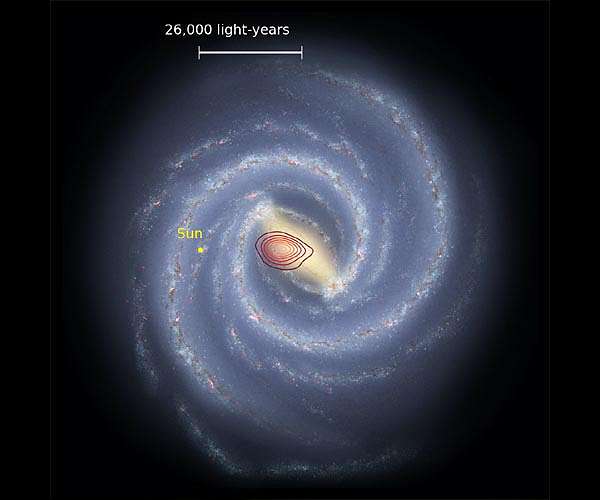
illustration only

Milky Way chemical map shows diverse paths to galactic evolution

by Sophie Jenkins
London, UK (SPX) Dec 12, 2025

A new analysis of simulated Milky Way analogues links the galaxy's unusual chemical patterns to how its disc formed and evolved over time. The work examines why stars near the Sun split into two distinct chemical groups despite occupying overlapping ranges in overall metallicity.

Astronomers have long noted that solar-neighbourhood stars fall into two main sequences when plotted by their iron and magnesium content, a feature known as chemical bimodality. The new study, published in Monthly Notices of the Royal Astronomical Society, tests how that structure might arise by modelling the assembly of galaxies similar to the Milky Way.

Researchers at the Institute of Cosmos Sciences of the University of Barcelona and the French Centre national de la recherche scientifique analysed 30 galaxies from the Auriga simulation suite, which tracks how Milky Way-mass systems grow in a cosmological context. By following how gas cools, forms discs and fuels star formation, they identified conditions that generate two separate chemical tracks in iron-magnesium space.

The team reports that bimodality can emerge through several routes rather than a single universal mechanism. In some simulated galaxies, rapid bursts of star formation, separated by quieter phases, produce chemically distinct stellar populations, while in others the main driver is a change in the rate or composition of gas accreted from the surrounding environment.

The results challenge the idea that the Milky Way's merger with the Gaia-Sausage-Enceladus dwarf galaxy is required to explain the split chemical sequences. Instead, the simulations point to metal-poor gas from the circumgalactic medium as a key ingredient for building a second, chemically different group of stars on top of an existing disc.

Lead author Matthew Orkney of ICCUB and the Institut dEstudis Espacials de Catalunya said the work shows that the Milky Way should not be treated as a template for all disc galaxies. According to the study, systems with similar masses and morphologies can experience different gas accretion and star formation histories yet arrive at broadly comparable present-day structures.

The shape of the chemical sequences in each simulated galaxy tracks its specific star formation history, linking abundance patterns directly to how and when stars formed. That connection offers a way to read past inflows, outflows and merger events from present-day stellar chemistry, and to compare the Milky Way with neighbours such as Andromeda where no clear bimodality has yet been observed.

The authors argue that forthcoming facilities will make it possible to test these predictions in detail. Observations from the James Webb Space Telescope and future missions including PLATO and Chronos, combined with 30-metre-class ground-based telescopes, are expected to map chemical patterns in external galaxies with the precision already achieved in the Milky Way.

Co-author Chervin Laporte of ICCUB-IEEC, CNRS-Observatoire de Paris and Kavli IPMU said the next generation of surveys should reveal whether diverse chemical sequences are common in disc galaxies. Those measurements will in turn refine models of how the Milky Way assembled its disc and populated it with multiple chemically distinct stellar populations.

Research Report:The Milky Way in context: The formation of galactic discs and chemical sequences from a cosmological perspective

Related Links
Royal Astronomical Society
Stellar Chemistry, The Universe And All Within It

Subscribe Free To Our Daily Newsletters
Tweet

RELATED CONTENT
The following news reports may link to other Space Media Network websites.
STELLAR CHEMISTRY
JWST spots early Milky Way style spiral galaxy Alaknanda
Los Angeles CA (SPX) Dec 05, 2025
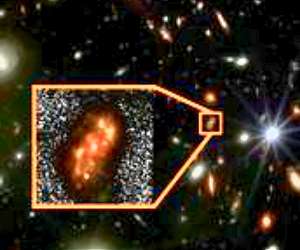
Astronomers using NASAs James Webb Space Telescope have identified a massive spiral galaxy that resembles the Milky Way but existed when the Universe was only about 1.5 billion years old. Named Alaknanda, after a Himalayan river paired with the Mandakini which shares its Hindi name with the Milky Way, the system appears as a mature, disk dominated spiral at a time when galaxies were expected to be irregular and still assembling. The galaxy was found in JWST images obtained as part of the UNCOVER a ... read more

STELLAR CHEMISTRY
Lodestar Space wins SECP support to advance AI satellite awareness system

ISS to change commanders before Soyuz crew leaves orbit

Micro nano robots aim to cut carbon buildup in closed life support systems

NASA extends ISS National Lab management contract through 2030

STELLAR CHEMISTRY
Space shuttle design study maps path to breakthrough inventions

LandSpace reviews booster loss after Zhuque-3 reusable rocket test

UK plasma thruster test positions Pulsar Fusion for larger satellite propulsion

EU dismisses 'completely crazy statements' after Musk attack

STELLAR CHEMISTRY
Martian sound study models acoustic signals in Jezero crater

Martian butterfly crater reveals low angle impact and buried lava history

Bacterial partnership offers pathway to produce Mars regolith bricks for future habitats

Chinese team runs long term Martian dust cycle simulation with GoMars model

STELLAR CHEMISTRY
Wenchang spaceport hits record cadence with double-digit launches in 2025

China consolidates new commercial space regulator and industry roadmap

Beijing space lab targets orbital data centers for AI era

China supports private space firms to expand global reach

STELLAR CHEMISTRY
MDA Space plans C250 million senior unsecured note issue maturing 2030

SLI and AscendArc agree on 200 million GEO satellite leasing framework

Applied Aerospace and PCX create US flight and space hardware group

EIB launches Space TechEU finance program for European space sector

STELLAR CHEMISTRY
Space operators urged to share costs of clearing orbital debris

X-MAT introduces X-FOAM: A game-changing ceramic foam for extreme environments

Canadian radar satellite contract positions MDA Space for RADARSAT replenishment role

IBM says buying data management firm Confluent for $11 bn

STELLAR CHEMISTRY
Subaru OASIS survey uncovers massive planet and brown dwarf

The bacteria that wont wake up found in spacecraft cleanrooms

Supernova mixing traced as source of key life elements

TRAPPIST 1 flares mapped to probe planetary habitability

STELLAR CHEMISTRY
SwRI links Uranus radiation belt mystery to solar storm driven waves

Looking inside icy moons

Saturn moon mission planning shifts to flower constellation theory

Could these wacky warm Jupiters help astronomers solve the planet formation puzzle?

Subscribe Free To Our Daily Newsletters


The content herein, unless otherwise known to be public domain, are Copyright 1995-2024 - Space Media Network. All websites are published in Australia and are solely subject to Australian law and governed by Fair Use principals for news reporting and research purposes. AFP, UPI and IANS news wire stories are copyright Agence France-Presse, United Press International and Indo-Asia News Service. ESA news reports are copyright European Space Agency. All NASA sourced material is public domain. Additional copyrights may apply in whole or part to other bona fide parties. All articles labeled "by Staff Writers" include reports supplied to Space Media Network by industry news wires, PR agencies, corporate press officers and the like. Such articles are individually curated and edited by Space Media Network staff on the basis of the report's information value to our industry and professional readership. Advertising does not imply endorsement, agreement or approval of any opinions, statements or information provided by Space Media Network on any Web page published or hosted by Space Media Network. General Data Protection Regulation (GDPR) Statement Our advertisers use various cookies and the like to deliver the best ad banner available at one time. All network advertising suppliers have GDPR policies (Legitimate Interest) that conform with EU regulations for data collection. By using our websites you consent to cookie based advertising. If you do not agree with this then you must stop using the websites from May 25, 2018. Privacy Statement. Additional information can be found here at About Us.