24/7 Space News
PHYSICS NEWS
Laser experiment proposed to probe quantum nature of gravity
illustration only

Laser experiment proposed to probe quantum nature of gravity

by Robert Schreiber
Berlin, Germany (SPX) Dec 17, 2025

Researchers at Helmholtz-Zentrum Dresden-Rossendorf have outlined an experiment in which light exchanges discrete packets of energy with gravitational waves, potentially revealing the long-sought quantum properties of gravity. In the proposed scheme, a laser beam interacts with a passing gravitational wave so that the light loses or gains an energy amount corresponding to one or more gravitons, the hypothetical quantum carriers of the gravitational field. The work, led by theoretical physicist Prof. Ralf Schutzhold, appears in Physical Review Letters under the title "Stimulated Emission or Absorption of Gravitons by Light" with DOI 10.1103/xd97-c6d7.

Schutzhold notes that gravity acts on all forms of energy, including electromagnetic radiation, so light and gravitational waves should influence each other when they cross. In the scenario he describes, a light wave can transfer a small energy packet to a gravitational wave, slightly amplifying the gravitational signal while reducing the light's energy by exactly the same amount. This loss appears as a minute shift in the light's frequency and corresponds to the emission of one or several gravitons into the gravitational wave.

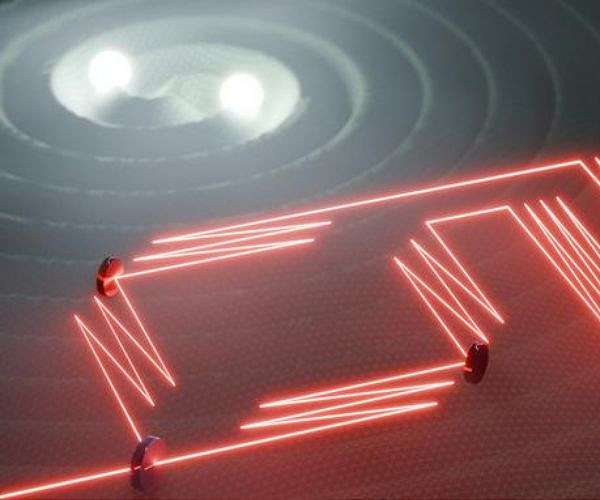
The process can also run in reverse, with the gravitational wave passing energy to the light so that the wave of spacetime loses a quantum of energy while the laser field gains it. Schutzhold calculates that detecting such stimulated emission and absorption of gravitons would demand a very large interferometric setup using intense laser pulses in the visible or near-infrared range. In one configuration, pulses would bounce between two mirrors up to a million times in a system about a kilometer long, generating an effective optical path length around one million kilometers.

However, the change in the frequency of the light wave caused by the absorption or release of the energy of one or more gravitons in interaction with the gravitational wave is extremely small. Nevertheless, by using a cleverly constructed interferometer it should be possible to demonstrate these changes in frequency. In the process, two light waves experience different changes in frequency - depending on whether they absorb or emit gravitons. After this interaction and passing along the optical path length they overlap again and generate an interference pattern. From this, it is possible to infer the frequency change that has occurred and thus the transfer of gravitons.

"It can take several decades from initial idea to experiment," says Schutzhold. But perhaps it might happen sooner in this case as the LIGO Observatory - acronym for the Laser Interferometer Gravitational-Wave Observatory - that is dedicated to detecting gravitational waves, shows strong similarities. LIGO consists of two L-shaped vacuum tubes approximately four kilometers long. A beam splitter divides a laser beam onto both arms of the detector. As they pass through, incoming gravitational waves minimally distort space-time, which causes changes of a few attometers (10-18 meters) in the originally equal length of the two arms. This tiny change in length alters the interference pattern of the laser light, generating a detectable signal.

In an interferometer tailored to Schutzhold's idea, it could be possible not only to observe gravitational waves but also to manipulate them for the first time by stimulated emission and absorption of gravitons. According to Schutzhold, light pulses whose photons are entangled, that is, quantum mechanically coupled, could significantly increase the sensitivity of the interferometer further. "Then we could even draw inferences about the quantum state of the gravitational field itself," says Schutzhold. While this would not be direct proof of the hypothetical graviton, which is the subject of intense debate among physicists, it would at least be a strong indication for its existence. After all, if the light waves did not exhibit the predicted interference effects when interacting with gravitational waves, the current theory based on gravitons would be disproved. It is thus hardly surprising that Schutzhold's concept for the manipulation of gravitational waves is meeting with great interest among his colleagues.

Research Report:Stimulated Emission or Absorption of Gravitons by Light

Related Links
Helmholtz-Zentrum Dresden-Rossendorf
The Physics of Time and Space

Subscribe Free To Our Daily Newsletters
Tweet

RELATED CONTENT
The following news reports may link to other Space Media Network websites.
PHYSICS NEWS
Quantum fuzzy spacetime may reshape gravity theory
Berlin, Germany (SPX) Dec 08, 2025
A team at TU Wien has developed a new way to connect quantum theory with general relativity by quantizing the spacetime metric and analyzing how this affects the paths that particles follow under gravity. Their work focuses on geodesics, the curves that represent the shortest connection between two points in curved spacetime and that underlie most applications of Einstein's theory, such as the orbit of Earth around the Sun. The researchers highlight that many candidate theories of quantum gravity ... read more

PHYSICS NEWS
ISS to change commanders before Soyuz crew leaves orbit

Lodestar Space wins SECP support to advance AI satellite awareness system

Micro nano robots aim to cut carbon buildup in closed life support systems

NASA extends ISS National Lab management contract through 2030

PHYSICS NEWS
Musk signals plan to launch IPO for SpaceX

Southern Launch to host INNOSPACE missions from South Australian spaceports

Rocket Lab completes first dedicated JAXA mission with Electron launch

Neutron Hungry Hippo fairing completes qualification ahead of first launch

PHYSICS NEWS
GoMars model simulates Martian dust storms to improve mission safety

NASA JPL Unveils Rover Operations Center for Moon, Mars Missions

Ancient Martian brines left bromine rich fingerprints in jarosite minerals

Maven stays silent after routine pass behind Mars

PHYSICS NEWS
Experts at Hainan symposium call for stronger global space partnership

Foreign satellites ride Kinetica 1 on new CAS Space mission

Triple Long March launches mark record day for Chinese space program

China prepares Qingzhou cargo ship for low cost resupply flights

PHYSICS NEWS
Smart modeling framework targets 6G spectrum chaos in space air and ground networks

K2 Space raises 250m to scale Mega class high power satellites

Private capital targets mission-critical software power and platforms in new space economy

Beyond Gravity positions new modular satellite platform for European LEO missions

PHYSICS NEWS
Galactic Slots: Space-Themed Games with Out-of-This-World Bonus Features

X-MAT introduces X-FOAM: A game-changing ceramic foam for extreme environments

Bible 1.0: How Ancient Canon Became Our First Large Language Models

Digital twin successfully launched and deployed into space

PHYSICS NEWS
RISTRETTO spectrograph cleared for Proxima b atmospheric hunt

Clues to the migration path of hot Jupiters in their orbits

Can scientists detect life without knowing what it looks like

Ultra hot super Earth shows dense atmosphere over magma ocean

PHYSICS NEWS
Uranus and Neptune may be rock rich worlds

SwRI links Uranus radiation belt mystery to solar storm driven waves

Looking inside icy moons

Saturn moon mission planning shifts to flower constellation theory

Subscribe Free To Our Daily Newsletters


The content herein, unless otherwise known to be public domain, are Copyright 1995-2024 - Space Media Network. All websites are published in Australia and are solely subject to Australian law and governed by Fair Use principals for news reporting and research purposes. AFP, UPI and IANS news wire stories are copyright Agence France-Presse, United Press International and Indo-Asia News Service. ESA news reports are copyright European Space Agency. All NASA sourced material is public domain. Additional copyrights may apply in whole or part to other bona fide parties. All articles labeled "by Staff Writers" include reports supplied to Space Media Network by industry news wires, PR agencies, corporate press officers and the like. Such articles are individually curated and edited by Space Media Network staff on the basis of the report's information value to our industry and professional readership. Advertising does not imply endorsement, agreement or approval of any opinions, statements or information provided by Space Media Network on any Web page published or hosted by Space Media Network. General Data Protection Regulation (GDPR) Statement Our advertisers use various cookies and the like to deliver the best ad banner available at one time. All network advertising suppliers have GDPR policies (Legitimate Interest) that conform with EU regulations for data collection. By using our websites you consent to cookie based advertising. If you do not agree with this then you must stop using the websites from May 25, 2018. Privacy Statement. Additional information can be found here at About Us.