24/7 Space News
WATER WORLD
ENSO drives synchronized shifts in global water extremes
illustration only

ENSO drives synchronized shifts in global water extremes

by Monica Kortsha
Austin, United States (SPX) Jan 12, 2026

Water extremes such as droughts and floods strongly affect communities, ecosystems, and economies across the globe, and new research shows that a single climate pattern has largely driven these extremes over the past two decades.

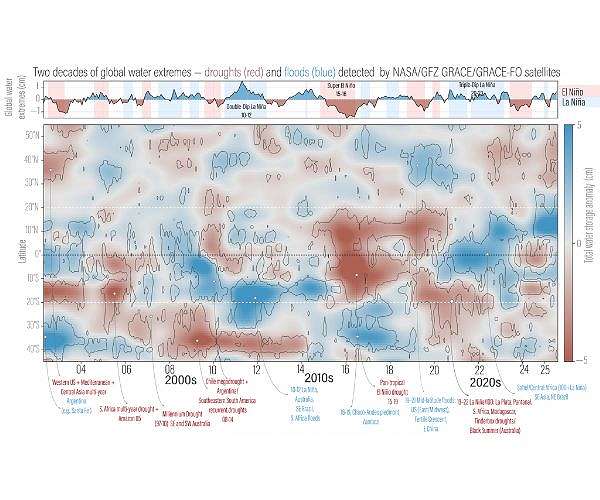
In a study in AGU Advances, scientists at The University of Texas at Austin report that the El Nino Southern Oscillation, or ENSO, has been the dominant influence on global total water storage extremes since 2002, synchronizing wet and dry conditions across continents.

Study co author Bridget Scanlon, a research professor at the Bureau of Economic Geology at the UT Jackson School of Geosciences, said that identifying how extremes unfold worldwide has major implications for humanitarian planning and policy.

"Looking at the global scale, we can identify what areas are simultaneously wet or simultaneously dry," Scanlon said. "And that of course affects water availability, food production, food trade - all of these global things."

Total water storage is a key climate metric that sums all water in a region, including surface water in rivers and lakes, snowpack, soil moisture, and groundwater.

The new analysis is among the first to track total water storage extremes and ENSO together at the global level, allowing researchers to examine how far flung water extremes connect, said lead author Ashraf Rateb, a research assistant professor at the Bureau of Economic Geology.

"Most studies count extreme events or measure how severe they are, but by definition extremes are rare. That gives you very few data points to study changes over time," Rateb said. "Instead, we examined how extremes are spatially connected, which provides much more information about the patterns driving droughts and floods globally."

The team used gravity measurements from NASA's GRACE and GRACE Follow On (GRACE FO) satellite missions to estimate total water storage at spatial scales of roughly 300 to 400 kilometers, an area similar to the size of the U.S. state of Indiana.

They defined wet extremes as values above the 90th percentile of total water storage for a region and dry extremes as values below the 10th percentile.

The results show that abnormal ENSO activity can push distant regions into wet or dry extremes at the same time.

Dry extremes line up with El Nino events in some regions and with La Nina in others, with the opposite relationship for wet extremes.

For example, South Africa experienced dry extremes during an El Nino event in the mid 2000s, while the Amazon saw severe drying during the strong 2015 to 2016 El Nino.

In contrast, the 2010 to 2011 La Nina corresponded to extremely wet conditions in Australia, southeast Brazil, and South Africa, illustrating ENSO's capacity to synchronize water extremes across continents.

Beyond the immediate ENSO signal, the researchers identified a global shift in water extremes around 2011 to 2012.

Before 2011, wet extremes dominated the global pattern.

After 2012, dry extremes became more common, a transition the team links to a decade long climate pattern in the Pacific that modulates ENSO's impacts on land water storage.

Because GRACE and GRACE FO observations do not cover the entire period continuously, including an 11 month gap between missions in 2017 to 2018, the scientists used probabilistic models based on spatial patterns to reconstruct total water storage extremes when satellite data were unavailable.

Altogether, the GRACE and GRACE FO records provide a 22 year window from 2002 to 2024, which is short in climate terms but still reveals how tightly climate and terrestrial water are coupled worldwide, said JT Reager, deputy project scientist for the GRACE FO mission at NASA's Jet Propulsion Laboratory and JPL Discipline Program manager for the Water and Energy Cycle.

"They're really capturing the rhythm of these big climate cycles like El Nino and La Nina and how they affect floods and droughts, which are something we all experience," Reager said. "It's not just the Pacific Ocean out there doing its own thing. Everything that happens out there seems to end up affecting us all here on land."

Scanlon said that recognizing water extremes as part of broader climate cycles underscores the need to plan for variability rather than treating scarcity as a simple depletion problem.

"Oftentimes we hear the mantra that we're running out of water, but really it's managing extremes," Scanlon said. "And that's quite a different message."

The research was supported by the UT Jackson School of Geosciences.

Research Report:Dynamics and Couplings of Terrestrial Water Storage Extremes From GRACE and GRACE FO Missions During 2002 2024

Related Links
University of Texas at Austin
Water News - Science, Technology and Politics

Subscribe Free To Our Daily Newsletters
Tweet

RELATED CONTENT
The following news reports may link to other Space Media Network websites.
WATER WORLD
Ankara city hall says water cuts due to 'record drought'
Ankara (AFP) Jan 10, 2026
Water cuts for the past several weeks in Turkey's capital were due to the worst drought in 50 years and an exploding population, a municipal official told AFP, rejecting accusations of mismanagement. Dam reservoir levels have dropped to 1.12 percent and taps are being shut off for several hours a day in certain districts on a rotating schedule in Ankara, forcing many residents to line up at public fountains to fill pitchers. "2025 was a record year in terms of drought. The amount of water feedi ... read more

WATER WORLD
Startups go public in litmus test for Chinese AI

Sprawling CES gadgetfest a world stage for AI and its hype

ESA reaches new benchmark in autonomous formation flying

Billionaire Trump nominee confirmed to lead NASA amid Moon race

WATER WORLD
North Korea tests hypersonic missiles, says nuclear forces ready for war

AI systems proposed to boost launch cadence reliability and traffic management

China debuts Long March 12A reusable rocket in Jiuquan test flight

Japan's flagship H3 rocket fails to launch satellite

WATER WORLD
Wind-Sculpted Landscapes: Investigating the Martian Megaripple 'Hazyview'

HiRISE camera aboard Mars Reconnaissance Orbiter passes 100000 image milestone

Search for life should be top science priority for first human landing on Mars report says

Curiosity Blog, Sols 4750-4762: See You on the Other Side of the Sun

WATER WORLD
China harnesses nationwide system to drive spaceflight and satellite navigation advances

Shenzhou 21 crew complete eight hour spacewalk outside Tiangong station

Foreign satellites ride Kinetica 1 on new CAS Space mission

Experts at Hainan symposium call for stronger global space partnership

WATER WORLD
Time-expanded network model cuts complexity in mega constellation launch planning

Southern Launch to Host Lux Aeterna Re-Entries South Australia

Smart modeling framework targets 6G spectrum chaos in space air and ground networks

K2 Space raises 250m to scale Mega class high power satellites

WATER WORLD
Planet delivers first light image from Pelican 6 satellite capturing Lhasa Gonggar Airport

New tool narrows the search for ideal material structures

Chlorine and hydrogen from waste brines without external power

Ferritic alloy offers superalloy-level strength and oxidation resistance for reactor systems

WATER WORLD
Deep Arctic gas hydrate mounds host ultra deep cold seep ecosystem

Clues to the migration path of hot Jupiters in their orbits

Hubble pinpoints asteroid smash ups in nearby Fomalhaut system

Evolution study finds history and environment shifts can steer species in very different directions

WATER WORLD
Uranus and Neptune may be rock rich worlds

SwRI links Uranus radiation belt mystery to solar storm driven waves

Looking inside icy moons

Saturn moon mission planning shifts to flower constellation theory

Subscribe Free To Our Daily Newsletters


The content herein, unless otherwise known to be public domain, are Copyright 1995-2024 - Space Media Network. All websites are published in Australia and are solely subject to Australian law and governed by Fair Use principals for news reporting and research purposes. AFP, UPI and IANS news wire stories are copyright Agence France-Presse, United Press International and Indo-Asia News Service. ESA news reports are copyright European Space Agency. All NASA sourced material is public domain. Additional copyrights may apply in whole or part to other bona fide parties. All articles labeled "by Staff Writers" include reports supplied to Space Media Network by industry news wires, PR agencies, corporate press officers and the like. Such articles are individually curated and edited by Space Media Network staff on the basis of the report's information value to our industry and professional readership. Advertising does not imply endorsement, agreement or approval of any opinions, statements or information provided by Space Media Network on any Web page published or hosted by Space Media Network. General Data Protection Regulation (GDPR) Statement Our advertisers use various cookies and the like to deliver the best ad banner available at one time. All network advertising suppliers have GDPR policies (Legitimate Interest) that conform with EU regulations for data collection. By using our websites you consent to cookie based advertising. If you do not agree with this then you must stop using the websites from May 25, 2018. Privacy Statement. Additional information can be found here at About Us.