24/7 Space News
TECTONICS
Ancient Tethys Ocean helped build Central Asia mountains
illustration only

Ancient Tethys Ocean helped build Central Asia mountains

by Simon Mansfield
Sydney, Australia (SPX) Jan 15, 2026

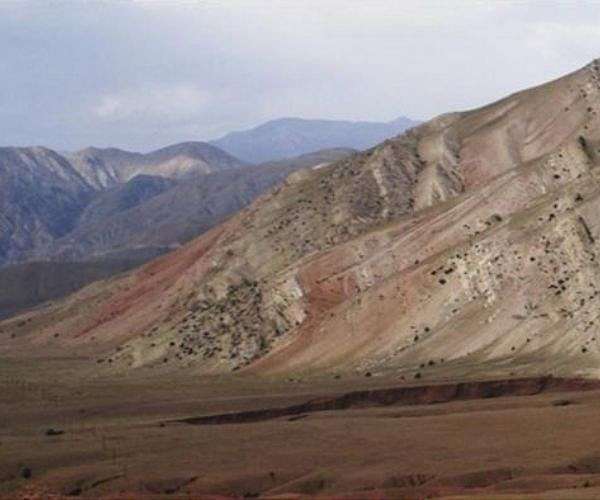
New research from Adelaide University links the power of the ancient Tethys Ocean to the way Central Asia's landscape developed during the Cretaceous period. The work draws on decades of thermochronology data to reassess how mountains in the region rose and evolved.

The study uses a big data approach built from hundreds of published thermal history models for Central Asia compiled over about 30 years. These models track when rocks cooled as they moved toward the surface during mountain uplift and subsequent erosion, providing a time-resolved record of tectonic activity.

Creation of Central Asia's landscape is usually explained as the result of interactions between tectonic forces, climate and mantle processes over the last 250 million years. The new analysis, however, suggests that climate change and mantle convection played only a minor role, with the region remaining arid for much of that interval.

"We found that climate change and mantle processes had only little influence on the Central Asian landscape, which persisted in an arid climate for much of the last 250 million years," said lead author Dr Sam Boone, who conducted the research while a post doctoral researcher at Adelaide University. "Instead, the dynamics of the distant Tethys Ocean can directly be correlated with short lived periods of mountain building in Central Asia."

The once extensive Tethys Ocean closed during the Meso Cenozoic era, which spans roughly the last 250 million years, and survives today only as the Mediterranean Sea. The team links tectonic changes in this retreating ocean basin to pulses of deformation thousands of kilometers inland.

Co author Associate Professor Stijn Glorie, from Adelaide University's School of Physics, Chemistry and Earth Sciences, said the present day relief of Central Asia mainly formed through the collision and continued convergence between India and Eurasia. According to Glorie, this collision built the major mountain belts that dominate the region today.

However, the researchers conclude that during the Cretaceous period, dinosaurs would also have seen a rugged landscape in Central Asia. They compare this earlier topography to the present day Basin and Range Province in the western United States, which consists of a series of roughly parallel mountain ranges and intervening basins.

"It is thought that the extension in the Tethys, due to roll back of subducting slabs of ocean crust, reactivated old suture zones into a series of roughly parallel ridges in Central Asia, up to thousands of kilometres away from the Himalaya collision zone," Glorie said. These reactivated structures provided pathways for rocks to be uplifted and cooled, leaving a recognizable signal in the thermal history models.

To test these ideas, the team analysed their compilation of thermal history models alongside plate tectonic reconstructions of the Tethys Ocean, as well as deep time precipitation and mantle convection models. By comparing the timing of cooling events in Central Asian rocks to changes in plate boundaries and subduction geometry, they identified correlations that point to the ocean as a key driver.

The research appears in Nature Communications Earth and Environment and demonstrates the potential of combining thermochronology with global geodynamic models. The authors argue that this integrative method can reveal previously hidden links between distant plate boundary processes and intraplate mountain building.

Glorie said the same approach could clarify the drivers of other poorly understood episodes of mountain building and rifting around the world. In particular, he highlighted the break up of Australia from Antarctica as a nearby example where the tectonic record is puzzling.

Australia separated from Antarctica about 80 million years ago, but the thermal history data from both continental margins mostly record older cooling events. There is little obvious imprint of that break up in the available thermochronology record, which raises questions about how the rift and subsequent seafloor spreading progressed.

The Adelaide team is now applying its Central Asia workflow to investigate the Australia Antarctica system. By integrating new and existing thermal history models with updated plate reconstructions and geodynamic simulations, they aim to better constrain when and how the two continents finally parted.

Beyond specific case studies, the researchers suggest that systematic global compilations of thermochronology data could transform understanding of how surface topography responds to changes at convergent and divergent plate margins. Such databases would allow scientists to test whether distant subduction dynamics, like those recorded in the Tethys Ocean, have shaped other continental interiors in similar ways.

Research Report:Deciphering mantle, tectonic and climatic drivers of exhumation

Related Links
Adelaide University
Tectonic Science and News

Subscribe Free To Our Daily Newsletters
Tweet

RELATED CONTENT
The following news reports may link to other Space Media Network websites.
TECTONICS
Study reveals why mysterious structures within Earth's mantle hold clues to life here
New Brunswick, NJ (SPX) Nov 20, 2025
For decades, scientists have been baffled by two enormous, enigmatic structures buried deep inside Earth with features so vast and unusual that they defy conventional models of planetary evolution. Now, a study published in Nature Geoscience by Rutgers geodynamicist Yoshinori Miyazaki in combination with collaborators offers a striking new explanation for these anomalies and their role in shaping Earth's ability to support life. The structures, known as large low-shear-velocity provinces and ... read more

TECTONICS
International Space Station crew to return early after astronaut medical issue

Startups go public in litmus test for Chinese AI

Second ESCAPADE spacecraft completes key trajectory fix on path to Mars

Overseas scholars drawn to China's scientific clout, funding

TECTONICS
North Korea tests hypersonic missiles, says nuclear forces ready for war

Galileo satellites ride Ariane 6 to boost Europe navigation resilience

AI systems proposed to boost launch cadence reliability and traffic management

China debuts Long March 12A reusable rocket in Jiuquan test flight

TECTONICS
The electrifying science behind Martian dust

Sandblasting winds sculpt Mars landscape

Thin ice may have protected lake water on frozen Mars

Curiosity's Nevado Sajama postcard captures Mars on the eve of conjunction

TECTONICS
Tiangong science program delivers data surge

China tallies record launch year as lunar and asteroid plans advance

China harnesses nationwide system to drive spaceflight and satellite navigation advances

Shenzhou 21 crew complete eight hour spacewalk outside Tiangong station

TECTONICS
Disaster losses drop in 2025, picture still 'alarming': Munich Re

Time-expanded network model cuts complexity in mega constellation launch planning

Southern Launch to Host Lux Aeterna Re-Entries South Australia

Smart modeling framework targets 6G spectrum chaos in space air and ground networks

TECTONICS
Planet delivers first light image from Pelican 6 satellite capturing Lhasa Gonggar Airport

New tool narrows the search for ideal material structures

Chlorine and hydrogen from waste brines without external power

Fast FPGA pulse shaping clears neutron gamma pile ups in nuclear detectors

TECTONICS
Puffy young exoplanets reveal origin of super Earths

M dwarf plasma torus offers window into space weather and planetary habitability

We finally know how the most common types of planets are created

NASA selects industry partners to mature Habitable Worlds Observatory technologies

TECTONICS
Jupiter's moon Europa has a seafloor that may be quiet and lifeless

Uranus and Neptune may be rock rich worlds

SwRI links Uranus radiation belt mystery to solar storm driven waves

Looking inside icy moons

Subscribe Free To Our Daily Newsletters


The content herein, unless otherwise known to be public domain, are Copyright 1995-2024 - Space Media Network. All websites are published in Australia and are solely subject to Australian law and governed by Fair Use principals for news reporting and research purposes. AFP, UPI and IANS news wire stories are copyright Agence France-Presse, United Press International and Indo-Asia News Service. ESA news reports are copyright European Space Agency. All NASA sourced material is public domain. Additional copyrights may apply in whole or part to other bona fide parties. All articles labeled "by Staff Writers" include reports supplied to Space Media Network by industry news wires, PR agencies, corporate press officers and the like. Such articles are individually curated and edited by Space Media Network staff on the basis of the report's information value to our industry and professional readership. Advertising does not imply endorsement, agreement or approval of any opinions, statements or information provided by Space Media Network on any Web page published or hosted by Space Media Network. General Data Protection Regulation (GDPR) Statement Our advertisers use various cookies and the like to deliver the best ad banner available at one time. All network advertising suppliers have GDPR policies (Legitimate Interest) that conform with EU regulations for data collection. By using our websites you consent to cookie based advertising. If you do not agree with this then you must stop using the websites from May 25, 2018. Privacy Statement. Additional information can be found here at About Us.