24/7 Space News
TIME AND SPACE
Thorium 229 nuclei driven by laser in opaque solid moves optical nuclear clock research forward
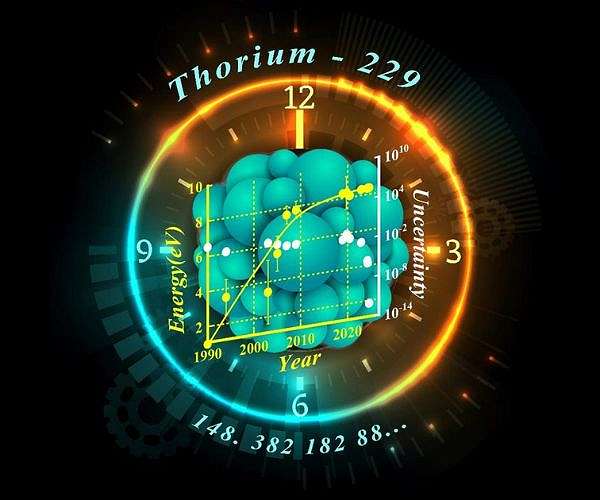
illustration only

Thorium 229 nuclei driven by laser in opaque solid moves optical nuclear clock research forward

by Robert Schreiber
Berlin, Germany (SPX) Dec 18, 2025
A team from the University of California Los Angeles (UCLA), Ludwig Maximilian University of Munich (LMU), and Johannes Gutenberg University Mainz (JGU) has for the first time excited the atomic nucleus of the isotope thorium 229 with laser light while the atoms are embedded in a non transparent solid host. The experiment demonstrates that nuclear laser excitation is possible even when the surrounding material is almost opaque at the excitation wavelength of 148 nanometers, opening a new class of solids for nuclear laser spectroscopy. The work is presented as a step toward quantum technologies based on nuclear transitions, including a prospective optical nuclear clock, and has been reported in the journal Nature.

Laser control of atomic electron shells has been standard since the 1960s and underpins optical atomic clocks and many quantum information platforms. Only in 2024 did researchers directly excite an atomic nucleus with laser light for the first time, marking the emergence of nuclear laser spectroscopy as a distinct field. The new study extends this capability from transparent host materials to a non transparent medium that can incorporate and stabilize thorium atoms while still allowing sufficient interaction with the 148 nanometer laser light used to drive the nuclear transition.

Until now, experimental excitation of the thorium 229 nucleus had been restricted to host crystals that transmit this vacuum ultraviolet wavelength. The new demonstration shows that even materials that are nearly opaque at 148 nanometers can still support nuclear excitation if they provide the right environment for thorium ions and allow a fraction of the laser light to reach them. This broadens the range of solid state systems available for precision nuclear spectroscopy, including materials selected for mechanical, thermal, or electronic properties rather than transparency alone.

The experiment also opens the way to laser based internal conversion (IC Mossbauer spectroscopy) in solids containing thorium 229. In IC Mossbauer spectroscopy, the de excited nucleus transfers its energy to an atomic electron, which is then emitted as a conversion electron. Detecting these electrons provides a sensitive probe of the nuclear transition in a solid state environment and enables detailed studies of how crystal fields and electronic structure influence nuclear energy levels.

"This success opens the door to a previously inaccessible area of nuclear physics," explains Dr. Lars von der Wense of the Institute of Physics at JGU, who first proposed the experiment in 2017. "The fact that we can now also perform nuclear excitation in non-transparent materials enables completely new experiments - and brings us a significant step closer to realizing an optical nuclear clock."

An optical nuclear clock based on thorium 229 is regarded as a candidate for an extremely stable frequency standard. Among other things, it could improve satellite based navigation and enable more precise applications in Earth observation, autonomous transport, and fundamental research. Particular attention also lies on questions of fundamental physics, such as searching for temporal variations in the constants of nature and the detection of dark matter.

With their recent achievement, the researchers have laid the foundation for numerous future experiments and applications and shown the potential of combining vacuum ultraviolet laser technology with nuclear physics. Their results indicate how engineered solid state environments and laser control of nuclear transitions can support the development of next generation nuclear clocks and related quantum technologies.

Research Report:Laser-based conversion electron Mossbauer spectroscopy of 229ThO2

Related Links
Johannes Gutenberg Universitaet Mainz
Understanding Time and Space

Subscribe Free To Our Daily Newsletters
Tweet

RELATED CONTENT
TIME AND SPACE
Thorium plated steel points to smaller nuclear clocks
Los Angeles CA (SPX) Dec 11, 2025
Last year a UCLA-led team achieved a long-sought goal in nuclear spectroscopy by making radioactive thorium-229 nuclei absorb and emit photons in a controlled way, a capability scientists had pursued for about 50 years. That work, first proposed by the group in 2008, opened the door to nuclear clocks with very high precision that could influence navigation and tests of fundamental physics. The approach relies on the rare isotope thorium-229, which must be extracted from weapons-grade uranium, leav ... read more

TIME AND SPACE
Sprawling CES gadgetfest a world stage for AI and its hype

ISS to change commanders before Soyuz crew leaves orbit

Lodestar Space wins SECP support to advance AI satellite awareness system

Micro nano robots aim to cut carbon buildup in closed life support systems

TIME AND SPACE
Hydrogen from ethanol reforming mapped as aviation fuel-cell pathway

Europe's Ariane 6 rocket puts EU navigation satellites in orbit

Southern Launch to host INNOSPACE missions from South Australian spaceports

Rocket Lab completes first dedicated JAXA mission with Electron launch

TIME AND SPACE
HiRISE camera aboard Mars Reconnaissance Orbiter passes 100000 image milestone

GoMars model simulates Martian dust storms to improve mission safety

Maven stays silent after routine pass behind Mars

Ancient Martian brines left bromine rich fingerprints in jarosite minerals

TIME AND SPACE
Shenzhou 21 crew complete eight hour spacewalk outside Tiangong station

Foreign satellites ride Kinetica 1 on new CAS Space mission

Experts at Hainan symposium call for stronger global space partnership

Triple Long March launches mark record day for Chinese space program

TIME AND SPACE
K2 Space raises 250m to scale Mega class high power satellites

Beyond Gravity positions new modular satellite platform for European LEO missions

Private capital targets mission-critical software power and platforms in new space economy

Applied Aerospace and PCX create US flight and space hardware group

TIME AND SPACE
One pull of a string is all it takes to deploy these complex structures

Japan's SoftBank in $4bln AI deal to buy DigitalBridge

US denies visas to EU ex-commissioner, four others over tech rules

Modena team outlines staged roadmap to cut emissions from metal laser 3D printing

TIME AND SPACE
Clues to the migration path of hot Jupiters in their orbits

Can scientists detect life without knowing what it looks like

Ultra hot super Earth shows dense atmosphere over magma ocean

Hidden circumbinary giant planet emerges from decade old Gemini data

TIME AND SPACE
Uranus and Neptune may be rock rich worlds

SwRI links Uranus radiation belt mystery to solar storm driven waves

Looking inside icy moons

Saturn moon mission planning shifts to flower constellation theory


The content herein, unless otherwise known to be public domain, are Copyright 1995-2026 - SpaceDaily.com. All websites are published in Australia and are solely subject to Australian law and governed by Fair Use principals for news reporting and research purposes. AFP, UPI and IANS news wire stories are copyright Agence France-Presse, United Press International and Indo-Asia News Service. ESA news reports are copyright European Space Agency. All NASA sourced material is public domain. Additional copyrights may apply in whole or part to other bona fide parties. All articles labeled "by Staff Writers" include reports supplied to Space Media Network by industry news wires, PR agencies, corporate press officers and the like. Such articles are individually curated and edited by Space Media Network staff on the basis of the report's information value to our industry and professional readership. Advertising does not imply endorsement, agreement or approval of any opinions, statements or information provided by Space Media Network on any Web page published or hosted by Space Media Network. General Data Protection Regulation (GDPR) Statement Our advertisers use various cookies and the like to deliver the best ad banner available at one time. All network advertising suppliers have GDPR policies (Legitimate Interest) that conform with EU regulations for data collection. By using our websites you consent to cookie based advertising. If you do not agree with this then you must stop using the websites from May 25, 2018. Privacy Statement. Additional information can be found here at About Us.
Subscribe Free To Our Daily Newsletters