24/7 Space News
TIME AND SPACE
Quasar X ray link to black hole environment found to evolve over cosmic time
illustration only

Quasar X ray link to black hole environment found to evolve over cosmic time

by Robert Schreiber
London, UK (SPX) Dec 14, 2025
Astronomers using new X ray data have found evidence that the structure of matter around supermassive black holes has changed over billions of years, challenging a quasar relationship that has been treated as a fundamental law for nearly 50 years.

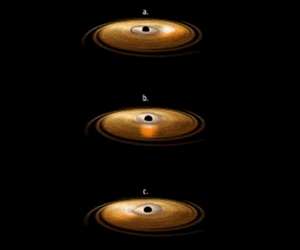
Quasars, identified in the 1960s, rank among the brightest known cosmic sources and are powered by supermassive black holes that draw in surrounding matter. As infalling material forms a rapidly rotating accretion disc and spirals toward the black hole, friction heats the gas to high temperatures and produces intense ultraviolet light, often hundreds to a thousand times brighter than a typical galaxy of 100 billion stars and capable of drowning out the host galaxy's starlight.

This ultraviolet emission is thought to power the X rays seen from quasars, as UV photons pass through a compact region of energetic particles near the black hole known as the corona. When UV photons scatter off these high energy particles, they gain energy and emerge as strong X ray radiation detectable with modern instruments.

Because both components arise from the same accretion flow, quasar X ray and ultraviolet luminosities show a tight correlation, where higher UV brightness usually comes with stronger X ray output. Established almost five decades ago, this relation has underpinned models of the geometry and physical state of gas close to supermassive black holes and has been central to efforts to use quasars as distance indicators.

The new study, led by researchers at the National Observatory of Athens and published in Monthly Notices of the Royal Astronomical Society, finds that this X ray to UV relation is not the same at all epochs. The team reports that when the universe was about half its current age, the correlation between quasar X ray and ultraviolet emission differed significantly from that seen in nearby quasars, implying that the disc corona connection has evolved over roughly the last 6.5 billion years.

"Confirming a non-universal X-ray-to-ultraviolet relation with cosmic time is quite surprising and challenges our understanding of how supermassive black holes grow and radiate," said Dr Antonis Georgakakis, one of the study's authors. "We tested the result using different approaches, but it appears to be persistent."

To probe this evolution, the astronomers combined new observations from the eROSITA X ray telescope with archival measurements from the European Space Agency's XMM-Newton observatory, assembling an unusually large quasar sample. The broad, uniform sky coverage from eROSITA was crucial, allowing the group to examine quasar populations on scales not previously accessible.

The long assumed universality of the UV X ray relation is also a key ingredient in techniques that treat quasars as standard candles to map cosmic expansion and investigate dark matter and dark energy. The reported evolution means that methods assuming a fixed relation over time may be biased, and the structure of material around black holes must be reassessed before drawing firm cosmological conclusions.

"The key advance here is methodological," said postdoctoral researcher Maria Chira of the National Observatory of Athens, who led the work. "The eROSITA survey is vast but relatively shallow - many quasars are detected with only a few X-ray photons. By combining these data in a robust Bayesian statistical framework, we could uncover subtle trends that would otherwise remain hidden."

Future eROSITA all sky scans will provide even larger samples of faint and distant quasars, allowing researchers to test whether the observed change in the X ray UV relation reflects a genuine shift in accretion physics or arises from selection effects. Analyses that merge upcoming X ray catalogues with multiwavelength surveys should clarify how supermassive black hole discs and coronae evolve and refine the use of quasars in precision cosmology.

Such work will deepen understanding of how black holes drive the most luminous persistent sources in the universe and how their energy output has varied across cosmic history.

Research Report:Revisiting the X-ray-to-UV relation of Quasars in the era of all-sky surveys

Related Links
Royal Astronomical Society
Understanding Time and Space

Subscribe Free To Our Daily Newsletters
Tweet

RELATED CONTENT
TIME AND SPACE
Star wobble reveals black hole dragging spacetime
Berlin, Germany (SPX) Dec 11, 2025
Astronomers have reported the first clear observation of a swirling distortion in spacetime produced by a rapidly spinning black hole, seen through the motion of material left over from a disrupted star. The team, led by researchers at the National Astronomical Observatories of the Chinese Academy of Sciences with support from Cardiff University, studied AT2020afhd, a tidal disruption event in which a star was torn apart by the intense gravity of a supermassive black hole. As the star was destroy ... read more

TIME AND SPACE
Lodestar Space wins SECP support to advance AI satellite awareness system

ISS to change commanders before Soyuz crew leaves orbit

Micro nano robots aim to cut carbon buildup in closed life support systems

NASA extends ISS National Lab management contract through 2030

TIME AND SPACE
LandSpace reviews booster loss after Zhuque-3 reusable rocket test

UK plasma thruster test positions Pulsar Fusion for larger satellite propulsion

Neutron Hungry Hippo fairing completes qualification ahead of first launch

EU dismisses 'completely crazy statements' after Musk attack

TIME AND SPACE
Martian sound study models acoustic signals in Jezero crater

NASA JPL Unveils Rover Operations Center for Moon, Mars Missions

Maven stays silent after routine pass behind Mars

Martian butterfly crater reveals low angle impact and buried lava history

TIME AND SPACE
Experts at Hainan symposium call for stronger global space partnership

Foreign satellites ride Kinetica 1 on new CAS Space mission

Triple Long March launches mark record day for Chinese space program

China prepares Qingzhou cargo ship for low cost resupply flights

TIME AND SPACE
Beyond Gravity positions new modular satellite platform for European LEO missions

From 1Mbps to 200: Starlink's Gaming Speed Revolution Explained

Private capital targets mission-critical software power and platforms in new space economy

MDA Space plans C250 million senior unsecured note issue maturing 2030

TIME AND SPACE
What is the appeal of playing space-themed video games?

ONE Bow River backs Odyssey Space Research growth in flight software and mission engineering

D-Orbit launches dual orbital transportation missions, passes 200-payload milestone

Space operators urged to share costs of clearing orbital debris

TIME AND SPACE
Subaru OASIS survey uncovers massive planet and brown dwarf

The bacteria that wont wake up found in spacecraft cleanrooms

Supernova mixing traced as source of key life elements

RISTRETTO spectrograph cleared for Proxima b atmospheric hunt

TIME AND SPACE
Uranus and Neptune may be rock rich worlds

SwRI links Uranus radiation belt mystery to solar storm driven waves

Looking inside icy moons

Saturn moon mission planning shifts to flower constellation theory


The content herein, unless otherwise known to be public domain, are Copyright 1995-2026 - SpaceDaily.com. All websites are published in Australia and are solely subject to Australian law and governed by Fair Use principals for news reporting and research purposes. AFP, UPI and IANS news wire stories are copyright Agence France-Presse, United Press International and Indo-Asia News Service. ESA news reports are copyright European Space Agency. All NASA sourced material is public domain. Additional copyrights may apply in whole or part to other bona fide parties. All articles labeled "by Staff Writers" include reports supplied to Space Media Network by industry news wires, PR agencies, corporate press officers and the like. Such articles are individually curated and edited by Space Media Network staff on the basis of the report's information value to our industry and professional readership. Advertising does not imply endorsement, agreement or approval of any opinions, statements or information provided by Space Media Network on any Web page published or hosted by Space Media Network. General Data Protection Regulation (GDPR) Statement Our advertisers use various cookies and the like to deliver the best ad banner available at one time. All network advertising suppliers have GDPR policies (Legitimate Interest) that conform with EU regulations for data collection. By using our websites you consent to cookie based advertising. If you do not agree with this then you must stop using the websites from May 25, 2018. Privacy Statement. Additional information can be found here at About Us.
Subscribe Free To Our Daily Newsletters