24/7 Space News
SOLAR SCIENCE
New MAGE model links solar storms to geospace response
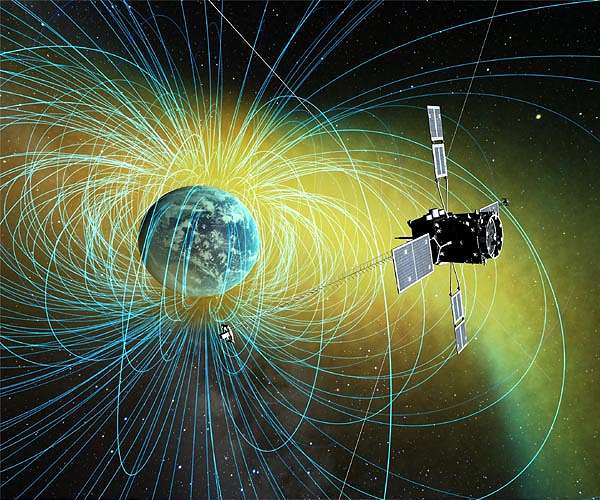
illustration only

New MAGE model links solar storms to geospace response

by Clarence Oxford
Los Angeles CA (SPX) Dec 14, 2025

NASA's Center for Geospace Storms, or CGS, has released the Multiscale Atmosphere-Geospace Environment model, or MAGE, a supercomputer-based system that uses NASA mission data to show how different regions of geospace react to solar disturbances.

The MAGE model links several existing predictive tools for Earth's magnetosphere, ring current, and upper atmosphere into a single framework, giving space weather specialists a more complete view of how solar activity drives changes in near-Earth space.

Researchers can access MAGE through NASA's Community Coordinated Modeling Center as well as via a public GitHub repository, where they can run simulations and integrate model outputs into their own studies of space weather.

The CGS team has also produced an open analysis and visualization package that enables users to process and display MAGE results, making it easier for scientists to examine simulations and compare them directly with observations.

"The public release of MAGE represents a major milestone for CGS and the space science community," said Slava Merkin, director of CGS at Johns Hopkins University's Applied Physics Laboratory in Laurel, Maryland.

"Our team is looking forward to working with heliophysics researchers on making scientific discoveries and helping to better predict space weather."

CGS is one of three NASA DRIVE (Diversify, Realize, Integrate, Venture, Educate) science centers, which were formed to support collaborative heliophysics work by bringing together multidisciplinary teams from several U.S. institutions.

These centers employ modelers, theorists, computer scientists, and observers to investigate how the Sun influences the space environment, and the development of MAGE involved more than 50 experts from seven organizations.

Heliophysics examines the coupled system that extends from the Sun through the space around Earth and other planets and out to the limits of the solar wind, with particular attention to how solar flares, coronal mass ejections, solar particle events, and the solar wind shape geospace.

This research underpins space weather science, which focuses on understanding and forecasting changes in the near-Earth environment that can affect technology and infrastructure.

Space weather storms can generate auroras, disrupt power grids, interfere with communications and navigation, and increase radiation exposure for astronauts and satellites, so realistic modeling tools such as MAGE are important for monitoring and forecasting these events.

The need for reliable space weather forecasts is growing as plans advance for sustained human activity beyond low Earth orbit, including NASA's Artemis campaign to explore the Moon and prepare for future crewed missions to Mars.

In May 2024, the MAGE model was used to simulate a sequence of strong solar flares and coronal mass ejections that struck Earth, producing a geospace storm rated G5, the highest level on the geomagnetic storm scale and the most intense in about two decades.

These storms generated bright auroras visible worldwide, including at unusually low magnetic latitudes such as the southern United States, offering a detailed test case for comparing MAGE simulations with global observations.

Further information on the Center for Geospace Storms and related heliophysics activities is available through NASA's heliophysics DRIVE science center pages.

Related Links
NASA Center for Geospace Storms
Solar Science News at SpaceDaily

Subscribe Free To Our Daily Newsletters
Tweet

RELATED CONTENT
The following news reports may link to other Space Media Network websites.
SOLAR SCIENCE
Stereo solar campaign links Inouye and Solar Orbiter data on tiny 'campfires'
Los Angeles CA (SPX) Dec 12, 2025
The Sun is not just a glowing ball in the sky. From large magnetic loops hundreds of times larger than Earth, to tiny features that blink in and out of existence, our home star is far more dynamic than most of us realize. According to Krzysztof Barczynski, a solar physicist who worked on this research while at ETH Zurich and is now at PMOD/WRC in Davos, "the Sun is an incredibly active and dynamic place, filled with countless tiny features that, despite their small size, play an important role in shapin ... read more

SOLAR SCIENCE
Lodestar Space wins SECP support to advance AI satellite awareness system

ISS to change commanders before Soyuz crew leaves orbit

Micro nano robots aim to cut carbon buildup in closed life support systems

NASA extends ISS National Lab management contract through 2030

SOLAR SCIENCE
LandSpace reviews booster loss after Zhuque-3 reusable rocket test

UK plasma thruster test positions Pulsar Fusion for larger satellite propulsion

Neutron Hungry Hippo fairing completes qualification ahead of first launch

EU dismisses 'completely crazy statements' after Musk attack

SOLAR SCIENCE
Martian sound study models acoustic signals in Jezero crater

NASA JPL Unveils Rover Operations Center for Moon, Mars Missions

Maven stays silent after routine pass behind Mars

Martian butterfly crater reveals low angle impact and buried lava history

SOLAR SCIENCE
Experts at Hainan symposium call for stronger global space partnership

Foreign satellites ride Kinetica 1 on new CAS Space mission

Triple Long March launches mark record day for Chinese space program

China prepares Qingzhou cargo ship for low cost resupply flights

SOLAR SCIENCE
Beyond Gravity positions new modular satellite platform for European LEO missions

From 1Mbps to 200: Starlink's Gaming Speed Revolution Explained

Private capital targets mission-critical software power and platforms in new space economy

MDA Space plans C250 million senior unsecured note issue maturing 2030

SOLAR SCIENCE
What is the appeal of playing space-themed video games?

ONE Bow River backs Odyssey Space Research growth in flight software and mission engineering

D-Orbit launches dual orbital transportation missions, passes 200-payload milestone

Space operators urged to share costs of clearing orbital debris

SOLAR SCIENCE
Subaru OASIS survey uncovers massive planet and brown dwarf

The bacteria that wont wake up found in spacecraft cleanrooms

Supernova mixing traced as source of key life elements

RISTRETTO spectrograph cleared for Proxima b atmospheric hunt

SOLAR SCIENCE
Uranus and Neptune may be rock rich worlds

SwRI links Uranus radiation belt mystery to solar storm driven waves

Looking inside icy moons

Saturn moon mission planning shifts to flower constellation theory

Subscribe Free To Our Daily Newsletters


The content herein, unless otherwise known to be public domain, are Copyright 1995-2024 - Space Media Network. All websites are published in Australia and are solely subject to Australian law and governed by Fair Use principals for news reporting and research purposes. AFP, UPI and IANS news wire stories are copyright Agence France-Presse, United Press International and Indo-Asia News Service. ESA news reports are copyright European Space Agency. All NASA sourced material is public domain. Additional copyrights may apply in whole or part to other bona fide parties. All articles labeled "by Staff Writers" include reports supplied to Space Media Network by industry news wires, PR agencies, corporate press officers and the like. Such articles are individually curated and edited by Space Media Network staff on the basis of the report's information value to our industry and professional readership. Advertising does not imply endorsement, agreement or approval of any opinions, statements or information provided by Space Media Network on any Web page published or hosted by Space Media Network. General Data Protection Regulation (GDPR) Statement Our advertisers use various cookies and the like to deliver the best ad banner available at one time. All network advertising suppliers have GDPR policies (Legitimate Interest) that conform with EU regulations for data collection. By using our websites you consent to cookie based advertising. If you do not agree with this then you must stop using the websites from May 25, 2018. Privacy Statement. Additional information can be found here at About Us.