





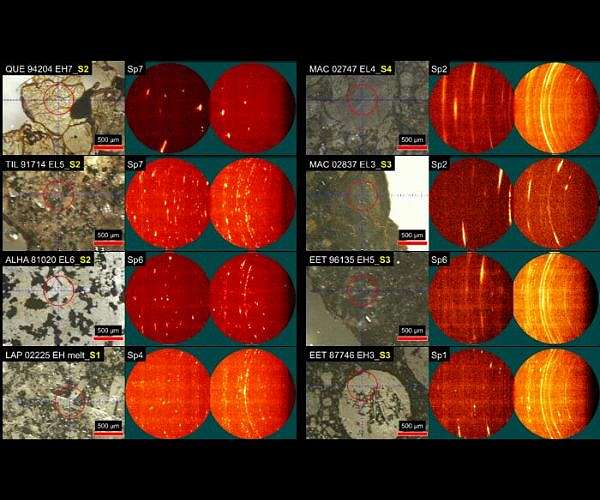
The study, led by Dr. Matthew Izawa of Okayama University, examined 11 enstatite chondrites that span the full range of recognized shock stages from S1 to S5. Using two dimensional micro X ray diffraction, the researchers measured strain related mosaicity in enstatite, expressed as the sum of full width at half maximum values along Debye rings, a metric they denote as SigmaFWHM-chi. By comparing this parameter with conventional shock stage classifications and with previously published pressure estimates from Rubin and co workers in 1997, they derived a linear calibration that links the diffraction broadening directly to peak shock pressure.
The resulting relation, Peak Pressure in gigapascals equals 4.62 times SigmaFWHM-chi plus 0.57, holds for impacts that produced pressures between 4 and 30 gigapascals and shows a tight correlation with an R squared value of 0.92. Because enstatite is a widespread mineral in planetary materials, the authors argue that this calibration can be applied beyond enstatite chondrites to shock damaged rocks from Mars, the Moon, and other planetary bodies. The measurements also demonstrate that shock deformation in the enstatite lattice is effectively isotropic, with similar increases in SigmaFWHM-chi recorded along the (020), (610), and (131) crystallographic planes as shock level rises.
The work points to several applications for meteoritics and planetary science. The non destructive nature of micro X ray diffraction allows high throughput screening of meteorite collections and sample return materials to rapidly map impact pressures without consuming or altering the specimens. It also offers a way to reconstruct collision histories of asteroid parent bodies, providing constraints on the intensity and frequency of impacts that helped shape the architecture of the early Solar System.
Co author Dr. Fengke Cao of Chengdu University of Technology emphasized the shift from qualitative impressions to numerical constraints on shock. "This work transforms shock quantification from art to science. We can now extract precise impact pressures from enstatite grains in any rock, from Earth's craters to asteroid fragments." The project received support from the Natural Sciences and Engineering Research Council of Canada through Discovery Grants and from the Open Project for Innovative Platform of Meteoritical Research at the Shanghai Science and Technology Museum.
Research Report:Quantification of shock in enstatite chondrites using micro-X-ray diffraction
Related Links
Higher Education Press Planet journal
Asteroid and Comet Mission News, Science and Technology
| Subscribe Free To Our Daily Newsletters |
| Subscribe Free To Our Daily Newsletters |








