24/7 Space News
STELLAR CHEMISTRY
Dark matter neutrino link may ease cosmic tension
illustration only

Dark matter neutrino link may ease cosmic tension

by Sophie Jenkins
London, UK (SPX) Jan 08, 2026

Scientists report signs that dark matter and neutrinos may interact, a possibility that would extend the standard cosmological model and change how structure growth in the universe is understood.

The study examines how such interactions could influence the formation of galaxies and other large-scale structures, addressing a known mismatch between predictions from early-universe measurements and observations of the present-day cosmos.

Researchers combined data that track the universe across its history, including measurements of the cosmic microwave background and maps of galaxy clustering, to look for subtle signatures of dark matter-neutrino interactions.

Information from the early universe comes from the ground-based Atacama Cosmology Telescope and the European Space Agency's Planck space observatory, both tuned to detect the faint microwave afterglow of the Big Bang.

Late-time structure was characterized using observations from the Dark Energy Camera on the Victor M. Blanco Telescope in Chile together with large galaxy catalogues from the Sloan Digital Sky Survey.

The combined data strengthen an existing tension in cosmology: early-universe measurements imply that matter clumping, quantified by parameters such as S8, should be stronger than what is inferred from surveys of the nearby universe.

Co-author Dr. Eleonora Di Valentino, Senior Research Fellow at the University of Sheffield, said: "The better we understand dark matter, the more insight we gain into how the Universe evolves and how its different components are connected."

"Our results address a long-standing puzzle in cosmology. Measurements of the early Universe predict that cosmic structures should have grown more strongly over time than what we observe today."

"However, observations of the modern Universe indicate that matter is slightly less clumped than expected, pointing to a mild mismatch between early- and late-time measurements."

"This tension does not mean the standard cosmological model is wrong, but it may suggest that it is incomplete."

"Our study shows that interactions between dark matter and neutrinos could help explain this difference, offering new insight into how structure formed in the Universe."

The authors find that allowing dark matter to scatter with neutrinos can reduce the predicted level of clustering, bringing early- and late-time measurements into closer agreement while remaining consistent with other cosmological constraints.

The work outlines how future cosmic microwave background experiments and weak gravitational lensing surveys, which track tiny distortions in the shapes of distant galaxies, could test this interaction scenario with higher precision.

Dr. William Giare, co-author of the study and former Postdoctoral Researcher at the University of Sheffield, now at the University of Hawai?i, said: "If this interaction between dark matter and neutrinos is confirmed, it would be a fundamental breakthrough."

"It would not only shed new light on a persistent mismatch between different cosmological probes, but also provide particle physicists with a concrete direction, indicating which properties to look for in laboratory experiments to help finally unmask the true nature of dark matter."

Research Report:A solution to the S8 tension through neutrino-dark matter interactions

Related Links
University of Sheffield
Stellar Chemistry, The Universe And All Within It

Subscribe Free To Our Daily Newsletters
Tweet

RELATED CONTENT
The following news reports may link to other Space Media Network websites.
STELLAR CHEMISTRY
We have no idea what most of the universe is made of, but scientists are closer than ever to finding out
College Station TX (SPX) Jan 06, 2026
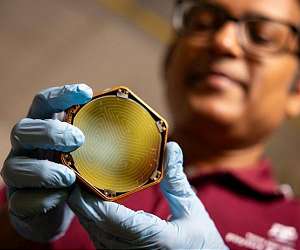
When it comes to understanding the universe, what we know is only a sliver of the whole picture. Dark matter and dark energy make up about 95% of the universe, leaving only 5% "ordinary matter," or what we can see. Dr. Rupak Mahapatra, an experimental particle physicist at Texas A&M University, designs highly advanced semiconductor detectors with cryogenic quantum sensors, powering experiments worldwide and pushing the boundaries to explore this most profound mystery. Mahapatra likens our understa ... read more

STELLAR CHEMISTRY
Second ESCAPADE spacecraft completes key trajectory fix on path to Mars

China launches twin Shijian-29 satellites to test space-target detection tech

ESA reaches new benchmark in autonomous formation flying

Overseas scholars drawn to China's scientific clout, funding

STELLAR CHEMISTRY
North Korea tests hypersonic missiles, says nuclear forces ready for war

Starfighters completes supersonic tests for GE Aerospace ramjet program

Galileo satellites ride Ariane 6 to boost Europe navigation resilience

AI systems proposed to boost launch cadence reliability and traffic management

STELLAR CHEMISTRY
Sandblasting winds sculpt Mars landscape

Thin ice may have protected lake water on frozen Mars

Curiosity's Nevado Sajama postcard captures Mars on the eve of conjunction

Wind-Sculpted Landscapes: Investigating the Martian Megaripple 'Hazyview'

STELLAR CHEMISTRY
China harnesses nationwide system to drive spaceflight and satellite navigation advances

Shenzhou 21 crew complete eight hour spacewalk outside Tiangong station

Foreign satellites ride Kinetica 1 on new CAS Space mission

Experts at Hainan symposium call for stronger global space partnership

STELLAR CHEMISTRY
Time-expanded network model cuts complexity in mega constellation launch planning

Southern Launch to Host Lux Aeterna Re-Entries South Australia

Smart modeling framework targets 6G spectrum chaos in space air and ground networks

K2 Space raises 250m to scale Mega class high power satellites

STELLAR CHEMISTRY
Essential Strategies for Enhancing Data Integrity and Compliance in Today's Business Environment

Momentus to flight test 3D printed fuel tank on Vigoride 7

Satellites lined up for shared space computing power networks

Planet delivers first light image from Pelican 6 satellite capturing Lhasa Gonggar Airport

STELLAR CHEMISTRY
Deep Arctic gas hydrate mounds host ultra deep cold seep ecosystem

Joint ground- and space-based observations reveal Saturn-mass rogue planet

ALMA views giant dusty disk in Gomezs Hamburger with signs of early giant planet formation

We finally know how the most common types of planets are created

STELLAR CHEMISTRY
Jupiter's moon Europa has a seafloor that may be quiet and lifeless

Uranus and Neptune may be rock rich worlds

SwRI links Uranus radiation belt mystery to solar storm driven waves

Looking inside icy moons

Subscribe Free To Our Daily Newsletters


The content herein, unless otherwise known to be public domain, are Copyright 1995-2024 - Space Media Network. All websites are published in Australia and are solely subject to Australian law and governed by Fair Use principals for news reporting and research purposes. AFP, UPI and IANS news wire stories are copyright Agence France-Presse, United Press International and Indo-Asia News Service. ESA news reports are copyright European Space Agency. All NASA sourced material is public domain. Additional copyrights may apply in whole or part to other bona fide parties. All articles labeled "by Staff Writers" include reports supplied to Space Media Network by industry news wires, PR agencies, corporate press officers and the like. Such articles are individually curated and edited by Space Media Network staff on the basis of the report's information value to our industry and professional readership. Advertising does not imply endorsement, agreement or approval of any opinions, statements or information provided by Space Media Network on any Web page published or hosted by Space Media Network. General Data Protection Regulation (GDPR) Statement Our advertisers use various cookies and the like to deliver the best ad banner available at one time. All network advertising suppliers have GDPR policies (Legitimate Interest) that conform with EU regulations for data collection. By using our websites you consent to cookie based advertising. If you do not agree with this then you must stop using the websites from May 25, 2018. Privacy Statement. Additional information can be found here at About Us.