24/7 Space News
TIME AND SPACE
Superradiant spin teamwork yields self driven microwave signals
illustration only

Superradiant spin teamwork yields self driven microwave signals

by Simon Mansfield
Sydney, Australia (SPX) Jan 05, 2026

When quantum particles work together, they can produce signals far stronger than any one particle could generate alone, a cooperative phenomenon known as superradiance that has often caused rapid energy loss in quantum systems and created challenges for quantum technologies. A study published in Nature Physics shows that the same collective effect can instead generate self-sustained, long-lived microwave emission, turning what was once seen as a source of decoherence into a mechanism for robust signal generation.

Dr Wenzel Kersten, first author of the study, explains that interactions among the spins, which might appear disordered, in fact drive the emission by allowing the system to organize itself into a state that produces an extremely coherent microwave signal. Researchers from TU Wien (Vienna University of Technology) and the Okinawa Institute of Science and Technology (OIST) report the first demonstration of self-induced superradiant masing, in which long-lived microwave bursts arise spontaneously without continuous external driving.

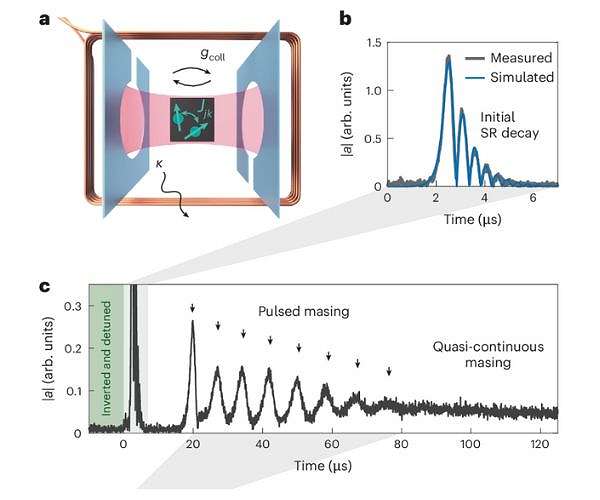
In their experiments, the team coupled a dense ensemble of nitrogen-vacancy (NV) centers in diamond, atomic-scale defects whose electron spins act as tiny magnets, to a microwave cavity to study how many spins behave together. They observed the expected initial superradiant burst, followed by a sequence of narrow, long-lived microwave pulses that did not match conventional expectations for a simple decay process.

Large-scale numerical simulations traced these pulses to self-induced spin - spin interactions that dynamically repopulate the energy levels of the NV centers, sustaining emission without external pumping. Professor William Munro, co-author and head of OIST's Quantum Engineering and Design Unit, notes that the spin interactions continually trigger new transitions so that the system effectively drives itself and reveals a new form of collective quantum behavior.

Beyond the fundamental physics, the work points to practical uses for stable, self-sustained microwave emission as a basis for precise clocks, communication links, and navigation systems that rely on microwave frequencies. Such signal sources are relevant for technologies including telecommunications, radar, and satellite-based positioning, where long-term stability and coherence are critical.

The researchers also highlight the potential to improve quantum sensors that detect tiny changes in magnetic or electric fields by exploiting collective spin behavior in solid-state systems. Professor Jorg Schmiedmayer of the Vienna Center for Quantum Science and Technology at TU Wien notes that advances in this direction could support medical imaging, materials science, and environmental monitoring by enabling more sensitive field measurements, illustrating how detailed insight into many-body quantum dynamics can translate into new tools for science and industry.

Research Report:Self-induced superradiant masing

Related Links
Okinawa Institute of Science and Technology (OIST) Graduate University
Understanding Time and Space

Subscribe Free To Our Daily Newsletters
Tweet

RELATED CONTENT
The following news reports may link to other Space Media Network websites.
TIME AND SPACE
Heat limits on communication in computers
Los Angeles CA (SPX) Jan 01, 2026
Every task performed on a computer, from numerical calculations to video playback, depends on internal components exchanging information, and researchers are now quantifying the energy cost of that communication. Former SFI Graduate Fellow Abhishek Yadav, a Ph.D. scholar at the University of New Mexico, notes that communication is central to computation, yet the energy budget that devices devote to it has remained poorly understood. Over the last decade, SFI Professor David Wolpert has led work on ... read more

TIME AND SPACE
Sprawling CES gadgetfest a world stage for AI and its hype

ISS to change commanders before Soyuz crew leaves orbit

Lodestar Space wins SECP support to advance AI satellite awareness system

Micro nano robots aim to cut carbon buildup in closed life support systems

TIME AND SPACE
Hydrogen from ethanol reforming mapped as aviation fuel-cell pathway

Europe's Ariane 6 rocket puts EU navigation satellites in orbit

Southern Launch to host INNOSPACE missions from South Australian spaceports

Rocket Lab completes first dedicated JAXA mission with Electron launch

TIME AND SPACE
HiRISE camera aboard Mars Reconnaissance Orbiter passes 100000 image milestone

GoMars model simulates Martian dust storms to improve mission safety

Maven stays silent after routine pass behind Mars

Ancient Martian brines left bromine rich fingerprints in jarosite minerals

TIME AND SPACE
Shenzhou 21 crew complete eight hour spacewalk outside Tiangong station

Foreign satellites ride Kinetica 1 on new CAS Space mission

Experts at Hainan symposium call for stronger global space partnership

Triple Long March launches mark record day for Chinese space program

TIME AND SPACE
K2 Space raises 250m to scale Mega class high power satellites

Beyond Gravity positions new modular satellite platform for European LEO missions

Private capital targets mission-critical software power and platforms in new space economy

Applied Aerospace and PCX create US flight and space hardware group

TIME AND SPACE
One pull of a string is all it takes to deploy these complex structures

Japan's SoftBank in $4bln AI deal to buy DigitalBridge

US denies visas to EU ex-commissioner, four others over tech rules

Modena team outlines staged roadmap to cut emissions from metal laser 3D printing

TIME AND SPACE
Clues to the migration path of hot Jupiters in their orbits

Can scientists detect life without knowing what it looks like

Ultra hot super Earth shows dense atmosphere over magma ocean

Hidden circumbinary giant planet emerges from decade old Gemini data

TIME AND SPACE
Uranus and Neptune may be rock rich worlds

SwRI links Uranus radiation belt mystery to solar storm driven waves

Looking inside icy moons

Saturn moon mission planning shifts to flower constellation theory

Subscribe Free To Our Daily Newsletters


The content herein, unless otherwise known to be public domain, are Copyright 1995-2024 - Space Media Network. All websites are published in Australia and are solely subject to Australian law and governed by Fair Use principals for news reporting and research purposes. AFP, UPI and IANS news wire stories are copyright Agence France-Presse, United Press International and Indo-Asia News Service. ESA news reports are copyright European Space Agency. All NASA sourced material is public domain. Additional copyrights may apply in whole or part to other bona fide parties. All articles labeled "by Staff Writers" include reports supplied to Space Media Network by industry news wires, PR agencies, corporate press officers and the like. Such articles are individually curated and edited by Space Media Network staff on the basis of the report's information value to our industry and professional readership. Advertising does not imply endorsement, agreement or approval of any opinions, statements or information provided by Space Media Network on any Web page published or hosted by Space Media Network. General Data Protection Regulation (GDPR) Statement Our advertisers use various cookies and the like to deliver the best ad banner available at one time. All network advertising suppliers have GDPR policies (Legitimate Interest) that conform with EU regulations for data collection. By using our websites you consent to cookie based advertising. If you do not agree with this then you must stop using the websites from May 25, 2018. Privacy Statement. Additional information can be found here at About Us.