24/7 Space News
UAV NEWS
Spatiotemporal resilience model targets IoT unmanned fleets
illustration only

Spatiotemporal resilience model targets IoT unmanned fleets

by Riko Seibo
Tokyo, Japan (SPX) Dec 31, 2025

Researchers from Zhengzhou University, the University of Kent, and City University of Hong Kong have developed a framework to evaluate and optimize the spatiotemporal resilience of Internet of Things (IoT)-enabled unmanned system of systems operating in complex missions. The work responds to the growing use of unmanned aerial vehicles and unmanned vehicles in hazardous environments where maintaining function under disruption is critical.

Conventional resilience assessments tend to track performance over time only, but the team argues that spatial factors, such as how platforms are positioned and how far they are from each other, strongly influence communication stability. To address this, the study defines spatiotemporal resilience as a combined measure over both space and time and embeds it in a model tailored to unmanned systems coordinated via IoT.

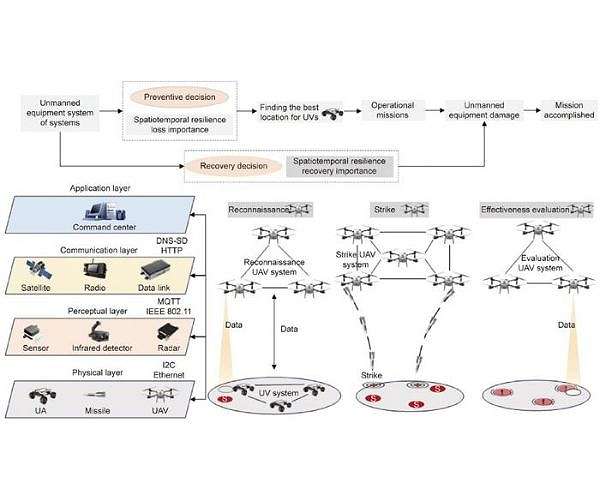
The authors construct a multi-layered architecture for IoT-enabled unmanned systems of systems that links physical assets and data flows. The structure includes physical, perceptual, communication, and application layers, with unmanned platforms such as UAVs and UVs in the physical layer and data exchange and cross-layer links handled in the data-related layers. This integrated representation is used to map the real-time state of the system during missions.

Within this architecture, the study introduces spatiotemporal performance metrics that capture system behavior as conditions change in both dimensions. Mathematical expressions account for path loss, signal frequency, and distances between UAVs and UVs to quantify how communication quality and system function evolve. These metrics underpin a method for optimizing resilience through maintenance planning and deployment strategies.

In the prevention phase, the authors design an optimal routing algorithm for unmanned vehicles to reduce path loss and strengthen the data layer. For the recovery phase, they propose a repair and reconfiguration scheme that focuses first on UAVs with higher recovery importance, aiming to restore overall resilience more quickly.

A case study tests the framework using a hexagonal layout involving six UAVs and one unmanned vehicle. Under this scenario, the optimization strategy increases prevention spatiotemporal resilience by 0.22 percent, recovery spatiotemporal resilience by 8.39 percent, and overall spatiotemporal resilience by 11.29 percent. These results indicate measurable gains when both spatial deployment and temporal dynamics are considered together.

The authors argue that incorporating spatial and temporal dimensions into resilience analysis can guide the design and operation of future unmanned systems used for tasks such as surveillance, disaster response, and environmental monitoring. They conclude that coupling IoT technologies with spatiotemporal metrics offers a route to more robust and adaptable unmanned fleets in dynamic, uncertain environments.

Research Report:Spatiotemporal Resilience of IoT-enabled Unmanned System of Systems

Related Links
Zhengzhou University
UAV News - Suppliers and Technology

Subscribe Free To Our Daily Newsletters
Tweet

RELATED CONTENT
The following news reports may link to other Space Media Network websites.
UAV NEWS
RTX radar selected to support autonomous X 62A fighter testing
Los Angeles CA (SPX) Jan 01, 2026
Raytheon has received a U.S. Air Force contract to integrate its PhantomStrike radar on the autonomous X-62A Variable In-flight Simulation Test Aircraft, or VISTA, a modified F-16D Block 30 test aircraft upgraded with Block 40 avionics and configured as a machine-learning and software testbed. The X-62A VISTA functions as a dedicated platform for flight testing autonomy and artificial intelligence, allowing Air Force and industry engineers to evaluate control laws, sensor fusion approaches and dec ... read more

UAV NEWS
ESA reaches new benchmark in autonomous formation flying

Hydrogen peroxide thruster qualifies for ESA launcher attitude control

China launches twin Shijian-29 satellites to test space-target detection tech

Billionaire Trump nominee confirmed to lead NASA amid Moon race

UAV NEWS
AI systems proposed to boost launch cadence reliability and traffic management

China debuts Long March 12A reusable rocket in Jiuquan test flight

Japan's flagship H3 rocket fails to launch satellite

North Korea tests hypersonic missiles, says nuclear forces ready for war

UAV NEWS
Curiosity Blog, Sols 4750-4762: See You on the Other Side of the Sun

Wind-Sculpted Landscapes: Investigating the Martian Megaripple 'Hazyview'

NASA team presses MAVEN recovery before Mars solar conjunction

Perseverance rover cleared for long distance Mars exploration

UAV NEWS
China harnesses nationwide system to drive spaceflight and satellite navigation advances

Shenzhou 21 crew complete eight hour spacewalk outside Tiangong station

Foreign satellites ride Kinetica 1 on new CAS Space mission

Experts at Hainan symposium call for stronger global space partnership

UAV NEWS
Southern Launch to Host Lux Aeterna Re-Entries South Australia

Smart modeling framework targets 6G spectrum chaos in space air and ground networks

Time-expanded network model cuts complexity in mega constellation launch planning

K2 Space raises 250m to scale Mega class high power satellites

UAV NEWS
India space agency launches its heaviest satellite

Space ground fluid AI framework targets satellite powered 6G edge intelligence

Engineered interlayers boost satellite insulation and flexible electronics

Planet delivers first light image from Pelican 6 satellite capturing Lhasa Gonggar Airport

UAV NEWS
Deep Arctic gas hydrate mounds host ultra deep cold seep ecosystem

Joint ground- and space-based observations reveal Saturn-mass rogue planet

Hubble pinpoints asteroid smash ups in nearby Fomalhaut system

Evolution study finds history and environment shifts can steer species in very different directions

UAV NEWS
Uranus and Neptune may be rock rich worlds

SwRI links Uranus radiation belt mystery to solar storm driven waves

Looking inside icy moons

Saturn moon mission planning shifts to flower constellation theory

Subscribe Free To Our Daily Newsletters


The content herein, unless otherwise known to be public domain, are Copyright 1995-2024 - Space Media Network. All websites are published in Australia and are solely subject to Australian law and governed by Fair Use principals for news reporting and research purposes. AFP, UPI and IANS news wire stories are copyright Agence France-Presse, United Press International and Indo-Asia News Service. ESA news reports are copyright European Space Agency. All NASA sourced material is public domain. Additional copyrights may apply in whole or part to other bona fide parties. All articles labeled "by Staff Writers" include reports supplied to Space Media Network by industry news wires, PR agencies, corporate press officers and the like. Such articles are individually curated and edited by Space Media Network staff on the basis of the report's information value to our industry and professional readership. Advertising does not imply endorsement, agreement or approval of any opinions, statements or information provided by Space Media Network on any Web page published or hosted by Space Media Network. General Data Protection Regulation (GDPR) Statement Our advertisers use various cookies and the like to deliver the best ad banner available at one time. All network advertising suppliers have GDPR policies (Legitimate Interest) that conform with EU regulations for data collection. By using our websites you consent to cookie based advertising. If you do not agree with this then you must stop using the websites from May 25, 2018. Privacy Statement. Additional information can be found here at About Us.