

24/7 Space News
INTERNET SPACE
Smart glasses find purpose among blind users

Smart glasses find purpose among blind users

By Thomas URBAIN
Las Vegas (AFP) Jan 5, 2026

The actual use-value of smart glasses remains keenly debated -- but less so among blind people, who are increasingly relying on the latest models to improve their lives.

Does this restaurant serve fish? Does this bus go to my neighborhood? None of the emerging leaders in the nascent smart glasses market designed their models to answer these questions with blind users in mind.

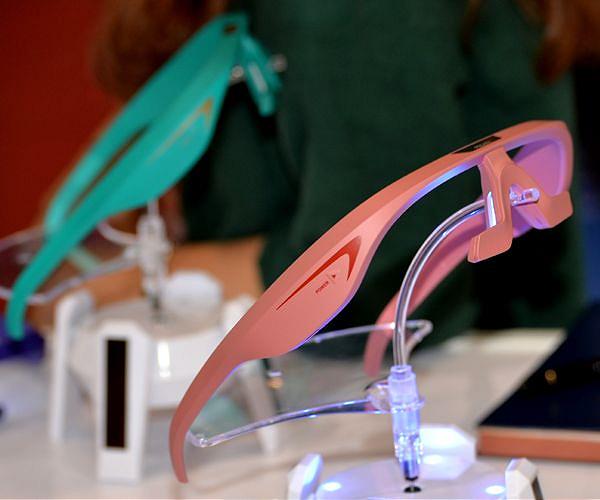
But several small startups -- some exhibiting at the Consumer Electronics Show in Las Vegas this week -- are helping build a dedicated ecosystem out of existing products.

For sighted people, smart glasses just tell them what they already see, noted Aaron Preece, editor-in-chief of AccessWorld magazine, published by the American Foundation for the Blind (AFB).

"But for blind people, it's useful."

Smartphone apps already serve people with blindness, "but you have to hold the device in the right direction," said Preece, who is blind.

"If it's on your head, it's definitely a lot more intuitive."

According to the International Agency for the Prevention of Blindness, 43 million people worldwide are blind, while another 295 million have moderate to severe visual impairment.

The most popular smart glasses are Meta's AI glasses, which come in Ray-Ban or Oakley styles and can describe what's in front of the user through voice commands.

Using the Be My Eyes app, users can even get a volunteer to describe the scene captured through the camera.

California startup Agiga developed its EchoVision glasses with input from blind users, including music legend Stevie Wonder.

The company says its audio descriptions are richer and more comprehensive than existing products.

The glasses' 110-degree camera angle captures 50 percent more than other smart glasses, said Agiga CEO Xiaoran Wang, reducing the need for users to turn their heads to capture a scene.

Launch is planned for the first quarter of 2026 at $599, not including an AI service subscription. This compares to Meta's Ray-Ban starting price of $299.

Is this too niche?

Netherlands-based Envision recently launched a model in partnership with Hong Kong specialist Solos, priced at $699 with one year's access to its Ally software ($10 monthly thereafter).

CEO Karthik Mahadevan doubts a manufacturer focused exclusively on the blind and visually impaired can succeed, as "you cannot be both affordable and only serving a niche."

He prefers partnering with manufacturers to focus on software usable across multiple glass brands and welcomes upcoming models from Google, Samsung, and Lenovo.

AI advances are expanding possibilities for people with low or no vision.

Startup HapWare recently developed the Aleye haptic bracelet, equipped with software that interprets an interlocutor's attitude and mood in real time through connected glasses, then applies specific pressure patterns on the arm corresponding to different emotions.

"A high majority of communication is nonverbal, and for the blind community, it's just simply inaccessible," said HapWare CEO Jack Walters.

Envision's smart glasses offer a feature that, once activated, continuously describes the user's surroundings without repeated prompting.

The startup is also developing a detector that can spontaneously alert users to approaching objects or people in real time.

Envision uses multiple AI models, including OpenAI's GPT-5, with regular updates to leverage the latest advances.

But the company acknowledges "it's still AI and it may not always be 100 percent right."

"We don't really recommend people use smart glasses as a primary navigation tool," Mahadevan said, because even a small margin of error can "have serious consequences when detecting obstacles."

Still, setting aside those use cases, "there are many others that present little risk" and prove useful, like taking photos, Preece said.

"Even if it's not quite accurate, I at least know vaguely what my picture is. So that's pretty helpful."

Related Links
Satellite-based Internet technologies

Subscribe Free To Our Daily Newsletters
Tweet

RELATED CONTENT
The following news reports may link to other Space Media Network websites.
INTERNET SPACE
What's my age again? The tech behind Australia's social media ban
Sydney (AFP) Dec 9, 2025
Tech giants will apply multiple layers of security to weed out young users under Australia's world-first ban on social media for under-16s. If they fail to take "reasonable steps" to block young teens, the firms behind platforms such as Instagram, TikTok and YouTube face hefty fines. Here are the main methods they're turning to as the law takes effect Wednesday: - ID please - It sounds simple: scan your passport, driver's licence or other official ID to prove you are aged 16 or over. ... read more

INTERNET SPACE
Startups go public in litmus test for Chinese AI

Sprawling CES gadgetfest a world stage for AI and its hype

Billionaire Trump nominee confirmed to lead NASA amid Moon race

ISS to change commanders before Soyuz crew leaves orbit

INTERNET SPACE
AI systems proposed to boost launch cadence reliability and traffic management

China debuts Long March 12A reusable rocket in Jiuquan test flight

Japan's flagship H3 rocket fails to launch satellite

Hydrogen from ethanol reforming mapped as aviation fuel-cell pathway

INTERNET SPACE
Wind-Sculpted Landscapes: Investigating the Martian Megaripple 'Hazyview'

HiRISE camera aboard Mars Reconnaissance Orbiter passes 100000 image milestone

Search for life should be top science priority for first human landing on Mars report says

Curiosity Blog, Sols 4750-4762: See You on the Other Side of the Sun

INTERNET SPACE
China harnesses nationwide system to drive spaceflight and satellite navigation advances

Shenzhou 21 crew complete eight hour spacewalk outside Tiangong station

Foreign satellites ride Kinetica 1 on new CAS Space mission

Experts at Hainan symposium call for stronger global space partnership

INTERNET SPACE
Time-expanded network model cuts complexity in mega constellation launch planning

Southern Launch to Host Lux Aeterna Re-Entries South Australia

Smart modeling framework targets 6G spectrum chaos in space air and ground networks

K2 Space raises 250m to scale Mega class high power satellites

INTERNET SPACE
From music to mind reading: AI startups bet on earbuds

New tool narrows the search for ideal material structures

Nostalgia and new fans as Tamagotchi turns 30

Chlorine and hydrogen from waste brines without external power

INTERNET SPACE
Clues to the migration path of hot Jupiters in their orbits

Hubble pinpoints asteroid smash ups in nearby Fomalhaut system

Evolution study finds history and environment shifts can steer species in very different directions

Webb maps carbon rich atmosphere on distorted pulsar planet

INTERNET SPACE
Uranus and Neptune may be rock rich worlds

SwRI links Uranus radiation belt mystery to solar storm driven waves

Looking inside icy moons

Saturn moon mission planning shifts to flower constellation theory

Subscribe Free To Our Daily Newsletters


The content herein, unless otherwise known to be public domain, are Copyright 1995-2024 - Space Media Network. All websites are published in Australia and are solely subject to Australian law and governed by Fair Use principals for news reporting and research purposes. AFP, UPI and IANS news wire stories are copyright Agence France-Presse, United Press International and Indo-Asia News Service. ESA news reports are copyright European Space Agency. All NASA sourced material is public domain. Additional copyrights may apply in whole or part to other bona fide parties. All articles labeled "by Staff Writers" include reports supplied to Space Media Network by industry news wires, PR agencies, corporate press officers and the like. Such articles are individually curated and edited by Space Media Network staff on the basis of the report's information value to our industry and professional readership. Advertising does not imply endorsement, agreement or approval of any opinions, statements or information provided by Space Media Network on any Web page published or hosted by Space Media Network. General Data Protection Regulation (GDPR) Statement Our advertisers use various cookies and the like to deliver the best ad banner available at one time. All network advertising suppliers have GDPR policies (Legitimate Interest) that conform with EU regulations for data collection. By using our websites you consent to cookie based advertising. If you do not agree with this then you must stop using the websites from May 25, 2018. Privacy Statement. Additional information can be found here at About Us.







