24/7 Space News
TIME AND SPACE
Single superconductor device shows Josephson junction behavior
illustration only

Single superconductor device shows Josephson junction behavior

by Clarence Oxford
Los Angeles CA (SPX) Dec 30, 2025

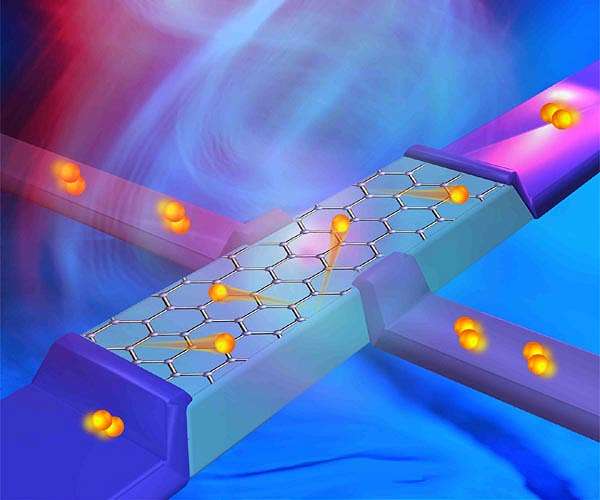
An international collaboration has demonstrated that a device containing only one superconductor can display electrical behavior characteristic of a Josephson junction, a core element in many quantum computers. Researchers found that the superconducting metal vanadium induced strong electron pairing across a magnesium oxide barrier into an adjacent layer of ferromagnetic iron, effectively allowing the iron to participate in Josephson-junction-like synchronization.

In a conventional Josephson junction, two superconductors separated by a thin barrier share their superconducting state so that paired electrons move coherently between them without energy loss. In the new study, the team observed similar synchronized behavior even though only one side of the junction was a true superconductor, confirming long-standing theoretical predictions that such a configuration could function using a single superconducting electrode.

The measurements, reported in Nature Communications, indicate that superconductivity from vanadium leaked through the magnesium oxide barrier and generated electron pairing inside the iron layer. While superconductors can induce weak superconducting correlations in nearby materials, the induced behavior in iron was strong enough to create collective charge motion that mimicked the dynamics of a standard two-superconductor Josephson junction.

Study co-corresponding author Igor Zutic, SUNY Distinguished Professor in the Department of Physics in the University at Buffalo College of Arts and Sciences, likened a typical Josephson junction to "two army battalions marching in step along opposite banks of a river." He explained that in the new device "there was only one battalion - yet it's as if its marching caused citizens on the other side to form a militia and begin marching to the beat of a different drum."

The experiments were carried out in the laboratory of co-corresponding author Farkhad Aliev, professor of condensed matter physics at the Autonomous University of Madrid in Spain, with additional collaborators from Comillas Pontifical University in Spain, the University of Lorraine in France, Babes-Bolyai University in Romania, and the Eastern Institute for Advanced Study in China. The work was supported by the U.S. Department of Energy Office of Science, Basic Energy Sciences program.

To probe how charge moved through the structure, the researchers analyzed tiny fluctuations in the electrical current known as noise, which reveal how electrons traverse a material. By monitoring this noise in the vanadium-magnesium oxide-iron stack, they detected electrons in the iron moving in large, coordinated groups, a signature usually associated with two superconductors coupled through a Josephson junction.

This behavior surprised the team because ferromagnetism and superconductivity typically oppose each other: paired electrons in superconductors have opposite spins, whereas electrons in ferromagnets tend to align their spins in the same direction. In the experiment, however, the iron formed same-spin electron pairs that still behaved collectively enough to synchronize with the vanadium layer across the barrier.

"The iron essentially created a different type of superconductivity from vanadium," Zutic said. "In other words, the citizens organized in their own way but kept time well enough to march as an army and send their own rhythm back across the river."

The team is now exploring how iron was able to generate same-spin pairs that were robust enough for the iron to act as if it were an independent superconductor. They suggest that this same-spin pairing may be relevant for topological superconductors, which are designed to protect quantum information - often encoded in electron spin - against local disturbances by storing it in non-local, knot-like configurations.

In conventional quantum computing systems, small changes in the environment can disturb electron spins and disrupt calculations, creating a major challenge for scaling devices. Zutic noted that researchers want to "find a way to essentially lock an electron's spin into place," and that pairing electrons with the same spin may offer a pathway toward more stable quantum states that are less sensitive to noise.

Another implication of the work is that future Josephson-like devices might be constructed from widely used industrial materials rather than exotic components. Both iron and magnesium oxide already appear in commercial magnetic hard drives and magnetic random-access memory, raising the prospect of integrating superconducting functions into existing device architectures.

"We have added a superconducting twist to commercially viable devices," Zutic said, suggesting that leveraging common ferromagnetic and oxide materials in this way could broaden the design space for quantum and superconducting electronics. The findings point toward simpler junction geometries that still deliver the coherent behavior needed for quantum technologies.

Research Report:Giant shot noise in superconductor/ferromagnet junctions with orbital-symmetry- controlled spin-orbit coupling

Related Links
University at Buffalo
Understanding Time and Space

Subscribe Free To Our Daily Newsletters
Tweet

RELATED CONTENT
The following news reports may link to other Space Media Network websites.
TIME AND SPACE
Heat limits on communication in computers
Los Angeles CA (SPX) Dec 26, 2025
Every task performed on a computer, from numerical calculations to video playback, depends on internal components exchanging information, and researchers are now quantifying the energy cost of that communication. Former SFI Graduate Fellow Abhishek Yadav, a Ph.D. scholar at the University of New Mexico, notes that communication is central to computation, yet the energy budget that devices devote to it has remained poorly understood. Over the last decade, SFI Professor David Wolpert has led work on ... read more

TIME AND SPACE
ISS to change commanders before Soyuz crew leaves orbit

Lodestar Space wins SECP support to advance AI satellite awareness system

Micro nano robots aim to cut carbon buildup in closed life support systems

NASA extends ISS National Lab management contract through 2030

TIME AND SPACE
Hydrogen from ethanol reforming mapped as aviation fuel-cell pathway

Europe's Ariane 6 rocket puts EU navigation satellites in orbit

Southern Launch to host INNOSPACE missions from South Australian spaceports

Rocket Lab completes first dedicated JAXA mission with Electron launch

TIME AND SPACE
HiRISE camera aboard Mars Reconnaissance Orbiter passes 100000 image milestone

GoMars model simulates Martian dust storms to improve mission safety

Maven stays silent after routine pass behind Mars

Ancient Martian brines left bromine rich fingerprints in jarosite minerals

TIME AND SPACE
Foreign satellites ride Kinetica 1 on new CAS Space mission

Experts at Hainan symposium call for stronger global space partnership

Triple Long March launches mark record day for Chinese space program

China prepares Qingzhou cargo ship for low cost resupply flights

TIME AND SPACE
K2 Space raises 250m to scale Mega class high power satellites

Beyond Gravity positions new modular satellite platform for European LEO missions

Private capital targets mission-critical software power and platforms in new space economy

Applied Aerospace and PCX create US flight and space hardware group

TIME AND SPACE
One pull of a string is all it takes to deploy these complex structures

US denies visas to EU ex-commissioner, four others over tech rules

Modena team outlines staged roadmap to cut emissions from metal laser 3D printing

Shrinking AI memory improves LLM accuracy

TIME AND SPACE
Ultra hot super Earth shows dense atmosphere over magma ocean

Hidden circumbinary giant planet emerges from decade old Gemini data

The bacteria that wont wake up found in spacecraft cleanrooms

RISTRETTO spectrograph cleared for Proxima b atmospheric hunt

TIME AND SPACE
Uranus and Neptune may be rock rich worlds

SwRI links Uranus radiation belt mystery to solar storm driven waves

Looking inside icy moons

Saturn moon mission planning shifts to flower constellation theory

Subscribe Free To Our Daily Newsletters


The content herein, unless otherwise known to be public domain, are Copyright 1995-2024 - Space Media Network. All websites are published in Australia and are solely subject to Australian law and governed by Fair Use principals for news reporting and research purposes. AFP, UPI and IANS news wire stories are copyright Agence France-Presse, United Press International and Indo-Asia News Service. ESA news reports are copyright European Space Agency. All NASA sourced material is public domain. Additional copyrights may apply in whole or part to other bona fide parties. All articles labeled "by Staff Writers" include reports supplied to Space Media Network by industry news wires, PR agencies, corporate press officers and the like. Such articles are individually curated and edited by Space Media Network staff on the basis of the report's information value to our industry and professional readership. Advertising does not imply endorsement, agreement or approval of any opinions, statements or information provided by Space Media Network on any Web page published or hosted by Space Media Network. General Data Protection Regulation (GDPR) Statement Our advertisers use various cookies and the like to deliver the best ad banner available at one time. All network advertising suppliers have GDPR policies (Legitimate Interest) that conform with EU regulations for data collection. By using our websites you consent to cookie based advertising. If you do not agree with this then you must stop using the websites from May 25, 2018. Privacy Statement. Additional information can be found here at About Us.