24/7 Space News
MARSDAILY
NASA JPL Unveils Rover Operations Center for Moon, Mars Missions
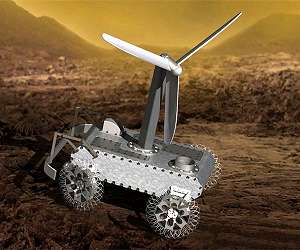
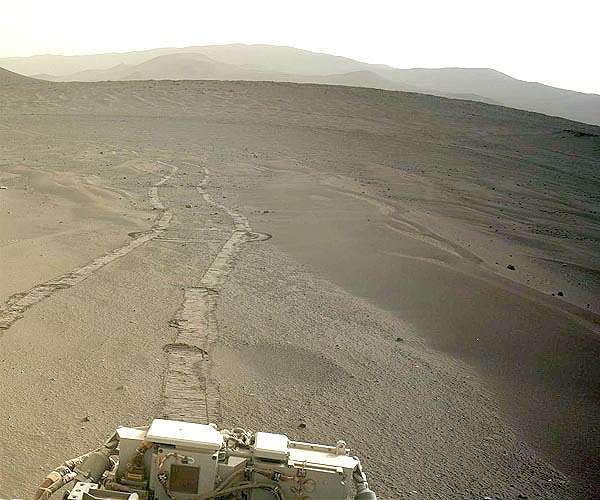
illustration only

NASA JPL Unveils Rover Operations Center for Moon, Mars Missions

by Staff Writers for JPL News
Pasadena CA (JPL) Dec 11, 2025

The center leverages AI along with JPL's unique infrastructure, unrivaled tools, and years of operations expertise to support industry partners developing future planetary surface missions.

NASA's Jet Propulsion Laboratory in Southern California on Wednesday inaugurated its Rover Operations Center (ROC), a center of excellence for current and future surface missions to the Moon and Mars. During the launch event, leaders from the commercial space and AI industries toured the facilities, participated in working sessions with JPL mission teams, and learned more about the first-ever use of generative AI by NASA's Perseverance Mars rover team to create future routes for the robotic explorer.

The center was established to integrate and innovate across JPL's planetary surface missions while simultaneously forging strategic partnerships with industry and academia to advance U.S. interests in the burgeoning space economy. The center builds on JPL's 30-plus years of experience developing and operating Mars surface missions, including humanity's only helicopter to fly at Mars as well as the only two active planetary surface missions.

"The Rover Operations Center is a force multiplier," said JPL Director Dave Gallagher. "It integrates decades of specialized knowledge with powerful new tools, and exports that knowledge through partnerships to catalyze the next generation of Moon and Mars surface missions. As NASA's federally funded research and development center, we are chartered to do exactly this type of work - to increase the cadence, the efficiency, and the impact for our transformative NASA missions and to support the commercial space market as they take their own giant leaps."

Genesis of ROC

Through decades of successful Mars rover missions, JPL has continuously improved the unique autonomy, robotic capabilities, and best practices that have been demanded by increasingly complex robotic explorers. The ROC offers an accessible centralized structure to facilitate future exploration efforts.

"Our rovers are lasting longer and are more sophisticated than ever before. The scientific stakes are high, as we have just witnessed with the discovery of a potential biosignature in Jezero Crater by the Perseverance mission. We are starting down a decade of unprecedented civil and commercial exploration at the Moon, which will require robotic systems to assist astronauts and support lunar infrastructure," said Matt Wallace, who heads JPL's Exploration Systems Office. "Mobile vehicles like rovers, helicopters, and drones are the most dynamic and challenging assets we operate. It's time to take our game up a notch and bring everybody we can with us."

Future forward

A key focus of the ROC is on the more rapid infusion of higher-level autonomy into surface missions through partnerships with the AI and commercial space industries. The objective is to catalyze change to deliver next-generation science and exploration capabilities for the nation and NASA.

As NASA's only federally funded research and development center, JPL has been evolving vehicle autonomy since the 1990s, when JPL began developing Sojourner, the first rover on another planet. Improvements to vehicle independence over the years have included the evolution of autonomy in sampling activities, driving, and science-target selection. Most recently, those improvements have extended to the development of Perseverance's ability to autonomously schedule and execute many commanded energy-intensive activities, like keeping warm at night, as it sees fit. This capability allows the rover to conserve power, which it can reallocate in real time to perform more science or longer drives.

With the explosion of AI capabilities, the ROC rover team is leaving no Mars stone unturned in the hunt for future efficiencies.

"We had a small team complete a 'three-week challenge,' applying generative AI to a few of our operational use cases. During this challenge, it became clear there are many opportunities for AI infusion that can supercharge our capabilities," said Jennifer Trosper, ROC program manager at JPL. "With these new partnerships, together we will infuse AI into operations to path-find the next generation of capabilities for science and exploration."

During the ROC's inauguration, attendees toured JPL operations facilities, including where the rover drivers plan their next routes. They also visited JPL's historic Mars Yard, which reproduces Martian terrain to test rover capabilities, and the massive 25-Foot Space Simulator that has tested spacecraft from Voyagers 1 and 2 to Perseverance to America's next generation of lunar landers. A panel discussion explored the historical value of rovers and aerial systems like the Ingenuity Mars Helicopter in planetary surface exploration. Also discussed was the promise of a new public-private partnership opportunity across a virtual network of operational missions.

Attendees were briefed on tiered engagement options for partners, from mission architecture support to autonomy integration, testing, and operations. These opportunities extend to science and human precursor robotic missions, as well as to human-robotic interaction and spacewalks for astronauts on the Moon and Mars.

A highlight for event participants came when the Perseverance team showcased how the ROC's generative AI can assist rover planners in creating future routes for the rover. The AI analyzed high-resolution orbital images of Jezero Crater and other relevant data and then generated waypoints that kept Perseverance away from hazardous terrain.

Related Links
Rover Operations Center
Mars News and Information at MarsDaily.com
Lunar Dreams and more

Subscribe Free To Our Daily Newsletters
Tweet

RELATED CONTENT
The following news reports may link to other Space Media Network websites.
MARSDAILY
Wind driven rovers show promise for low cost Mars missions
Berlin, Germany (SPX) Sep 26, 2025
Recent tests suggest that swarms of spherical tumbleweed rovers could offer an affordable and efficient way to explore Mars. Experiments conducted in a wind tunnel and on natural terrain show that the wind powered design can move across a range of surfaces under Mars like conditions. The five metre wide rovers are designed to roll with martian winds, dispersing across the surface to collect simultaneous data on the planet's atmosphere and terrain. In their final phase, the robots would collapse in ... read more

MARSDAILY
Lodestar Space wins SECP support to advance AI satellite awareness system

ISS to change commanders before Soyuz crew leaves orbit

Micro nano robots aim to cut carbon buildup in closed life support systems

NASA extends ISS National Lab management contract through 2030

MARSDAILY
Space shuttle design study maps path to breakthrough inventions

Neutron Hungry Hippo fairing completes qualification ahead of first launch

LandSpace reviews booster loss after Zhuque-3 reusable rocket test

UK plasma thruster test positions Pulsar Fusion for larger satellite propulsion

MARSDAILY
Martian sound study models acoustic signals in Jezero crater

Martian butterfly crater reveals low angle impact and buried lava history

Bacterial partnership offers pathway to produce Mars regolith bricks for future habitats

Chinese team runs long term Martian dust cycle simulation with GoMars model

MARSDAILY
Wenchang spaceport hits record cadence with double-digit launches in 2025

China consolidates new commercial space regulator and industry roadmap

Beijing space lab targets orbital data centers for AI era

China supports private space firms to expand global reach

MARSDAILY
Private capital targets mission-critical software power and platforms in new space economy

MDA Space plans C250 million senior unsecured note issue maturing 2030

SLI and AscendArc agree on 200 million GEO satellite leasing framework

Beyond Gravity positions new modular satellite platform for European LEO missions

MARSDAILY
Leading the Odds: Five Bookmakers Transforming Ireland's Modern Betting Landscape

Space operators urged to share costs of clearing orbital debris

X-MAT introduces X-FOAM: A game-changing ceramic foam for extreme environments

How Real-Time Follower Tracking Transforms Modern Social Media Analytics

MARSDAILY
Subaru OASIS survey uncovers massive planet and brown dwarf

The bacteria that wont wake up found in spacecraft cleanrooms

Supernova mixing traced as source of key life elements

RISTRETTO spectrograph cleared for Proxima b atmospheric hunt

MARSDAILY
SwRI links Uranus radiation belt mystery to solar storm driven waves

Looking inside icy moons

Saturn moon mission planning shifts to flower constellation theory

Could these wacky warm Jupiters help astronomers solve the planet formation puzzle?

Subscribe Free To Our Daily Newsletters


The content herein, unless otherwise known to be public domain, are Copyright 1995-2024 - Space Media Network. All websites are published in Australia and are solely subject to Australian law and governed by Fair Use principals for news reporting and research purposes. AFP, UPI and IANS news wire stories are copyright Agence France-Presse, United Press International and Indo-Asia News Service. ESA news reports are copyright European Space Agency. All NASA sourced material is public domain. Additional copyrights may apply in whole or part to other bona fide parties. All articles labeled "by Staff Writers" include reports supplied to Space Media Network by industry news wires, PR agencies, corporate press officers and the like. Such articles are individually curated and edited by Space Media Network staff on the basis of the report's information value to our industry and professional readership. Advertising does not imply endorsement, agreement or approval of any opinions, statements or information provided by Space Media Network on any Web page published or hosted by Space Media Network. General Data Protection Regulation (GDPR) Statement Our advertisers use various cookies and the like to deliver the best ad banner available at one time. All network advertising suppliers have GDPR policies (Legitimate Interest) that conform with EU regulations for data collection. By using our websites you consent to cookie based advertising. If you do not agree with this then you must stop using the websites from May 25, 2018. Privacy Statement. Additional information can be found here at About Us.