





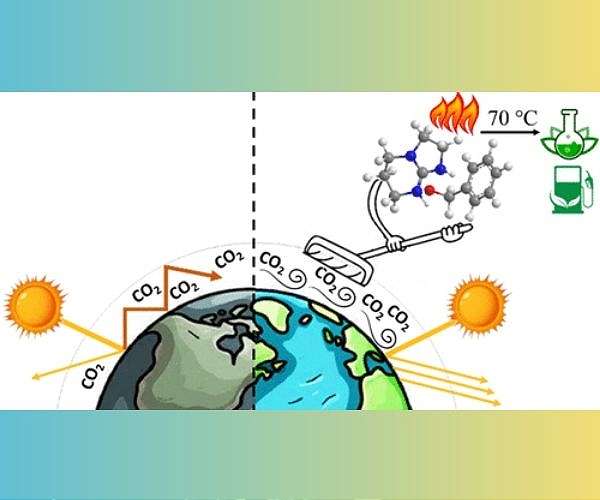
Tests show that one gram of the compound absorbs 156 milligrams of carbon dioxide from air without reacting with nitrogen, oxygen or other background gases. This capture capacity exceeds that of direct air capture solutions that are currently in use, according to the research team.
The captured carbon dioxide can be released by heating the compound to 70 degrees Celsius for 30 minutes, after which clean CO2 is recovered for reuse. In many current systems, the release step requires temperatures above 900 degrees Celsius, which increases energy demand.
The group reports that the same batch of liquid can be used repeatedly. The compound retained 75 percent of its original capture capacity after 50 capture and release cycles, and 50 percent of its capacity after 100 cycles.
The team identified the new fluid by testing a series of bases in different chemical environments over more than a year of experiments, Eshaghi Gorji explains. The most promising base was 1,5,7-triazabicyclo [4.3.0] non-6-ene (TBN), developed in professor Ilkka Kilpelainen's group, which they combined with benzyl alcohol to form the working capture compound.
None of the components is expensive to manufacture, Eshaghi Gorji notes, and the resulting fluid is reported to be non-toxic. The next stage of the project will move from gram scale experiments toward pilot plants operating closer to industrial conditions.
For larger scale applications, the researchers plan to convert the liquid into a solid-supported material. The concept is to attach the compound to materials such as silica and graphene oxide, which can increase contact between the active compound and carbon dioxide during operation.
Research Report:Direct Air Capture: Recyclability and Exceptional CO2 Uptake Using a Superbase
Related Links
University of Helsinki
Carbon Worlds - where graphite, diamond, amorphous, fullerenes meet
| Subscribe Free To Our Daily Newsletters |

| Subscribe Free To Our Daily Newsletters |








