24/7 Space News
STELLAR CHEMISTRY
ESO signs MOSAIC deal for Extremely Large Telescope spectrograph
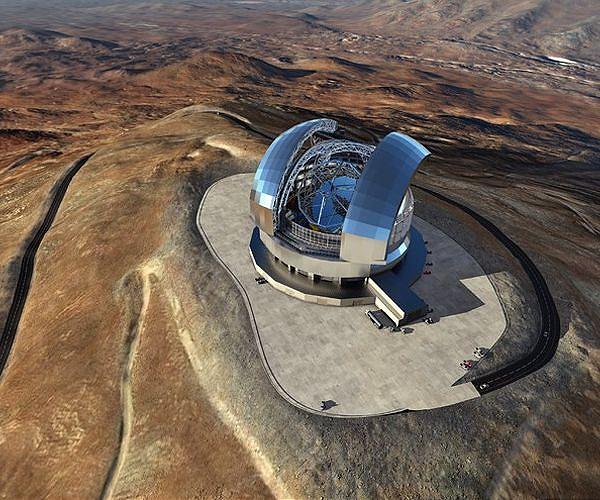
illustration only

ESO signs MOSAIC deal for Extremely Large Telescope spectrograph

by Robert Schreiber
Potsdam, Germany (SPX) Dec 08, 2025

The European Southern Observatory ESO has signed an agreement with a large international consortium for the design and construction of the Multi-Object Spectrograph MOSAIC, an instrument for the Extremely Large Telescope ELT. On what will be the world's largest optical telescope, MOSAIC will simultaneously measure the light from hundreds of astronomical sources, tracing the growth of galaxies and the distribution of matter from the Big Bang to the present day. As a consortium member, the Leibniz Institute for Astrophysics Potsdam AIP is responsible for part of the technical development of MOSAIC and for preparing its scientific use.

"We are delighted that AIP, with its many years of expertise in multi-object spectroscopy, will be contributing to key work packages of MOSAIC. Our task is to develop and build the complex optical fibre system that will guide the starlight from the telescope to the spectrographs," says Dr Andreas Kelz, head of the 3D and Multi-Object Spectroscopy department at the AIP.

The agreement was signed by ESO's Director General Xavier Barcons and Alain Schuhl, the Deputy CEO for Science at the French National Centre for Scientific Research CNRS, the institution leading the MOSAIC consortium. Also in attendance were Alexandre Vulic TBC, the Consul General of France in Munich, MOSAIC Principal Investigator Roser Pello from the Marseille Astrophysics Laboratory and Co-Principal Investigator Mathieu Puech from the Paris Observatory, along with other representatives from ESO, CNRS and the MOSAIC consortium at ESO Headquarters in Garching, Germany.

MOSAIC is a spectrograph that splits light into its component wavelengths so astronomers can determine properties of astronomical objects such as chemical composition and temperature. The instrument will use the widest possible field of view provided by the ELT, will operate in visible and near-infrared light, and will analyse light from more than two hundred objects at the same time.

"MOSAIC will conduct the first exhaustive inventory of matter in the early Universe, lifting the veil on how matter is distributed within and between galaxies and greatly advancing our understanding of how present-day galaxies formed and evolved.", explains Dr Davor Krajnovic, the AIP representative on the MOSAIC science team and a coordinator of the consortium science working group "Inventory of matter". "It is a versatile instrument allowing studies of the first galaxies and the intergalactic medium, star formation and chemical enrichment histories, mass assembly of galaxies, dark matter, transient phenomena and discovering electromagnetic counterparts of multi-messenger events".

ESO's ELT is under construction in Chile's Atacama Desert, a site selected for its favourable observing conditions.

Related Links
Leibniz Institute for Astrophysics Potsdam (AIP)
Stellar Chemistry, The Universe And All Within It

Subscribe Free To Our Daily Newsletters
Tweet

RELATED CONTENT
The following news reports may link to other Space Media Network websites.
STELLAR CHEMISTRY
Roman space telescope passes key construction milestone ahead of launch window
Los Angeles CA (SPX) Dec 05, 2025
NASA has completed assembly of the Nancy Grace Roman Space Telescope, joining the inner and outer sections of the observatory in the largest clean room at the agency's Goddard Space Flight Center in Greenbelt, Maryland, on Nov. 25, 2025. The mission is scheduled to launch no later than May 2027, with teams currently working to be ready for a launch opportunity as early as fall 2026 on a SpaceX Falcon Heavy rocket from NASA's Kennedy Space Center in Florida. After final environmental and performance test ... read more

STELLAR CHEMISTRY
NASA extends ISS National Lab management contract through 2030

Micro nano robots aim to cut carbon buildup in closed life support systems

ISS to change commanders before Soyuz crew leaves orbit

Space station reaches new record with all docking ports in use

STELLAR CHEMISTRY
Space shuttle design study maps path to breakthrough inventions

UK plasma thruster test positions Pulsar Fusion for larger satellite propulsion

How Cloud Render Farms Are Powering the Next Generation of Space Visualization and Simulation Workflows

LandSpace reviews booster loss after Zhuque-3 reusable rocket test

STELLAR CHEMISTRY
Martian butterfly crater reveals low angle impact and buried lava history

Chinese team runs long term Martian dust cycle simulation with GoMars model

Scientists trace ancient mega watersheds on Mars

NASA rover hears electric crackles inside Mars dust devils

STELLAR CHEMISTRY
China supports private space firms to expand global reach

Wenchang spaceport hits record cadence with double-digit launches in 2025

China consolidates new commercial space regulator and industry roadmap

Beijing space lab targets orbital data centers for AI era

STELLAR CHEMISTRY
Satellite surge threatens space telescopes, astronomers warn

MDA Space plans C250 million senior unsecured note issue maturing 2030

Applied Aerospace and PCX create US flight and space hardware group

EIB launches Space TechEU finance program for European space sector

STELLAR CHEMISTRY
Digital twin successfully launched and deployed into space

The Dos and Don'ts You Need to Keep in Mind When Playing Online Casino Games

Cybersecurity Advances Strengthen Protection in Online Gambling Infrastructure

Roadmap sets circular economy agenda for space hardware and debris mitigation

STELLAR CHEMISTRY
Subaru OASIS survey uncovers massive planet and brown dwarf

Supernova mixing traced as source of key life elements

SwRI opens NOUR lab to track chemical pathways from nebulae to planetary systems

TRAPPIST 1 flares mapped to probe planetary habitability

STELLAR CHEMISTRY
SwRI links Uranus radiation belt mystery to solar storm driven waves

Looking inside icy moons

Saturn moon mission planning shifts to flower constellation theory

Could these wacky warm Jupiters help astronomers solve the planet formation puzzle?

Subscribe Free To Our Daily Newsletters


The content herein, unless otherwise known to be public domain, are Copyright 1995-2024 - Space Media Network. All websites are published in Australia and are solely subject to Australian law and governed by Fair Use principals for news reporting and research purposes. AFP, UPI and IANS news wire stories are copyright Agence France-Presse, United Press International and Indo-Asia News Service. ESA news reports are copyright European Space Agency. All NASA sourced material is public domain. Additional copyrights may apply in whole or part to other bona fide parties. All articles labeled "by Staff Writers" include reports supplied to Space Media Network by industry news wires, PR agencies, corporate press officers and the like. Such articles are individually curated and edited by Space Media Network staff on the basis of the report's information value to our industry and professional readership. Advertising does not imply endorsement, agreement or approval of any opinions, statements or information provided by Space Media Network on any Web page published or hosted by Space Media Network. General Data Protection Regulation (GDPR) Statement Our advertisers use various cookies and the like to deliver the best ad banner available at one time. All network advertising suppliers have GDPR policies (Legitimate Interest) that conform with EU regulations for data collection. By using our websites you consent to cookie based advertising. If you do not agree with this then you must stop using the websites from May 25, 2018. Privacy Statement. Additional information can be found here at About Us.