| . |  |
. |
| . | |
. |


 by Staff Writers Paris (ESA) Nov 18, 2021
Arianespace announced liftoff of Vega's twentieth flight from Europe's Spaceport in French Guiana at 9:27 GMT (10:27 CET; 06:27 local time). Vega delivered three CERES payloads for the French Ministry of the Armed Forces. Each payload is equipped with high-performance sensors. Flying in formation in low Earth orbit, they will offer all-weather observation, daily revisit frequency, and can collect data enabling the characterisation and location of transmitters. The payloads were released about 56 minutes into the mission. Vega took a path to low orbit. Further to the standard stations used on Vega launches, this flight was also tracked by a Naval station and the Santa Maria station in the Azores. Vega's upper stage fired a final time to ensure indirect reentry and burn-up high in the atmosphere in compliance with debris regulations to help keep space clean. The performance requested for this launch was 1548 kg. The three satellites totalled about 1346 kg, with payload adaptors and carrying structures making up the rest. Vega has been in operation at Europe's Spaceport since 13 February 2012. It has orbited a total of 111 satellites so far, on single, double and multiple payload missions to multiple orbits: polar and Sun-synchronous, elliptical and equatorial orbit.
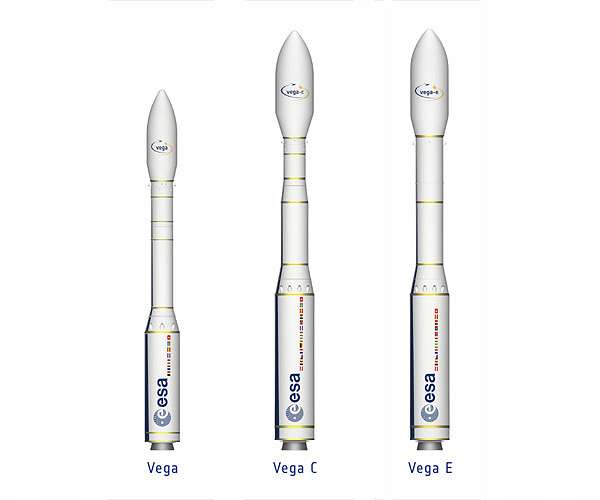
Start of transition to more powerful Vega-C ESA's Vega-C, developed and built by prime contractor Avio in Italy, will be able to perform more launches per year than Vega and offers 800 kg more payload capacity to multiple orbits. Vega-C is more powerful than Vega and has a larger fairing but will keep the same launch cost as Vega. This is partly achieved through sharing the same P120C motor with Ariane 6 to reduce recurring costs and thus reduce the launch cost per kilogram. Vega-C will use a range of payload carriers for different shapes and sizes of payloads from 1 kg to 2300 kg. "This is the latest Vega success before we welcome Vega-C and new mission opportunities through increased performance and competitiveness. ESA will oversee this transition, build on the accomplishments of Vega and prepare future adaptations for a Vega-E suitable for a rapidly evolving and competitive market, to continue guaranteed access to space for Europe," commented Renato Lafranconi, Vega programmes manager at ESA.
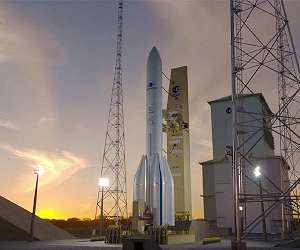
Arianespace to launch Australian satellite Optus-11 with Ariane 6 Paris, France (SPX) Nov 18, 2021 Arianespace and Australian operator SingTel Optus signed the launch contract for the Optus-11 communications satellite. The launch, scheduled for the second half of 2023, will use the Ariane 64 version of the Ariane 6 launcher, with four solid boosters. Optus-11 is a Ku-band communications satellite with a coverage zone encompassing Australia and New Zealand. Optus-11 incorporates a number of advanced technologies, especially the latest developments in digital processing, plus active antennas enab ... read more
|
|||||||||||||
| The content herein, unless otherwise known to be public domain, are Copyright 1995-2026 - SpaceDaily. All websites are published in Australia and are solely subject to Australian law and governed by Fair Use principals for news reporting and research purposes. By using our websites you consent to cookie based advertising. If you do not agree with this then you must stop using the websites from May 25, 2018. Privacy Statement. Additional information can be found here at About Us. |

 del.icio.us
 Digg
Digg Reddit
 Google






