| . |  |
. |
| . | |
. |


 by Staff Writers Beijing (XNA) Nov 08, 2021
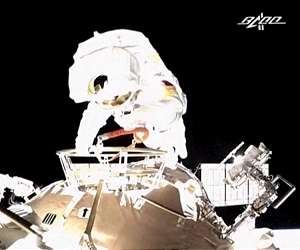
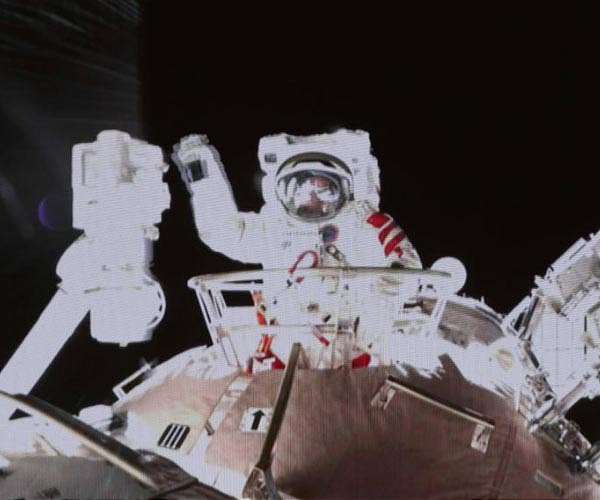
The extravehicular activities (EVAs) carried out by two Chinese astronauts from Sunday evening till early Monday morning will help expand the capabilities of the mechanical arm on the country's space station, said the China Academy of Space Technology (CAST). Astronauts Zhai Zhigang and Wang Yaping were out of China's space station core module Tianhe by 8:28 p.m. (Beijing Time) Sunday, and completed their EVAs and returned to the space station core module Tianhe at 1:16 a.m. (Beijing Time) Monday. They performed a series of extravehicular tasks, including installing the dual-arm connector (the device linking the big and small mechanical arms) and the suspension device. The devices will help realize the connection of the big arm on the core module Tianhe and the small arm on the lab module Wentian, which is expected to be launched in 2022 to dock with Tianhe. The connected mechanical arms will be able to transfer a heavier load for a larger area range. According to Gao Sheng, an engineer in charge of the mechanical arm operation with the CAST, after connection, the big arm, 10 meters long, and the small arm, five meters long, will form a combined mechanical arm, with its operation range extended to 14.5 meters. The combined mechanical arm can cover three modules of the space station, inspecting their surface at any time, and can carry out difficult and diverse missions, Gao said. China launched the Shenzhou-13 spaceship on Oct. 16, sending three astronauts on a six-month in-orbit mission to construct its space station. Source: Xinhua News Agency
Astronaut becomes first Chinese woman to spacewalk Beijing (AFP) Nov 8, 2021 Astronaut Wang Yaping became the first Chinese woman to walk in space, authorities said Monday, as her team completed a six-hour stint outside the Tiangong space station as part of its ongoing construction. Tiangong - meaning "heavenly palace" - is the latest achievement in China's drive to become a major space power, after landing a rover on Mars and sending probes to the Moon. Its core module entered orbit earlier this year, with the station expected to be operational by 2022. Wang and ... read more
|
|||||||||||||
| The content herein, unless otherwise known to be public domain, are Copyright 1995-2026 - SpaceDaily. All websites are published in Australia and are solely subject to Australian law and governed by Fair Use principals for news reporting and research purposes. By using our websites you consent to cookie based advertising. If you do not agree with this then you must stop using the websites from May 25, 2018. Privacy Statement. Additional information can be found here at About Us. |

 del.icio.us
 Digg
Digg Reddit
 Google






