| . |  |
. |
| . | |
. |


 by Staff Writers Paris (ESA) Dec 02, 2021
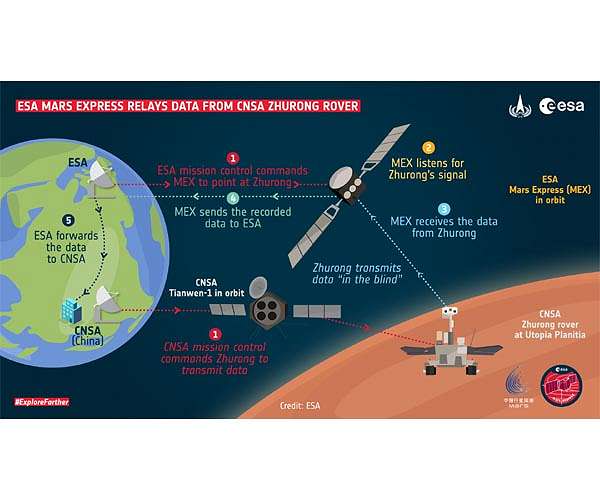
This November, ESA's Mars Express spacecraft carried out a series of experimental communication tests with the Chinese (CNSA) Zhurong Mars rover. Mars Express successfully caught data sent up 'in the blind' by the rover and relayed them to Earth where they were forwarded to the Zhurong team in China. 13:07 CET, 7 November, Utopia Planitia. The Zhurong rover, commanded by the Tianwen-1 orbiter, points its radio up at the Martian sky. Any minute now, ESA's Mars Express will begin to pass overhead. Zhurong starts transmitting a signal up into space. It has no way of knowing if its message is being received. Landers and rovers on Mars gather data that help scientists answer fundamental questions about the geology, atmosphere, surface environment, history of water and potential for life on the Red Planet. To get these insights to Earth, they first transmit the data up to spacecraft in orbit around Mars. These orbiters then use their much larger, more powerful transmitters to 'relay' the data across space to Earth. "Normally, an orbiter like ESA's Mars Express first sends down a hail signal to a rover as a 'hello'," says James Godfrey, Mars Express Spacecraft Operations Manager. "The rover then sends back a response to establish stable communications and begin the two-way exchange of information. But this relies on the rover's radio system being compatible with the orbiter's." As Mars Express transmits its 'hello' signal using communication frequencies that are different from those the Chinese Zhurong Mars rover receives, two-way communication is not possible. But in the other direction, Zhurong can transmit a signal using a frequency that Mars Express can receive. The relay radio on Mars Express has a mode that allows this one-way communication - communication 'in the blind' where the sender can't be sure if their signal is being received - but until now, the technique hadn't been tested on the spacecraft. In November, ESA's Mars Express and CNSA's Zhurong teams carried out a series of experimental communication tests in which Mars Express used this 'in the blind' mode to listen for signals sent to it by the Zhurong Rover. The experiments culminated in a successful test on 20 November. "Mars Express successfully received the signals sent by the rover, and our colleagues in the Zhurong team confirmed that all the data arrived on Earth in very good quality." says ESA's Gerhard Billig. "We're looking forward to carrying out more tests in the future to continue to experiment and further improve this method of communicating between space missions." The data relayed by Mars Express arrived on Earth at ESA's ESOC space operations centre in Darmstadt, Germany, via deep-space communication antennas. From there, these data were forwarded to the Zhurong team at the Beijing Aerospace Flight Control Center, who confirmed the success of the test.

Guiding Tianwen-1 to China's first successful Mars rover landing Beijing, China (SPX) Nov 30, 2021 Mars landing missions only succeed about half the time, a rate largely determined by the entry, descent and landing (EDL) phase, according to the researchers who designed Tianwen-1's control systems. They published their guidance, navigation and control approach for Tianwen-1 on October 16 in Space: Science and Technology. "The EDL phase, which begins at the Mars atmosphere interface and ends with a surface touchdown, is crucial for a Mars landing mission," said Xiaolei Wang, researcher professor ... read more
|
|||||||||||||
| The content herein, unless otherwise known to be public domain, are Copyright 1995-2026 - SpaceDaily. All websites are published in Australia and are solely subject to Australian law and governed by Fair Use principals for news reporting and research purposes. By using our websites you consent to cookie based advertising. If you do not agree with this then you must stop using the websites from May 25, 2018. Privacy Statement. Additional information can be found here at About Us. |

 del.icio.us
 Digg
Digg Reddit
 Google






